What it means
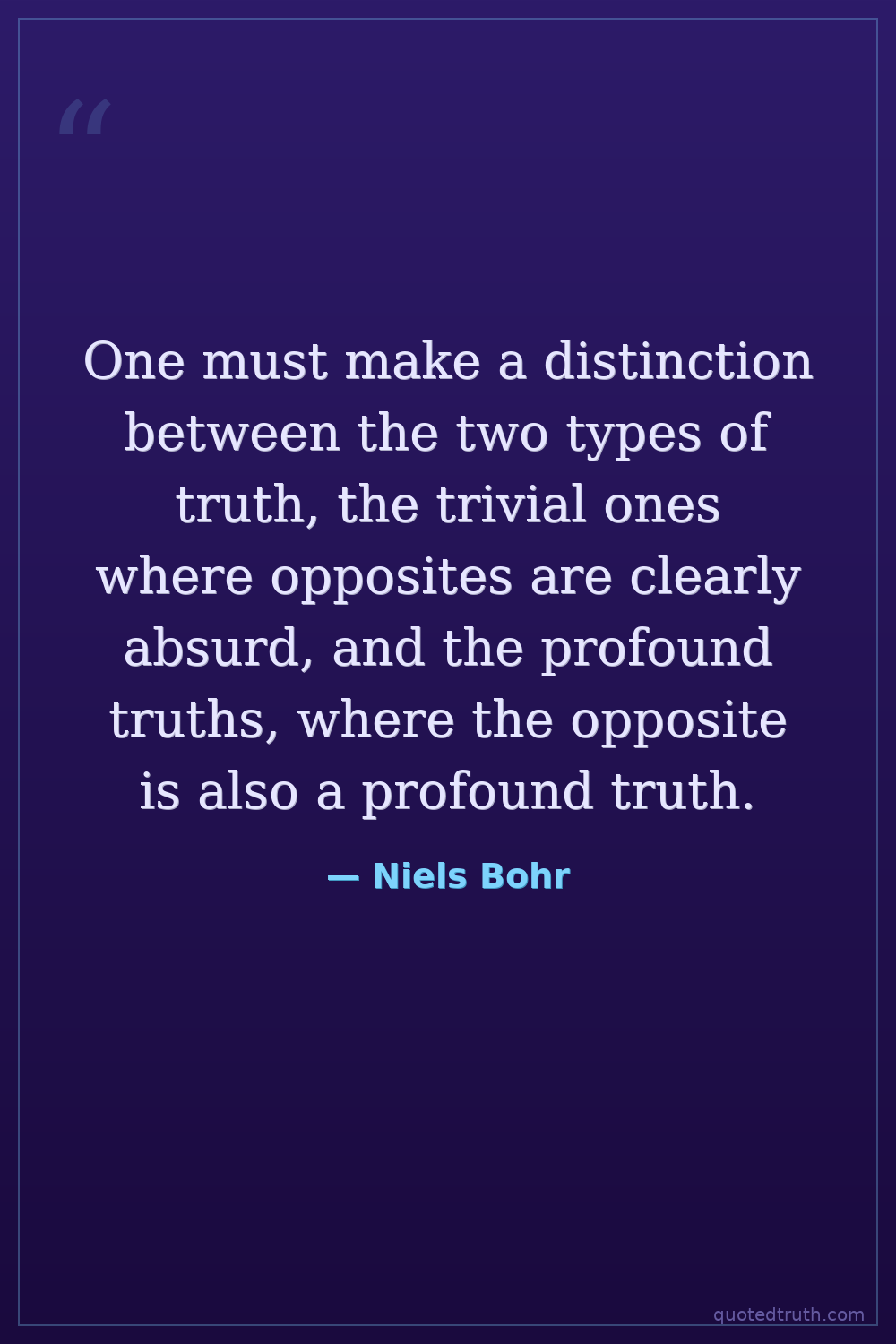
Bohr argues there are two kinds of truth. Ordinary truths work simply: their opposites are nonsense. But deep truths about reality are different—their opposites can also be genuine truths. Something and its apparent contradiction can both be valid at once, depending on perspective or circumstance. Profound insights resist simple either/or logic and often require holding seemingly contradictory ideas together to grasp the whole picture.
Relevance to Niels Bohr
Bohr built his physics on exactly this principle. His complementarity concept held that light and matter are both waves and particles—contradictory descriptions, both true. He adopted the yin-yang symbol on his coat of arms with the motto 'opposites are complementary.' Debating Einstein for decades over quantum mechanics, Bohr insisted reality at atomic scales demanded paradox, not classical certainty. This quote distills his entire philosophical framework for physics.
The era
Bohr lived through the quantum revolution (1913-1962), when physicists discovered atoms behaved nothing like everyday objects. Classical Newtonian certainty collapsed as experiments showed particles tunneling through barriers, existing in superposition, and defying causality. Einstein resisted this strangeness ('God does not play dice'), but Bohr's Copenhagen interpretation embraced it. Two world wars, nuclear weapons, and philosophical upheaval made holding contradictions—scientific, moral, political—a defining challenge of the modern century.
AI-generated insights based on extensive research and information for context. Factual errors? Email [email protected].