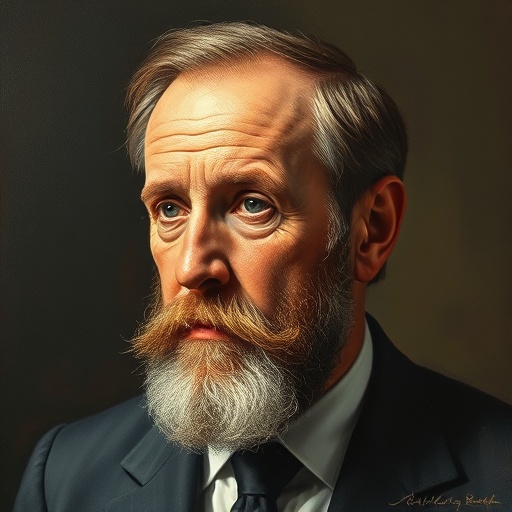
Niels Bohr — "We are all agreed that the only way to escape from the paradoxes of quantum theo…"
We are all agreed that the only way to escape from the paradoxes of quantum theory is to give up the idea of a 'classical' description of reality.
We are all agreed that the only way to escape from the paradoxes of quantum theory is to give up the idea of a 'classical' description of reality.
Click any product to generate a realistic preview. Up to 3 at a time.
* Initial load can take up to 90 seconds — revising the preview in another color is nearly instant.
"We are all in the same boat, in a stormy sea, and we owe each other a terrible loyalty."
"When it comes to atoms, language can be used only as in poetry. The poet, too, is not nearly so concerned with describing facts as with creating images and establishing mental connections."
"The human mind is the most complex and mysterious thing in the universe."
"The meaning of our words is always context-dependent."
"The task is not so much to see what no one has yet seen, but to think what nobody has yet thought, about that which everybody sees."
Found in 1 providers: grok
1 source checked
Bohr argues that the strange behavior of particles at the quantum level cannot be reconciled with everyday, common-sense physics. To make sense of experiments showing wave-particle duality, uncertainty, and probabilistic outcomes, physicists must abandon the assumption that objects have definite properties independent of observation. Trying to force quantum phenomena into familiar Newtonian categories creates contradictions; accepting a new framework resolves them.
Bohr spent his career wrestling with quantum weirdness. His 1913 atomic model introduced quantized electron orbits, breaking from classical mechanics. He developed complementarity, arguing particles and waves are two faces of one reality. His famous debates with Einstein, who insisted 'God does not play dice,' centered on exactly this point. Bohr's Copenhagen interpretation became the dominant view, asserting reality at the quantum scale simply does not behave classically.
In the 1920s-30s, physics was in upheaval. Experiments on electrons and photons produced results Newtonian mechanics could not explain. Heisenberg's uncertainty principle and Schrödinger's wave equation arrived in rapid succession. At Bohr's Copenhagen institute, young physicists hammered out a radical new worldview. The broader era, between world wars, reflected similar ruptures with classical certainty in art, philosophy, and politics, making Bohr's call to abandon old frameworks resonate culturally.
AI-generated insights based on extensive research and information for context. Factual errors? Email [email protected].
Your cart is empty