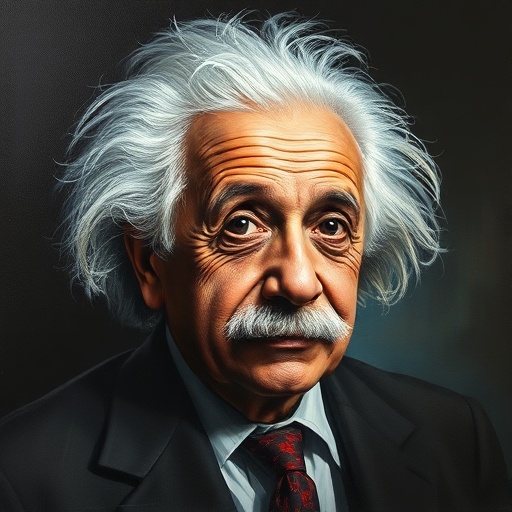
Albert Einstein — "Only two things are infinite, the universe and human stupidity, and I'm not sure…"
Only two things are infinite, the universe and human stupidity, and I'm not sure about the former.
Only two things are infinite, the universe and human stupidity, and I'm not sure about the former.
Click any product to generate a realistic preview. Up to 3 at a time.
* Initial load can take up to 90 seconds — revising the preview in another color is nearly instant.
"The only way to escape the corrupting influence of praise is to go on working."
"I do not believe in a personal God and I have never denied this but have expressed it clearly. If something is in me which can be called religious then it is the unbounded admiration for the structure…"
"I want to go when I want. It is tasteless to prolong life artificially. I have done my share, it is time to go. I will do it elegantly."
"I see only with deep regret that God punishes so many of His children for their numerous stupidities."
"God does not play dice with the universe."
Attributed, but exact source and wording vary, often cited without definitive proof.
Date: Undetermined
WisdomFound in 2 providers: grok,deepseek
2 sources checked
Human stupidity has no ceiling — it's boundless, self-renewing across generations, cultures, and contexts. Intelligence might illuminate the cosmos, but it offers no protection against collective or individual folly. The punchline inverts the joke: whether the universe is truly infinite remains an open scientific question, but humanity's capacity for foolishness feels empirically settled. It's wry, precise, and deliberately provocative — a scientist diagnosing irrationality with the same confidence he'd apply to physics.
Einstein spent decades mapping the universe's structure — special relativity in 1905, general relativity in 1915, decades of cosmological debate over whether space-time is finite or infinite. He also fled Nazi Germany, watched colleagues weaponize physics, and publicly resisted McCarthyism. Having witnessed both the pinnacle of human intellect and its most catastrophic failures of judgment, his mock-uncertainty about the universe's infinitude versus stupidity's boundlessness carried genuine biographical weight.
Einstein's most active decades (1905–1955) produced a jarring paradox: quantum mechanics and relativity transformed science while two World Wars, the Holocaust, and nuclear weapons revealed civilization's fragility. His own equation, E=mc², helped enable atomic bombs dropped on civilian cities. Political ideologies generated mass atrocities even as laboratories achieved miracles. In that climate of simultaneous intellectual triumph and moral catastrophe, doubting whether human stupidity or cosmic scale was the greater infinity felt less like a joke and more like a diagnosis.
AI-generated insights based on extensive research and information for context. Factual errors? Email [email protected].
Your cart is empty