Wright Brothers (Orville & Wilbur) — "Our experiments were made on a larger scale than those of any other investigator…"
Our experiments were made on a larger scale than those of any other investigator.
Our experiments were made on a larger scale than those of any other investigator.
Click any product to generate a realistic preview. Up to 3 at a time.
* Initial load can take up to 90 seconds — revising the preview in another color is nearly instant.
"The machine is under perfect control and can be turned in any direction at will."
"We worked together and we thought together."
"We have not been able to get any very good pictures, as the camera was not very good."
"The greatest danger in flying is the ground."
"The machine is a thing of life, and will respond to the touch of the hand."
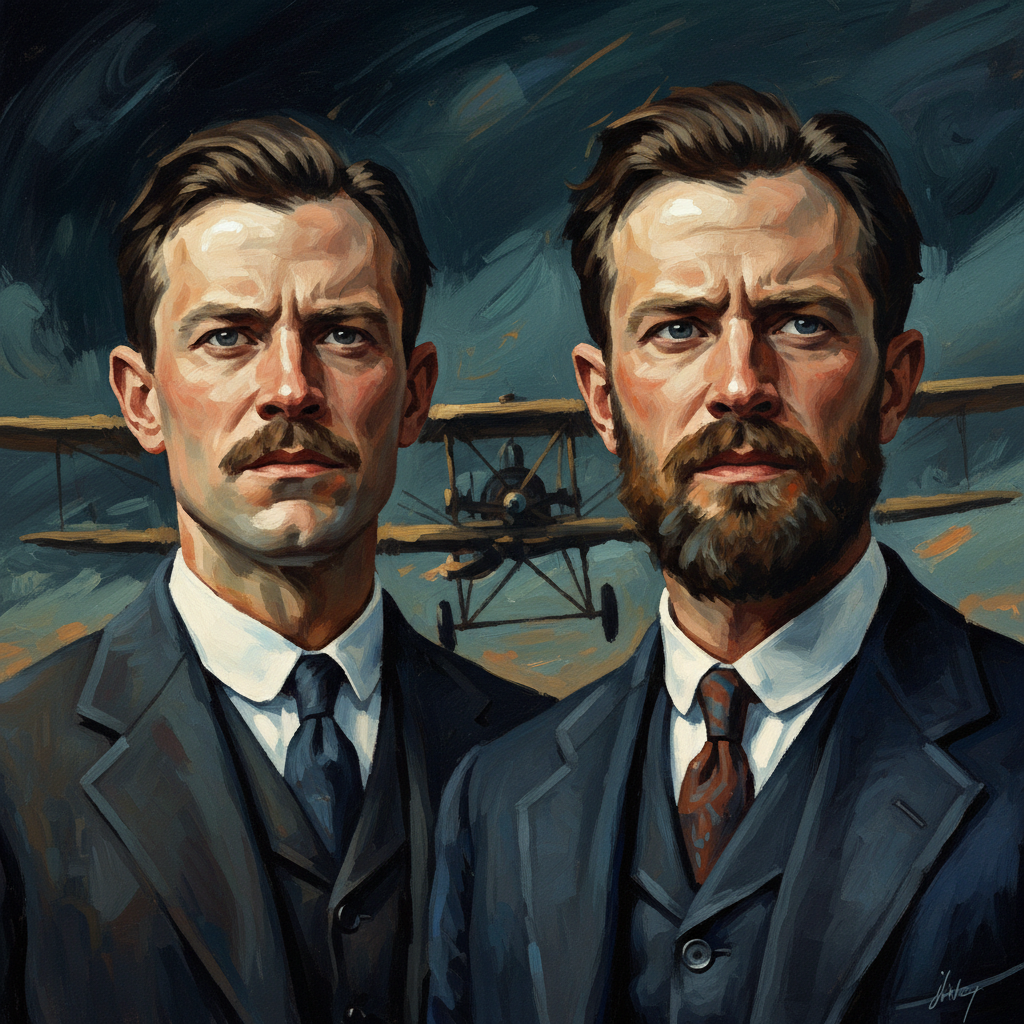
American aviation pioneers who achieved the first sustained powered controlled airplane flight at Kitty Hawk, NC, on December 17, 1903. Closely associated with Octave Chanute (their gliding mentor and aeronautical correspondent). For an intellectual contrast, see Samuel Pierpont Langley, Smithsonian Institution Secretary and government-funded aviation researcher — Langley's Aerodrome crashed twice into the Potomac in October-December 1903 with $50,000 of War Department funding; the Wright Brothers' bicycle-shop empiricism beat Langley's institutional Big Science by 9 days. The most-cited example in engineering history of empirical-tinkerer beating institution-funded credentialism.
Found in 1 providers: grok
1 source checked
The speaker claims their testing and research program was bigger and more ambitious than anyone else working on the same problem. They are pointing out that the sheer size and thoroughness of their trials set their work apart. It is a statement of confidence grounded in hard data rather than theory, arguing that scale of experimentation is what produced breakthrough results where smaller efforts failed.
The Wrights built their own wind tunnel in 1901 and tested roughly 200 wing shapes, generating data that corrected errors in Lilienthal's published tables. Before Kitty Hawk in 1903, they logged hundreds of glider flights at Kill Devil Hills. As bicycle mechanics without formal engineering degrees, they compensated with methodical, large-volume experimentation, treating flight as a measurable engineering problem rather than a daring stunt.
In the late 1890s and early 1900s, aeronautics was crowded with theorists and showmen: Lilienthal had died gliding in 1896, Langley was burning government money on failed launches, and most inventors relied on borrowed tables and single prototypes. The scientific method was ascendant in industry, but aviation remained guesswork. The Wrights' insistence on scale and measurement reflected the era's shift toward data-driven engineering over heroic improvisation.
AI-generated insights based on extensive research and information for context. Factual errors? Email [email protected].
Your cart is empty