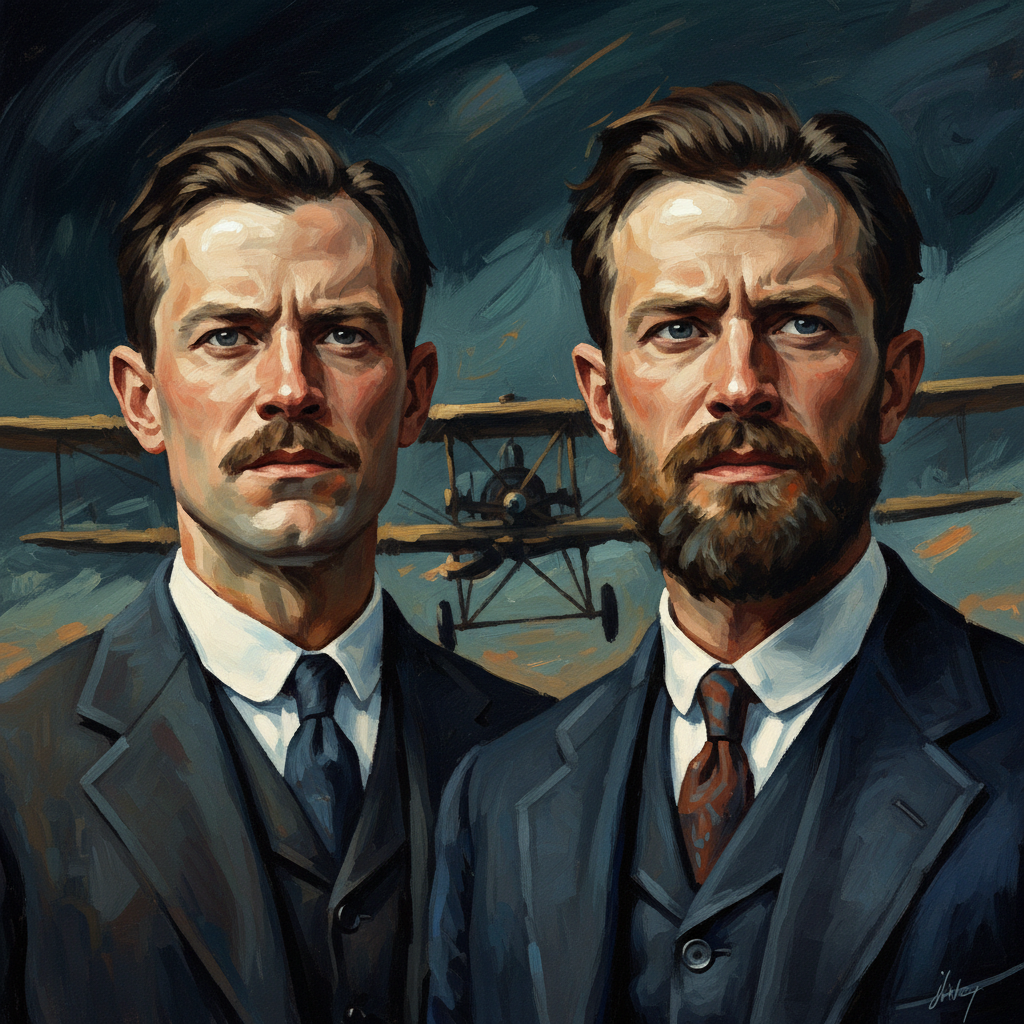
Wright Brothers (Orville & Wilbur) — "We worked together and we thought together."
We worked together and we thought together.
We worked together and we thought together.
Click any product to generate a realistic preview. Up to 3 at a time.
* Initial load can take up to 90 seconds — revising the preview in another color is nearly instant.
"The greatest obstacle to progress is not ignorance, but the illusion of knowledge."
"No one can appreciate the work and worry it cost us to build our first machine."
"The difficulties of the problem are so great that few have dared to attack it."
"We had to be our own mechanics, our own engineers, and our own scientists."
"The machine had scarcely cleared the ground when it began to turn up, and the next instant it darted into the ground."
American aviation pioneers who achieved the first sustained powered controlled airplane flight at Kitty Hawk, NC, on December 17, 1903. Closely associated with Octave Chanute (their gliding mentor and aeronautical correspondent). For an intellectual contrast, see Samuel Pierpont Langley, Smithsonian Institution Secretary and government-funded aviation researcher — Langley's Aerodrome crashed twice into the Potomac in October-December 1903 with $50,000 of War Department funding; the Wright Brothers' bicycle-shop empiricism beat Langley's institutional Big Science by 9 days. The most-cited example in engineering history of empirical-tinkerer beating institution-funded credentialism.
Found in 1 providers: grok
1 source checked
Real collaboration means more than dividing labor — it means sharing the thinking itself. When two people genuinely think together, ideas get tested, refined, and strengthened in ways solitary work cannot achieve. Neither person owns the insight; the conclusion emerges from the exchange. This describes a partnership where the boundary between individuals blurs, where disagreement sharpens ideas rather than dividing people, and where the result belongs entirely to both.
Orville and Wilbur ran their Dayton bicycle shop as genuine equals, then spent years at Kitty Hawk solving flight together. They famously argued positions they didn't personally hold just to stress-test ideas, then switched sides. Neither held a college degree; their breakthroughs came from shared reasoning, not formal authority. They filed patents jointly and refused to separate credit. The 1903 powered flight was literally the product of two minds functioning as one.
The early 1900s celebrated the lone genius — Edison, Bell, and Tesla were cultural heroes credited with singular invention. The Wright Brothers' fully shared collaboration was unusual in an era of cutthroat individual patents and institutional competition. Samuel Langley's government-funded rival program, backed by the Smithsonian, failed days before Kitty Hawk. Against that backdrop of solitary ambition and well-funded competitors, the brothers' joint thinking model proved decisively superior, redefining how breakthrough innovation could look.
AI-generated insights based on extensive research and information for context. Factual errors? Email [email protected].
Your cart is empty