What it means
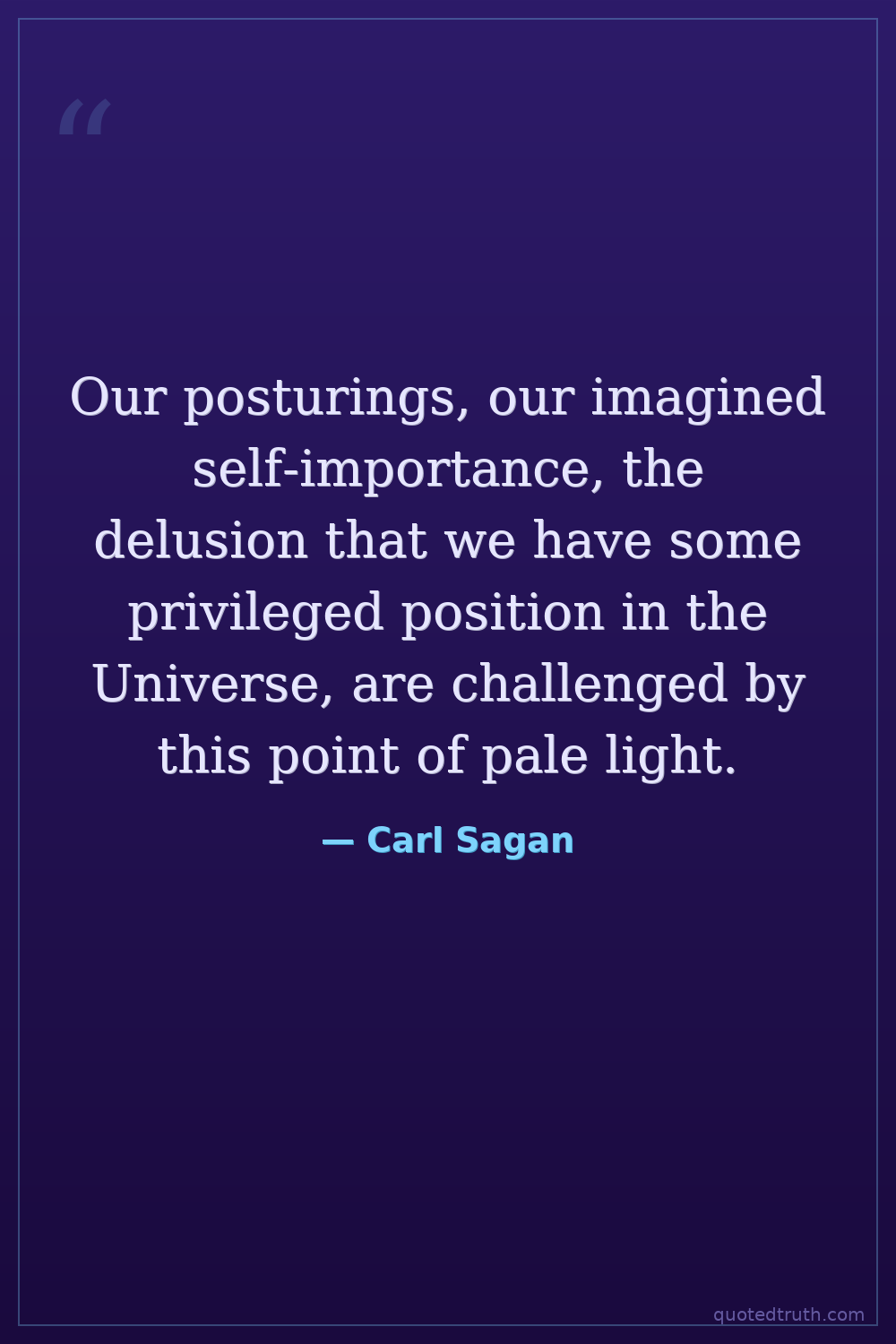
Human arrogance — our posturing, our sense of cosmic importance, our belief we occupy some privileged place in existence — collapses when Earth appears as a tiny speck of light in deep space. We wage wars over invisible borders, claim divine centrality in a universe containing billions of galaxies. The cosmic perspective doesn't argue against us; it simply makes our self-importance impossible to maintain without recognizing it as delusion.
Relevance to Carl Sagan
Sagan personally lobbied NASA to turn Voyager 1's camera back toward Earth in 1990, creating the exact photograph this quote describes. As the host of Cosmos and author of Pale Blue Dot, he built his career converting cosmic scale into moral argument. His opposition to nuclear weapons, religious dogma, and pseudoscience all stemmed from this same conviction: recognizing our smallness is the beginning of wisdom, not despair.
The era
Sagan published this in 1994, immediately after the Cold War — four decades during which superpowers threatened mutual annihilation over geopolitical dominance. The Voyager photo was captured in February 1990 as the Soviet Union disintegrated. Nuclear arsenals remained enormous, nationalism was resurging across post-Soviet states, and the Gulf War had just concluded. Sagan's pale dot framing delivered a precise counter-argument: no ideology, border, or empire registers at cosmic scale.
AI-generated insights based on extensive research and information for context. Factual errors? Email [email protected].