Laozi — "People fail at the threshold of success. Be as cautious at the end as at the beg…"
People fail at the threshold of success. Be as cautious at the end as at the beginning. Then there will be no failure.
People fail at the threshold of success. Be as cautious at the end as at the beginning. Then there will be no failure.
Click any product to generate a realistic preview. Up to 3 at a time.
* Initial load can take up to 90 seconds — revising the preview in another color is nearly instant.
"A man with outward courage dares to die; a man with inward courage dares to live."
"The wise man does not lay up his own treasures. The more he gives to others, the more he has for his own."
"The greatest skill is to seem unskilled; The greatest abundance is to seem empty."
"The more prohibitions there are, the poorer the people will be."
"The five colors make one blind in the eyes; the five tones make one deaf in the ears."
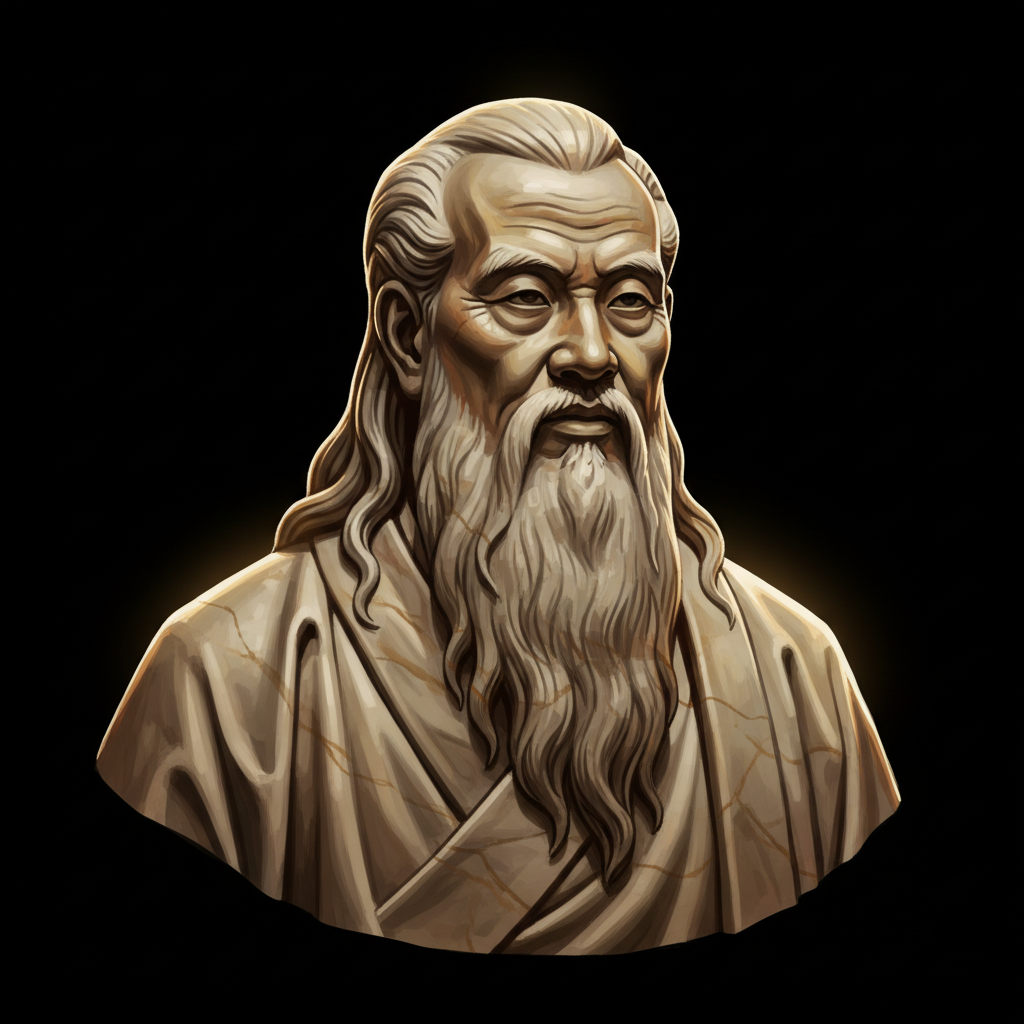
Reputed founder of Taoism and author of the Tao Te Ching, whose wu wei (effortless action) shaped East Asian philosophy. Closely associated with Zhuangzi (later Taoist who extended Laozi's framework). For an intellectual contrast, see Confucius, near-contemporary Chinese sage of social ritual and duty — Confucius systematized social order through ritual and hierarchy; Laozi argued that all such systems were the disease, not the cure — the two founding poles of Chinese moral philosophy.
Found in 1 providers: gemini
1 source checked
Many people work hard and get close to achieving their goal, then relax their effort or grow careless right before crossing the finish line, which is exactly when things fall apart. The warning is simple: treat the final stretch with the same focus, patience, and discipline you had on day one. If you stay alert all the way through completion instead of coasting, the work holds together and you actually succeed.
Laozi is traditionally cast as an archivist in the Zhou royal court, a role demanding meticulous, sustained attention to detail across long projects. His Tao Te Ching repeatedly warns against forcing outcomes and praises wu wei, effortless consistency over bursts of ambition. This saying mirrors his core teaching that small steady actions aligned with the Tao outlast grand pushes, and that humility and caution, not pride near victory, are what let a person complete what they begin.
Laozi lived during the late Zhou dynasty, an era sliding into the Warring States period when rival lords rose quickly through military campaigns and then collapsed just as fast through overreach, betrayal, or arrogance after early wins. Courts were littered with ministers who succeeded briefly and lost everything at the peak. Against that backdrop of volatile ambition, a teaching that urged rulers and officials to stay cautious through the final step carried urgent political weight, not just personal advice.
AI-generated insights based on extensive research and information for context. Factual errors? Email [email protected].
Your cart is empty