Laozi — "The five colors make one blind in the eyes; the five tones make one deaf in the …"
The five colors make one blind in the eyes; the five tones make one deaf in the ears.
The five colors make one blind in the eyes; the five tones make one deaf in the ears.
Click any product to generate a realistic preview. Up to 3 at a time.
* Initial load can take up to 90 seconds — revising the preview in another color is nearly instant.
"He who is content with what he has, is rich."
"He who conquers others is strong; He who conquers himself is mighty."
"He who is without desire sees the mystery. He who is with desire sees only the manifestations."
"The sage's Way is to act and not to contend."
"Fame or integrity: which is more important? Money or happiness: which is more precious?"
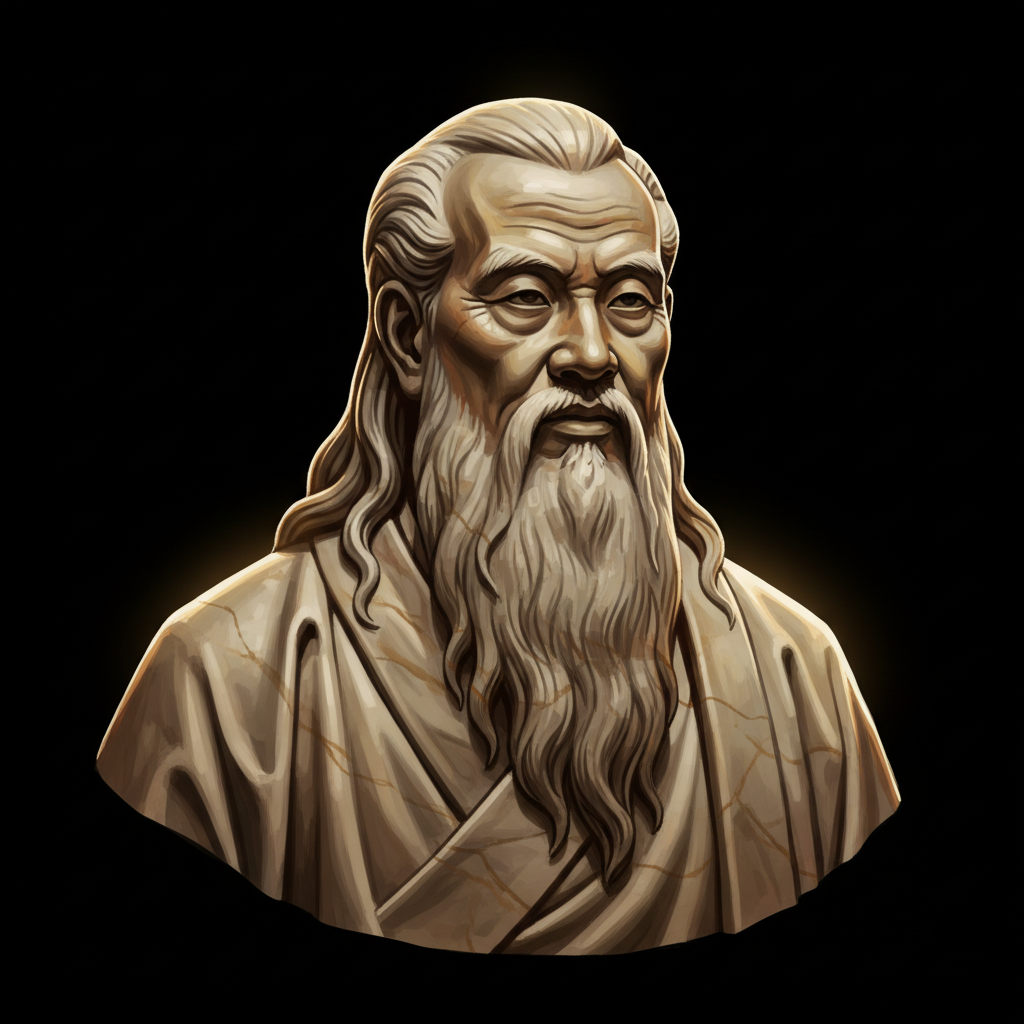
Reputed founder of Taoism and author of the Tao Te Ching, whose wu wei (effortless action) shaped East Asian philosophy. Closely associated with Zhuangzi (later Taoist who extended Laozi's framework). For an intellectual contrast, see Confucius, near-contemporary Chinese sage of social ritual and duty — Confucius systematized social order through ritual and hierarchy; Laozi argued that all such systems were the disease, not the cure — the two founding poles of Chinese moral philosophy.
Found in 1 providers: deepseek
1 source checked
Overwhelming your senses with constant visual stimulation and noise dulls your ability to truly see and hear. When you chase endless variety—bright spectacles, loud entertainment, nonstop input—you lose sensitivity to subtle beauty and quiet truth. Excess doesn't enrich perception; it numbs it. The more you consume, the less you actually experience, because saturation replaces discernment and appetite outpaces satisfaction.
Laozi advocated simplicity, stillness, and returning to the uncarved block—a natural state uncluttered by artificial desires. As the legendary keeper of Zhou archives who withdrew from courtly life to write the Tao Te Ching before vanishing west, he rejected ornate ritual and sensory indulgence favored by aristocrats. His philosophy of wu wei and minimal desire treats sensory excess as a distraction from the Tao's quiet presence.
Laozi lived during the late Zhou dynasty (6th century BCE), as ritual order decayed into the chaos preceding the Warring States period. Courts flaunted elaborate music, dyed silks, and banquets to project power, while Confucians prescribed more ceremony as the fix. Laozi pushed back, arguing that this sensory and ritual inflation corrupted natural virtue. His critique targeted the aristocratic excess of a society drowning in performance while losing its moral center.
AI-generated insights based on extensive research and information for context. Factual errors? Email [email protected].
Your cart is empty