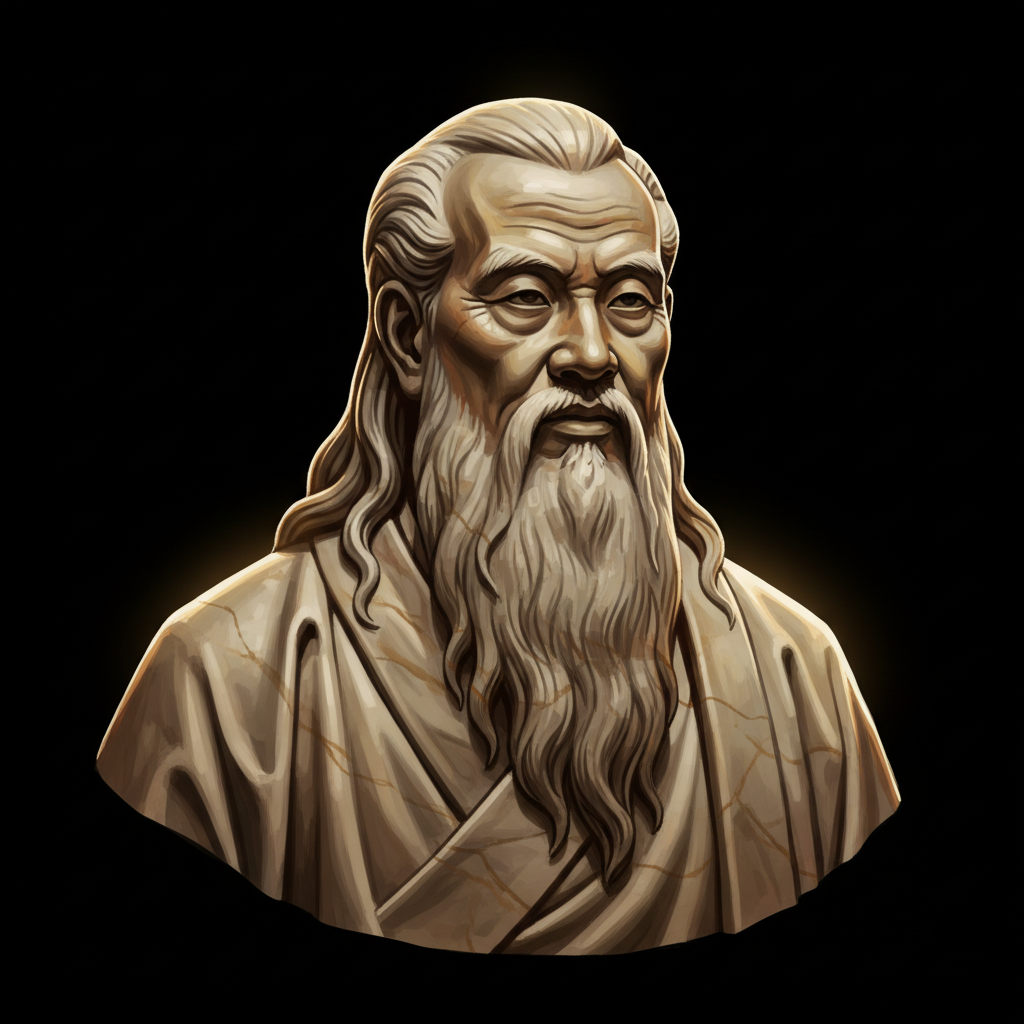
Laozi — "The wise man does not lay up his own treasures. The more he gives to others, the…"
The wise man does not lay up his own treasures. The more he gives to others, the more he has for his own.
The wise man does not lay up his own treasures. The more he gives to others, the more he has for his own.
Click any product to generate a realistic preview. Up to 3 at a time.
* Initial load can take up to 90 seconds — revising the preview in another color is nearly instant.
"Let people return to making knots on ropes, instead of writing."
"Those who know when to halt are unharmed."
"The best way to manage is to manage very little."
"When the best student hears about the Way, he practices it diligently. When the average student hears about the Way, he is half-hearted. When the worst student hears about the Way, he laughs out loud.…"
"To see things in the seed, that is genius."
Reputed founder of Taoism and author of the Tao Te Ching, whose wu wei (effortless action) shaped East Asian philosophy. Closely associated with Zhuangzi (later Taoist who extended Laozi's framework). For an intellectual contrast, see Confucius, near-contemporary Chinese sage of social ritual and duty — Confucius systematized social order through ritual and hierarchy; Laozi argued that all such systems were the disease, not the cure — the two founding poles of Chinese moral philosophy.
Found in 3 providers: grok,deepseek,gemini
3 sources checked
True wealth comes from generosity, not hoarding. When you share your knowledge, resources, and kindness with others, you don't become poorer—you actually gain more in return, whether through relationships, gratitude, or personal growth. Clinging to possessions creates scarcity in your life, while open-handed giving creates abundance. The paradox is that letting go of what you have is what makes you genuinely rich, both materially and spiritually.
Laozi embodied this principle as a humble archivist at the Zhou court who reportedly refused fame and accumulated status. His Tao Te Ching teaches wu wei (effortless action) and the value of emptiness—a bowl is useful because it's hollow. Legend says he left civilization riding a water buffalo, carrying nothing, giving his wisdom freely to the gatekeeper Yinxi before vanishing west. He rejected treasure-hoarding rulers of his day.
Laozi lived during the late Zhou Dynasty (6th century BCE), an era of political fragmentation leading into the Warring States period. Feudal lords hoarded wealth, waged constant war, and oppressed peasants to fund armies and palaces. Confucian scholars promoted hierarchy and ritual accumulation. Against this backdrop of greed and violence, Laozi's message of generous detachment was radical—a direct critique of rulers who believed power came from grasping more, not giving more.
AI-generated insights based on extensive research and information for context. Factual errors? Email [email protected].
Your cart is empty