What it means
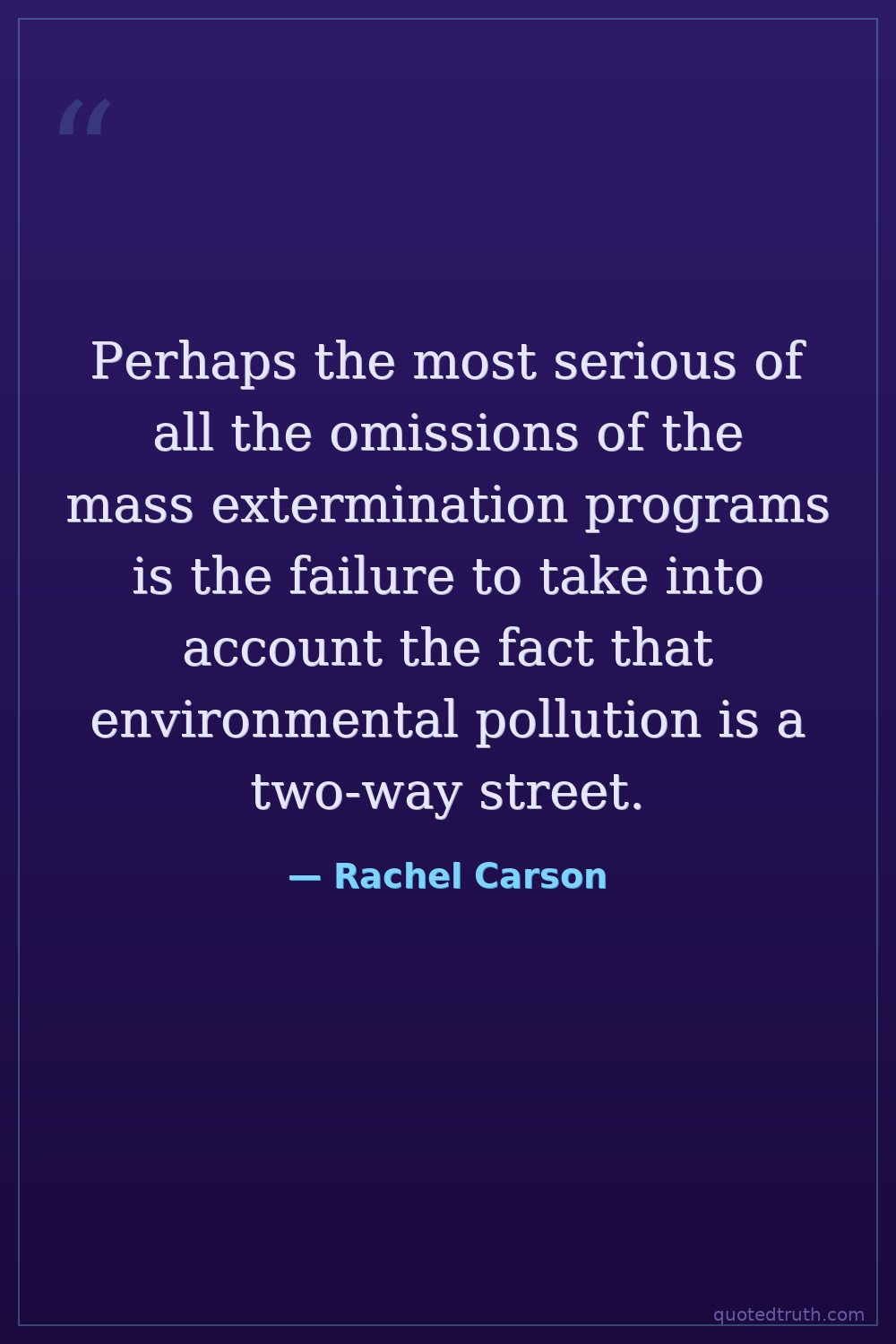
When governments spray pesticides to eliminate insects or pests, they treat pollution as a one-way weapon aimed at a target. Carson argues this is dangerously wrong — chemicals released into soil, water, and air cycle back through food chains, groundwater, and wildlife into human bodies. Poisoning the environment to kill pests ultimately poisons everything connected to that environment, including people. The contamination returns to its source along ecological pathways no one mapped.
Relevance to Rachel Carson
Carson spent fifteen years as a marine biologist and science writer at the U.S. Fish and Wildlife Service before Silent Spring made her famous. Her training in ecology — the study of interconnected systems — made her uniquely positioned to see what DDT programs ignored: food chains link every creature. Her meticulous documentation of bird die-offs and contaminated fish directly proved that pesticides sprayed on fields returned through nature to human dinner tables.
The era
In the late 1950s and early 1960s, U.S. and state governments ran massive aerial DDT-spraying campaigns targeting gypsy moths, fire ants, and mosquitoes across millions of acres. The chemical industry, flush from WWII synthetic chemistry breakthroughs, marketed pesticides as risk-free progress. No environmental impact assessments existed; the EPA wouldn't exist until 1970. Carson's quote targeted the institutional blind spot: planners measured dead pests but never traced where the poison went next.
AI-generated insights based on extensive research and information for context. Factual errors? Email [email protected].