What it means
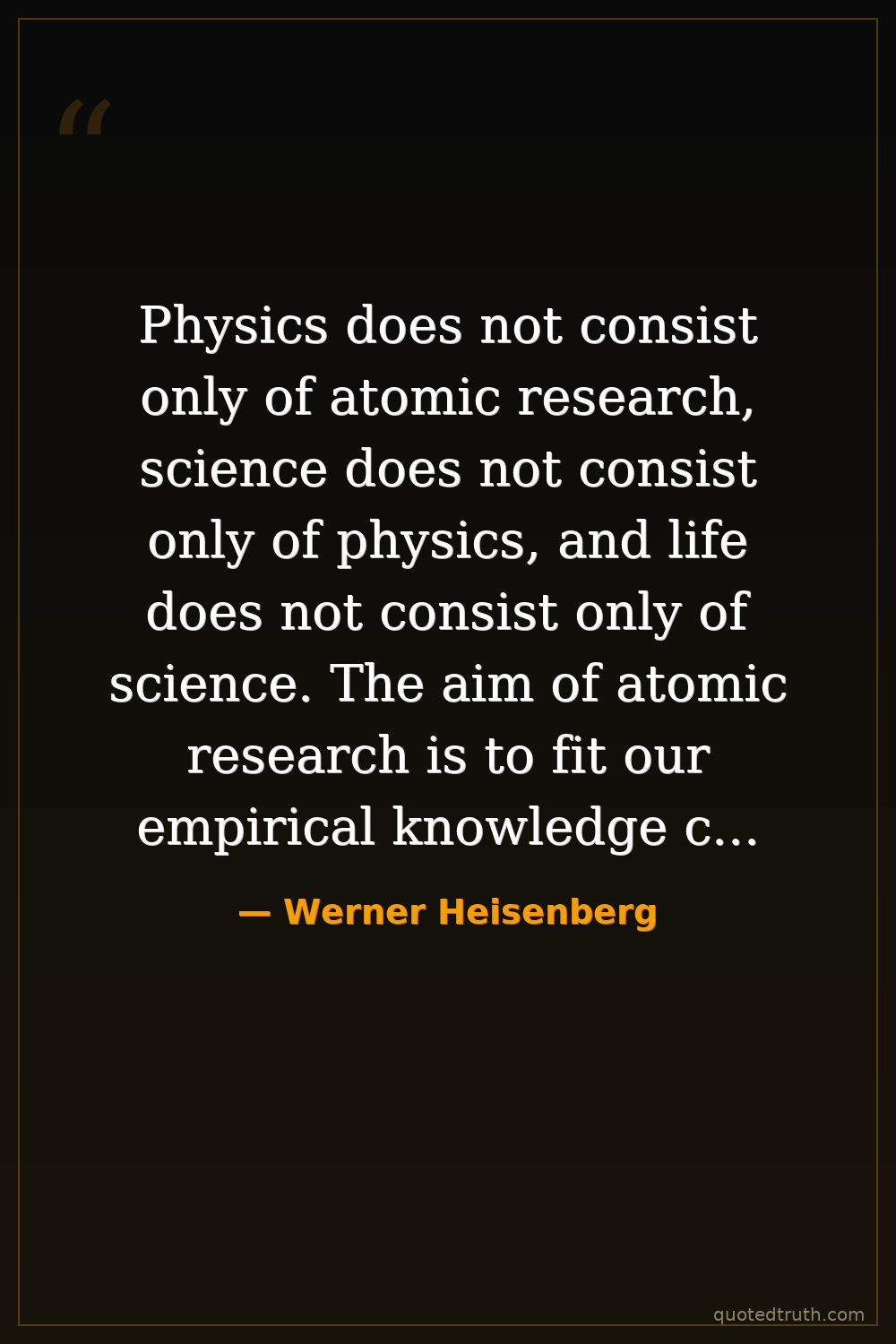
Atomic research is just one branch of physics, physics is just one branch of science, and science is just one part of human life. The point of studying atoms is not to wall that knowledge off as something special, but to weave it into the broader way we understand ourselves, society, and the world. Specialized discovery only matters when it connects to everything else we think and value.
Relevance to Werner Heisenberg
Heisenberg spent his career at the edge of the smallest scales known, yet he repeatedly resisted treating physics as self-contained. He wrote on philosophy, Greek thought, religion, and art, and led Germany's wartime uranium project where physics collided with ethics. His uncertainty principle itself blurred the line between observer and observed, pushing him to insist that atomic knowledge must rejoin ordinary human understanding.
The era
Heisenberg worked from the 1920s through the postwar decades, when quantum mechanics overturned classical certainty and atomic research produced both reactors and Hiroshima. Specialization was exploding, science was splintering from philosophy, and physicists were suddenly political figures answerable for weapons. In that climate, his call to fit atomic findings into wider thinking was a direct response to fears that science had outrun humanity's capacity to absorb it.
AI-generated insights based on extensive research and information for context. Factual errors? Email [email protected].