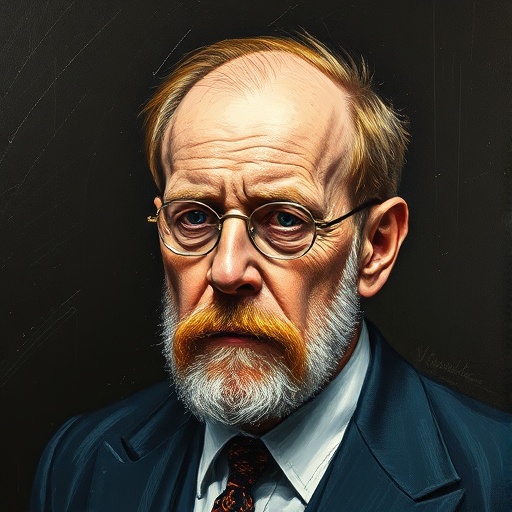
Werner Heisenberg — "The reality we can put into words is never reality itself."
The reality we can put into words is never reality itself.
The reality we can put into words is never reality itself.
Click any product to generate a realistic preview. Up to 3 at a time.
* Initial load can take up to 90 seconds — revising the preview in another color is nearly instant.
"The Copenhagen interpretation of quantum mechanics starts from the paradox that we describe our experiments in terms of classical physics, and we describe the elementary particles in terms of quantum …"
"The positivists have a simple solution: the world must be divided into that which we can say clearly and the rest, which we had better pass over in silence. But can anyone conceive of a more pointless…"
"The world is not composed of 'things' but of 'events'."
"Modern physics has, in a certain sense, revived Plato's philosophy of forms in the atomic world."
"The very act of observing changes the observed."
Found in 1 providers: deepseek
1 source checked
Language captures only a limited, filtered version of what actually exists. Whatever we describe in words has already been simplified, categorized, and shaped by human concepts. The raw fabric of reality—whatever it truly is—always exceeds our ability to name it. Descriptions are maps, not territory. No matter how precise the vocabulary, something essential about the underlying thing slips through the gap between experience, thought, and speech.
Heisenberg spent his career confronting the limits of classical description. His uncertainty principle showed that a particle's position and momentum cannot both be pinned down, and his work on quantum mechanics revealed that everyday language, built for tables and chairs, breaks down at atomic scales. He repeatedly argued that physics gives us mathematical relationships, not pictures of nature itself, making this statement a direct summary of his philosophical stance on measurement and knowledge.
Heisenberg worked in the 1920s–1970s, when physics was shattering Newtonian certainty. Relativity, quantum theory, and the Copenhagen interpretation forced scientists to accept that observation shapes outcomes and that intuitive words like 'particle' or 'wave' fail. Alongside this, logical positivism and Wittgenstein were probing the limits of language itself. His remark fits an era when both science and philosophy were grappling with the unsettling gap between human description and the world it tries to capture.
AI-generated insights based on extensive research and information for context. Factual errors? Email [email protected].
Your cart is empty