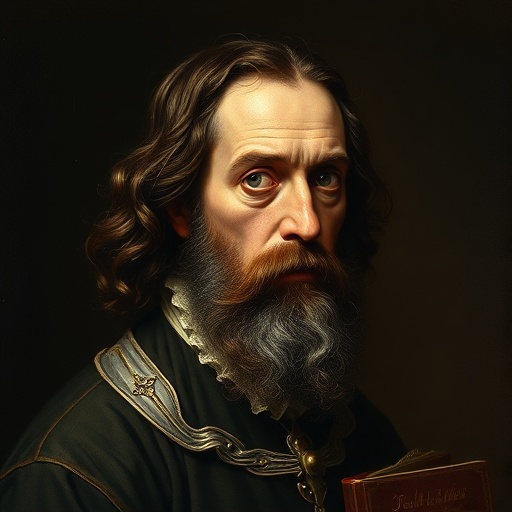
Johannes Kepler — "My stars were not Mercury rising in the seventh angle, but Copernicus and Tycho …"
My stars were not Mercury rising in the seventh angle, but Copernicus and Tycho Brahe.
My stars were not Mercury rising in the seventh angle, but Copernicus and Tycho Brahe.
Click any product to generate a realistic preview. Up to 3 at a time.
* Initial load can take up to 90 seconds — revising the preview in another color is nearly instant.
"I have been a scientist, and I have sought to understand the mysteries of the universe."
"See, I cast the die, and I write the book. Whether it is to be read by the people of the present or of the future makes no difference: let it await its reader for a hundred years, if God himself has s…"
"The celestial machine is not like a divine animal but like a clockwork."
"I have often been poor, but I have always been rich in spirit."
"The works of God are beautiful and great; let us, therefore, with all our might, strive to know them."
Found in 1 providers: deepseek
1 source checked
Kepler rejects the idea that his destiny was shaped by astrological signs at his birth. Instead, he credits two real influences: the astronomers whose work formed his thinking. He is saying that who you study and learn from matters more than any cosmic fortune cast at the moment you entered the world. Mentors and ideas, not horoscopes, made him who he became.
Though Kepler earned income casting horoscopes, he privately doubted astrology's deterministic claims. Copernicus supplied the heliocentric framework he defended and refined, while Tycho Brahe's precise Mars observations at Prague gave him the raw data from which he derived his three laws of planetary motion. The line captures his intellectual lineage honestly: a mathematician whose real fate was being Tycho's assistant and Copernicus's successor, not a chart of planets at birth.
In the early 1600s, astrology and astronomy were still entangled; court mathematicians like Kepler were expected to cast horoscopes for patrons such as Rudolf II. Copernicus's 1543 heliocentric model was contested, and Tycho's Uraniborg observations set a new empirical standard. Kepler worked amid the Counter-Reformation, Thirty Years' War upheavals, and Galileo's telescopic discoveries, a moment when natural philosophy was beginning to separate measurement and mathematics from fate and divination.
AI-generated insights based on extensive research and information for context. Factual errors? Email [email protected].
Your cart is empty