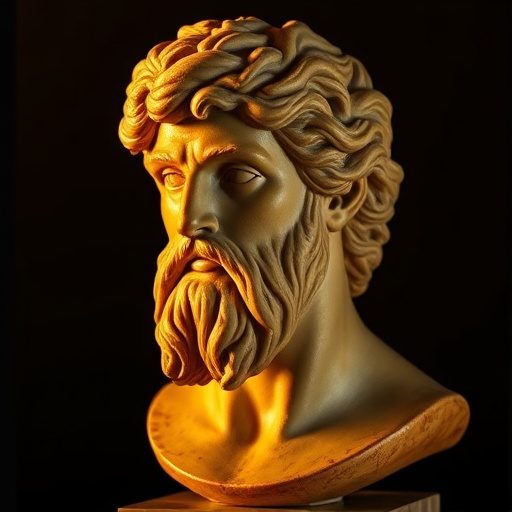
Pythagoras — "Reason is immortal, all else mortal."
Reason is immortal, all else mortal.
Reason is immortal, all else mortal.
Click any product to generate a realistic preview. Up to 3 at a time.
* Initial load can take up to 90 seconds — revising the preview in another color is nearly instant.
"Do not speak without light."
"Man, know thyself; then thou shalt know the Universe and God."
"Concern should drive us into action and not into a depression. No man is free who is not master of himself."
"Don't eat your heart."
"The universe is a living creature, endowed with soul and reason."
Greek philosopher and mathematician whose school in Croton combined geometry (the Pythagorean theorem), number-mysticism, and a religious-vegetarian way of life. Closely associated with Thales of Miletus (earlier pre-Socratic and the first philosopher). For an intellectual contrast, see Heraclitus, pre-Socratic Greek philosopher of flux — Heraclitus called Pythagoras 'the chief of swindlers' — among the founding insults of the philosophical-rivalry tradition. Their 'all is flux' vs 'all is number' poles still organize the philosophy of mathematics today (Platonist vs anti-realist).
A philosophical statement on the nature of reason and mortality.
Date: c. 570-495 BCE (attributed later)
Life & DeathFound in 2 providers: gemini,deepseek
2 sources checked
The quote asserts that logical reasoning outlasts everything physical. Bodies decay, empires crumble, individuals die — but a mathematical truth proven through reason remains valid forever. The number two will always be even; a right triangle's sides will always obey their ratio. Rational thought, once exercised, produces truths that no amount of time can destroy. Reason is the one human faculty whose products genuinely transcend death.
Pythagoras built his entire philosophical identity around the eternal nature of numbers. He founded a mystical brotherhood in Croton around 530 BCE that treated mathematics as sacred knowledge. He also believed in metempsychosis — the soul's reincarnation across bodies — making immortality a personal conviction, not just a metaphor. When he uncovered geometric relationships, he saw timeless truths being revealed, not invented. For Pythagoras, reason was the closest humans came to touching the divine.
Around 570–495 BCE, Greek thinkers were abandoning mythological explanations for rational ones — the Pre-Socratic revolution. Life was precarious: plague, warfare, and political upheaval made mortality vivid and constant. Most knowledge survived only through oral tradition, making it inherently fragile. Against this backdrop, the idea that reasoned mathematical truths could outlast any human catastrophe was genuinely radical. A theorem required no temple or priest to persist — only a mind willing to follow its logic.
AI-generated insights based on extensive research and information for context. Factual errors? Email [email protected].
Your cart is empty