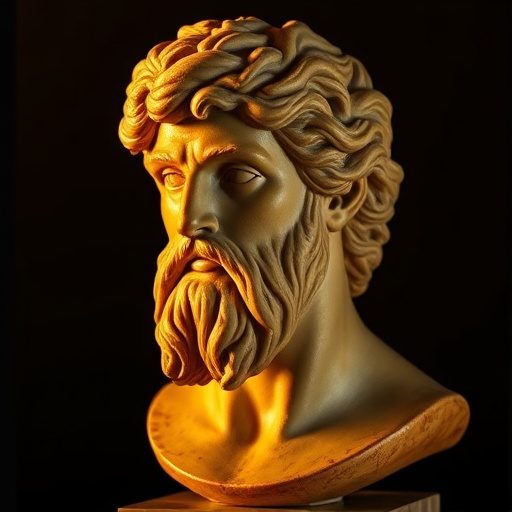
Pythagoras — "Man, know thyself; then thou shalt know the Universe and God."
Man, know thyself; then thou shalt know the Universe and God.
Man, know thyself; then thou shalt know the Universe and God.
Click any product to generate a realistic preview. Up to 3 at a time.
* Initial load can take up to 90 seconds — revising the preview in another color is nearly instant.
"Declining from the public ways, walk in unfrequented paths."
"Don't walk on the highway."
"The property of friends is common."
"Do not stir the fire with a sword."
"No one is free who has not obtained the empire of himself. No man is free who cannot command himself."
Greek philosopher and mathematician whose school in Croton combined geometry (the Pythagorean theorem), number-mysticism, and a religious-vegetarian way of life. Closely associated with Thales of Miletus (earlier pre-Socratic and the first philosopher). For an intellectual contrast, see Heraclitus, pre-Socratic Greek philosopher of flux — Heraclitus called Pythagoras 'the chief of swindlers' — among the founding insults of the philosophical-rivalry tradition. Their 'all is flux' vs 'all is number' poles still organize the philosophy of mathematics today (Platonist vs anti-realist).
Found in 2 providers: grok,gemini
2 sources checked
To understand the universe and its deepest truths, you must first turn inward and examine your own nature, mind, and soul. Self-knowledge is not merely personal insight but the gateway to understanding all existence. The examined inner life unlocks outer reality — introspection and cosmic understanding are not separate pursuits but one continuous, unified act of discovery.
Pythagoras founded a philosophical brotherhood at Croton treating mathematics, music, and spiritual discipline as unified paths to truth. He believed the soul was immortal and subject to transmigration, requiring rigorous self-examination across lifetimes. His theorem wasn't merely geometry — it was evidence that rational order underlies reality, and only a disciplined, self-knowing mind could perceive that order.
Sixth-century BCE Greece was the Axial Age — a period when Greek, Indian, and Chinese thinkers simultaneously turned from myth toward rational inquiry and self-reflection. The Delphic oracle's inscription 'Know Thyself' defined Greek intellectual culture. Mystery religions and Orphic traditions emphasized the soul's journey. Pythagoras synthesized these currents: mathematical order, soul-purification, and cosmic unity converged in a revolutionary philosophy that seeded Western thought.
AI-generated insights based on extensive research and information for context. Factual errors? Email [email protected].
Your cart is empty