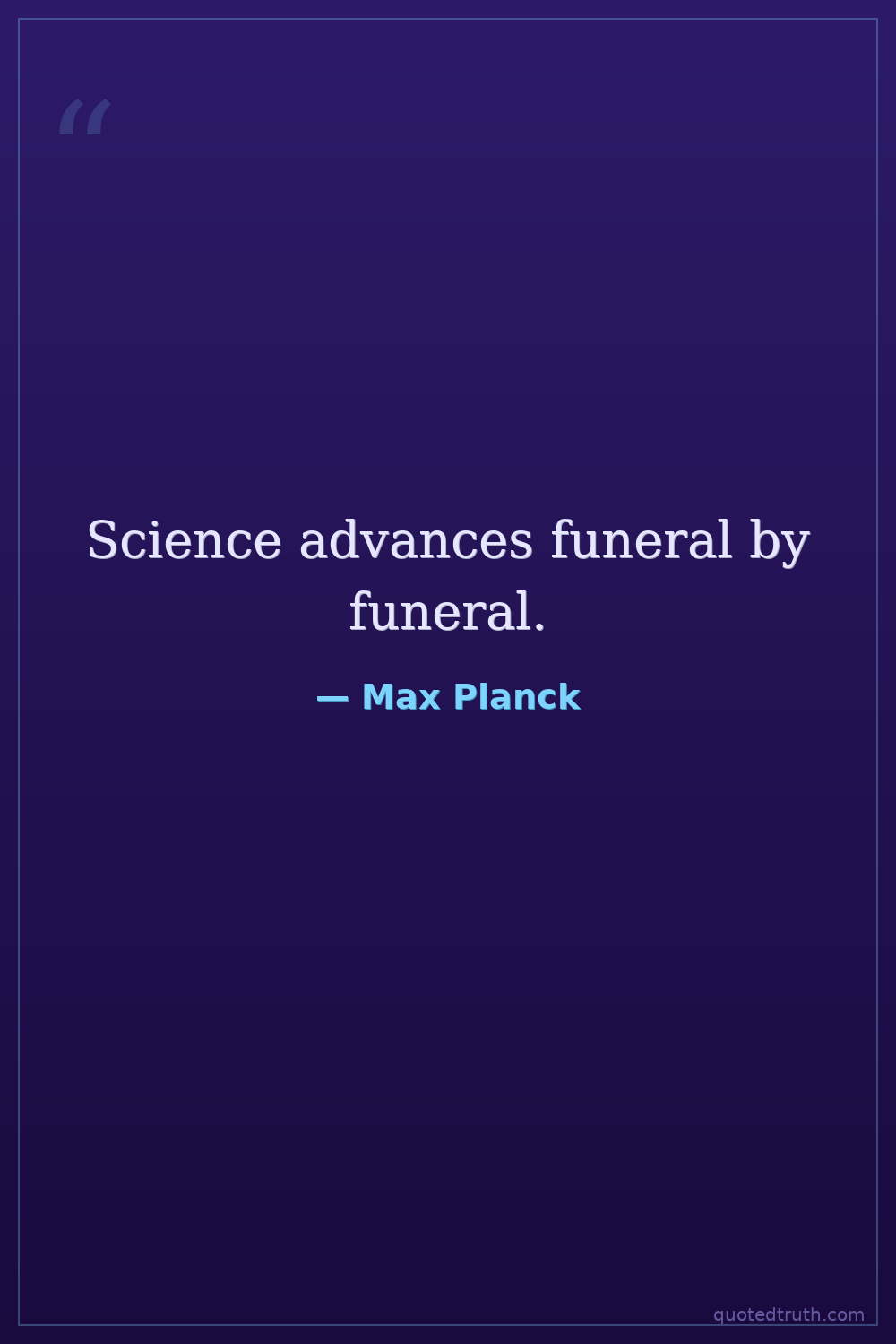
Max Planck — "Science advances funeral by funeral."
Science advances funeral by funeral.
Science advances funeral by funeral.
Click any product to generate a realistic preview. Up to 3 at a time.
* Initial load can take up to 90 seconds — revising the preview in another color is nearly instant.
"The human mind is the most complex and mysterious thing in the universe."
"Thermodynamics is a funny subject. The first time you go through it, you don't understand it at all. The second time you go through it, you think you understand it, except for one or two small points.…"
"Religion and natural science are fighting a joint battle in an incessant, never-ending crusade against skepticism and against dogmatism, against unbelief and against superstition, and as the motto for…"
"It was a dark and stormy night..."
"The scientific method is a never-ending process of refinement and correction."
Often attributed to Planck, a common paraphrase of his 'new scientific truth' quote.
Date: Attributed
EducationalFound in 1 providers: grok
1 source checked
New scientific ideas rarely win people over through debate alone. Established experts tend to cling to the theories they built their careers on, and real progress happens only when that older generation dies off and younger scientists, already comfortable with the new ideas, take their place. Progress is less about persuasion and more about generational turnover replacing entrenched thinking with fresher perspectives.
Planck lived this firsthand. His 1900 quantum hypothesis was resisted for decades by classical physicists who refused to abandon continuous energy models, and even Planck himself hesitated over its radical implications. Having watched Einstein, Bohr, and Heisenberg push quantum theory forward while older colleagues stayed skeptical, Planck concluded that scientific truth triumphs not by converting opponents but by outliving them, a lesson drawn from his own bruising career.
Planck worked through physics' most turbulent upheaval, roughly 1900 to 1947. Newtonian certainty was collapsing as relativity, quantum mechanics, and atomic theory overturned centuries of doctrine. German academia was rigidly hierarchical, and two world wars plus Nazi interference devastated science. Planck witnessed colleagues reject quantum ideas, saw his son executed by the Nazis, and watched institutions crumble, shaping his sober view that intellectual revolutions depend on time and mortality, not merely evidence.
AI-generated insights based on extensive research and information for context. Factual errors? Email [email protected].
Your cart is empty