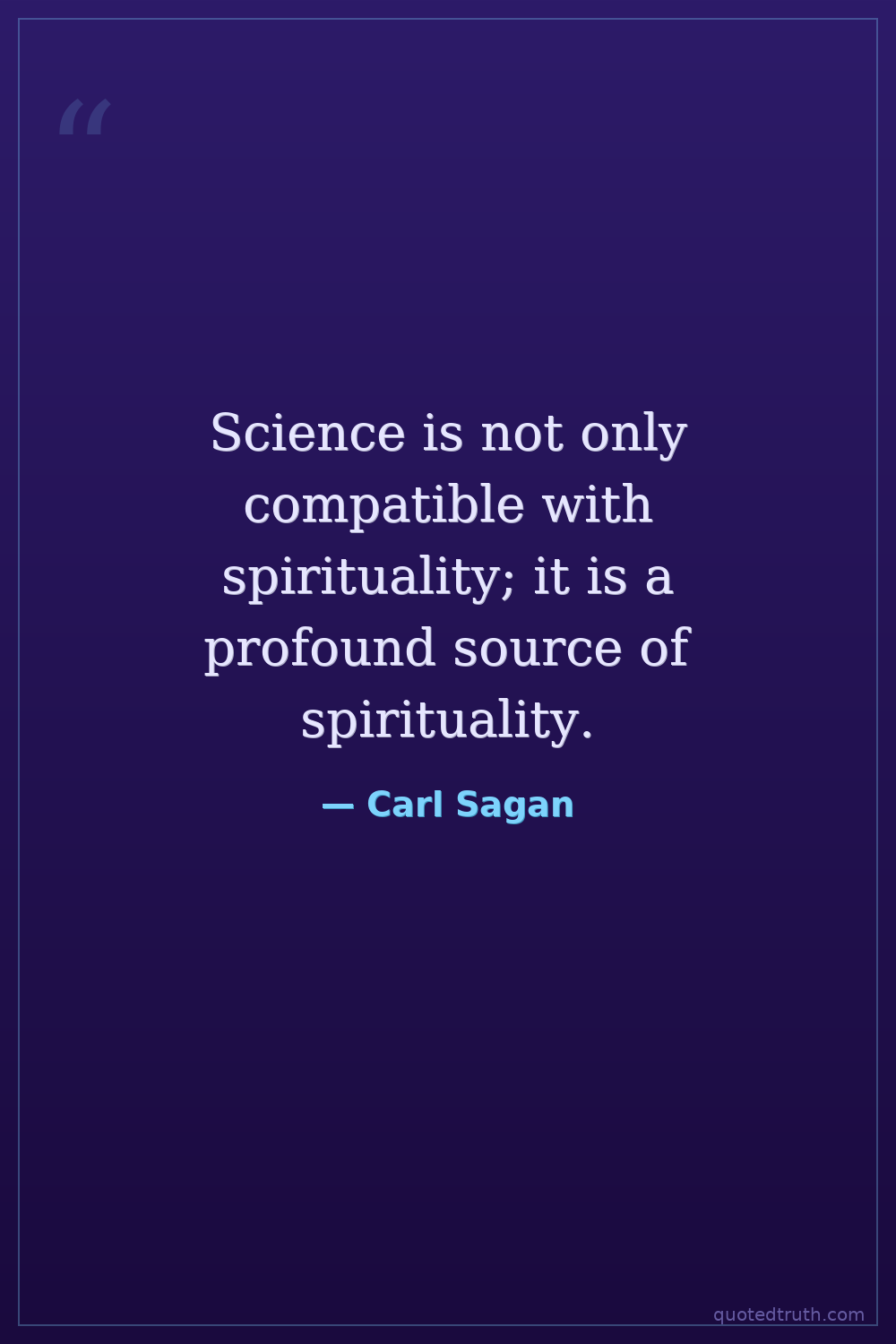
Carl Sagan — "Science is not only compatible with spirituality; it is a profound source of spi…"
Science is not only compatible with spirituality; it is a profound source of spirituality.
Science is not only compatible with spirituality; it is a profound source of spirituality.
Click any product to generate a realistic preview. Up to 3 at a time.
* Initial load can take up to 90 seconds — revising the preview in another color is nearly instant.
"Who are we? We are a collection of water and a few fundamental chemicals, but we are also a way for the universe to know itself."
"I would love to believe that when I die I will live again, that some thinking, feeling, remembering part of me will continue. But much as I want to believe that, and despite the ancient and worldwide …"
"The universe seems neither benign nor hostile, merely indifferent."
"The brain is a very big place in a very small space."
"The notion that the pre-Copernican Earth was flat is a common misconception."
Found in 1 providers: grok
1 source checked
Science and spirituality aren't enemies — understanding the universe through evidence and reason generates the same awe and humility traditionally tied to religious experience. The more we learn about the cosmos's scale, life's complexity, and the laws governing reality, the deeper our wonder becomes. Scientific knowledge doesn't diminish mystery; it expands it, offering a grounded yet transcendent way of engaging with existence that doesn't require abandoning critical thought.
Sagan spent his career arguing that cosmic understanding produces genuine wonder. His Cosmos series and Pale Blue Dot described humanity's tiny place in the universe with scientific precision and emotional depth. An agnostic who rejected organized religion, he nonetheless wrote extensively about the awe evoked by astronomy. He believed the universe's scale — billions of galaxies, billions of years — inspired more authentic reverence than any scripture, and lived that conviction publicly.
Written in the mid-1990s, when culture-war tensions between religious conservatives and scientific communities were intensifying — creationism versus evolution battles dominated school boards, and secular humanism was widely framed as spiritually hollow. Space exploration had revealed Earth as a pale blue dot in a vast cosmos, while molecular biology unlocked life's mechanisms. Many feared science eroded meaning. Sagan's reframing offered a bridge: empirical rigor and transcendent wonder are partners, not adversaries.
AI-generated insights based on extensive research and information for context. Factual errors? Email [email protected].
Your cart is empty