What it means
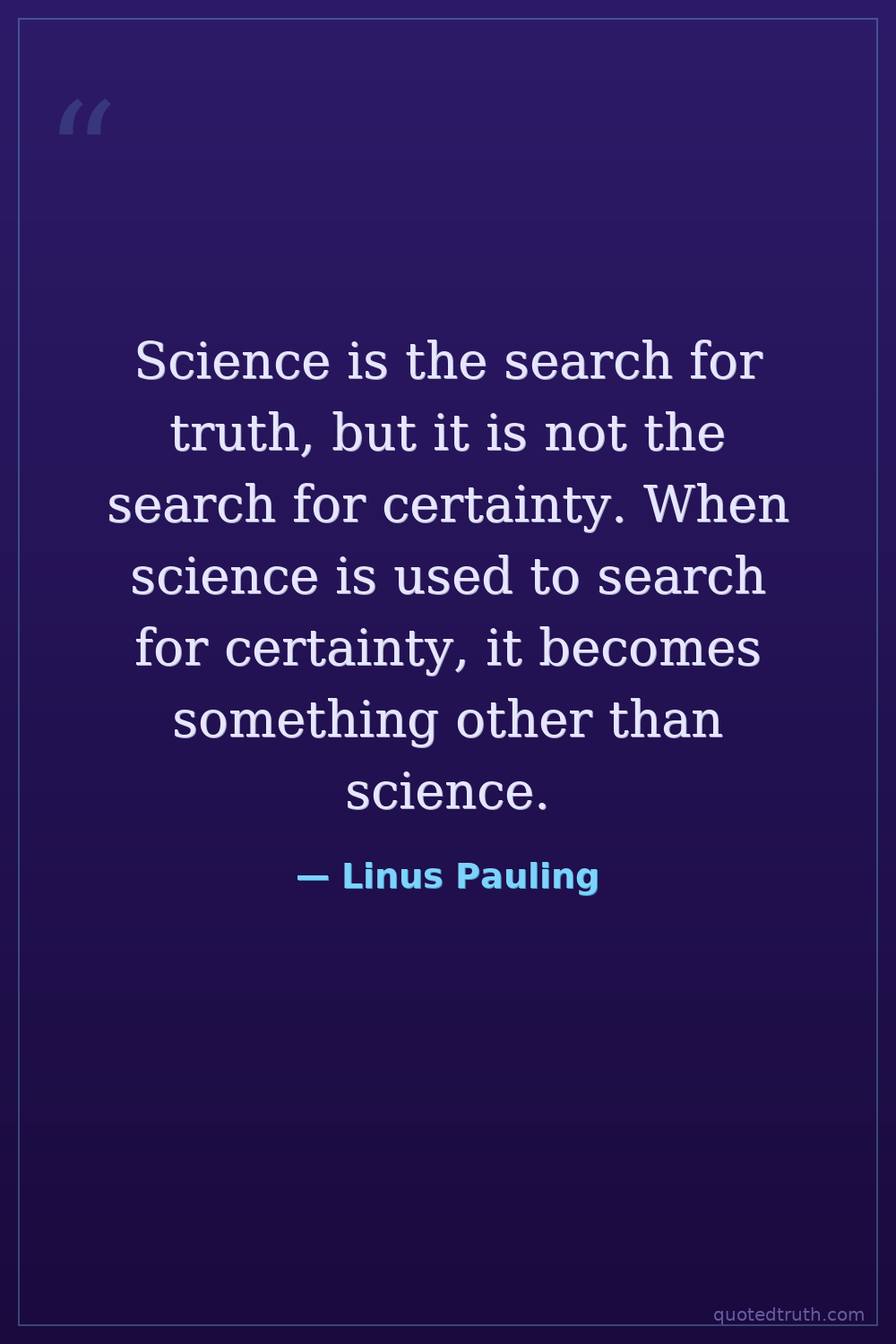
Science pursues truth through questioning, testing, and revising — not through locking in final answers. Certainty belongs to dogma and ideology, not inquiry. The moment a field stops questioning its conclusions and demands fixed, unquestionable answers, it has abandoned the scientific method. Real science holds findings provisionally, always open to revision when better evidence emerges. Intellectual honesty requires embracing uncertainty as a feature, not a flaw.
Relevance to Linus Pauling
Pauling won two Nobel Prizes — Chemistry (1954) for chemical bonding theory, and Peace (1962) for opposing nuclear weapons testing. His activism clashed with Cold War certainty-seekers demanding scientists align politically. He also controversially championed high-dose Vitamin C, demonstrating firsthand the tension between provisional findings and settled consensus — sometimes getting it wrong himself, which made his defense of open inquiry deeply personal and hard-won.
The era
Pauling lived through the 20th century (1901–1994), when both superpowers weaponized science for ideological ends — Soviet Lysenkoism forced biologists to reject genetics, while American McCarthyism pressured researchers over nuclear policy. Science was routinely co-opted to manufacture certainty for propaganda purposes. His insistence that genuine inquiry must remain open, provisional, and self-correcting was a direct rebuke of how governments on both sides misappropriated scientific authority.
AI-generated insights based on extensive research and information for context. Factual errors? Email [email protected].