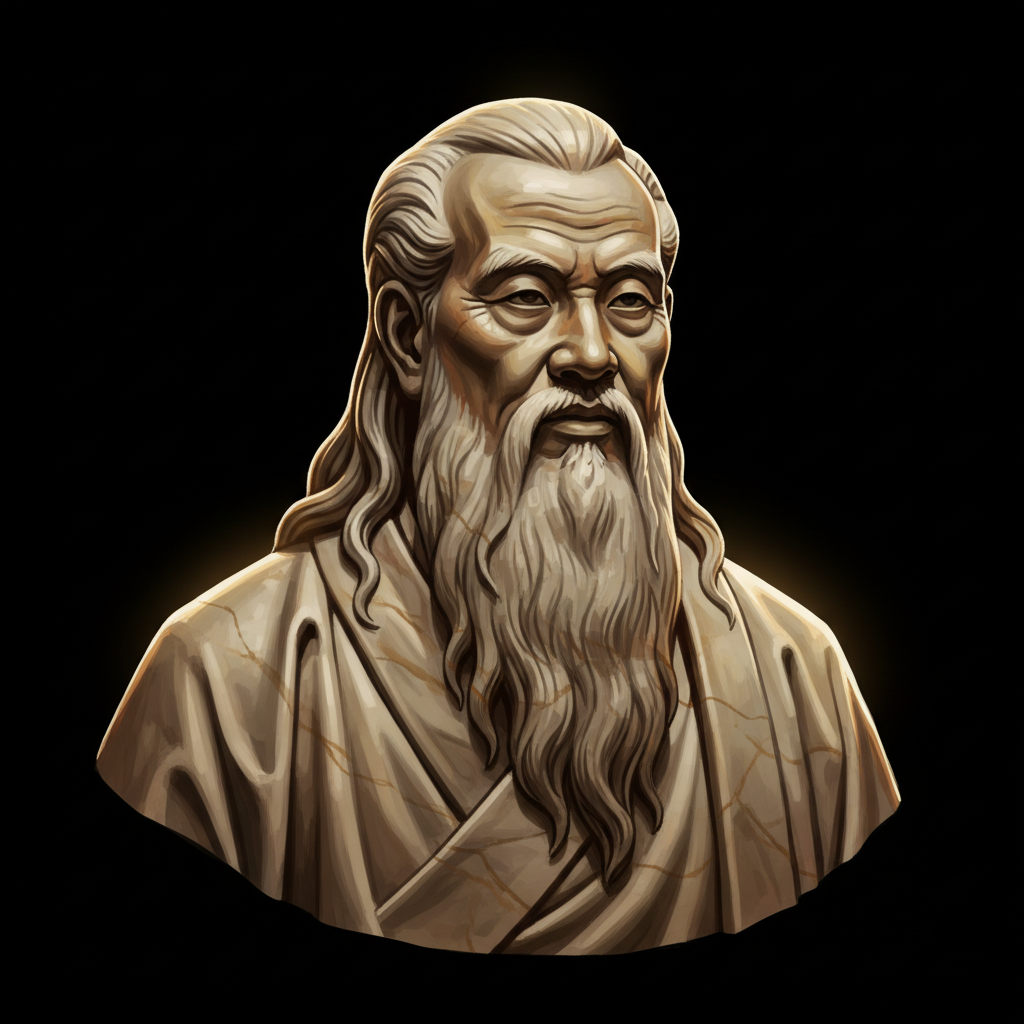
Laozi — "Silence is a source of great strength."
Silence is a source of great strength.
Silence is a source of great strength.
Click any product to generate a realistic preview. Up to 3 at a time.
* Initial load can take up to 90 seconds — revising the preview in another color is nearly instant.
"The Sage manages affairs without doing anything, and spreads doctrines without speaking."
"He who values himself more than the world can be entrusted with the world. He who loves himself more than the world can be charged with the world."
"Stop thinking, and end your problems."
"A man with outward courage dares to die; a man with inward courage dares to live."
"The greatest skill is to seem unskilled; The greatest abundance is to seem empty."
Reputed founder of Taoism and author of the Tao Te Ching, whose wu wei (effortless action) shaped East Asian philosophy. Closely associated with Zhuangzi (later Taoist who extended Laozi's framework). For an intellectual contrast, see Confucius, near-contemporary Chinese sage of social ritual and duty — Confucius systematized social order through ritual and hierarchy; Laozi argued that all such systems were the disease, not the cure — the two founding poles of Chinese moral philosophy.
Found in 1 providers: grok
1 source checked
Holding back words and resisting the urge to react gives you real power. When you stay quiet, you observe more, avoid saying things you'll regret, and keep your intentions hidden from rivals. Silence lets you think clearly instead of being pulled into noise and conflict. People who constantly talk reveal their weaknesses and drain their energy, while those who stay composed preserve their focus and command more respect in any situation.
Laozi is traditionally described as a reserved archivist in the Zhou royal court who preferred reflection over public teaching. Legend says he rode west into obscurity rather than argue his ideas, only writing the Tao Te Ching when a border guard insisted. This fits his philosophy of wu wei, effortless non-action, and his repeated praise of the sage who speaks little. Silence wasn't passivity for him but the disciplined quiet from which genuine insight and power flow.
Laozi lived during the late Zhou dynasty, around the 6th century BCE, as central authority crumbled and rival states slid toward the Warring States period. Traveling philosophers loudly pitched kings on statecraft, and Confucian ritualists emphasized proper speech and ceremony. Against this noisy marketplace of advisors, Laozi's praise of silence was radical counter-culture, rejecting court rhetoric and argument. His ideas spread among people exhausted by war, political scheming, and moralizing lectures, offering stillness as an alternative path to wisdom.
AI-generated insights based on extensive research and information for context. Factual errors? Email [email protected].
Your cart is empty