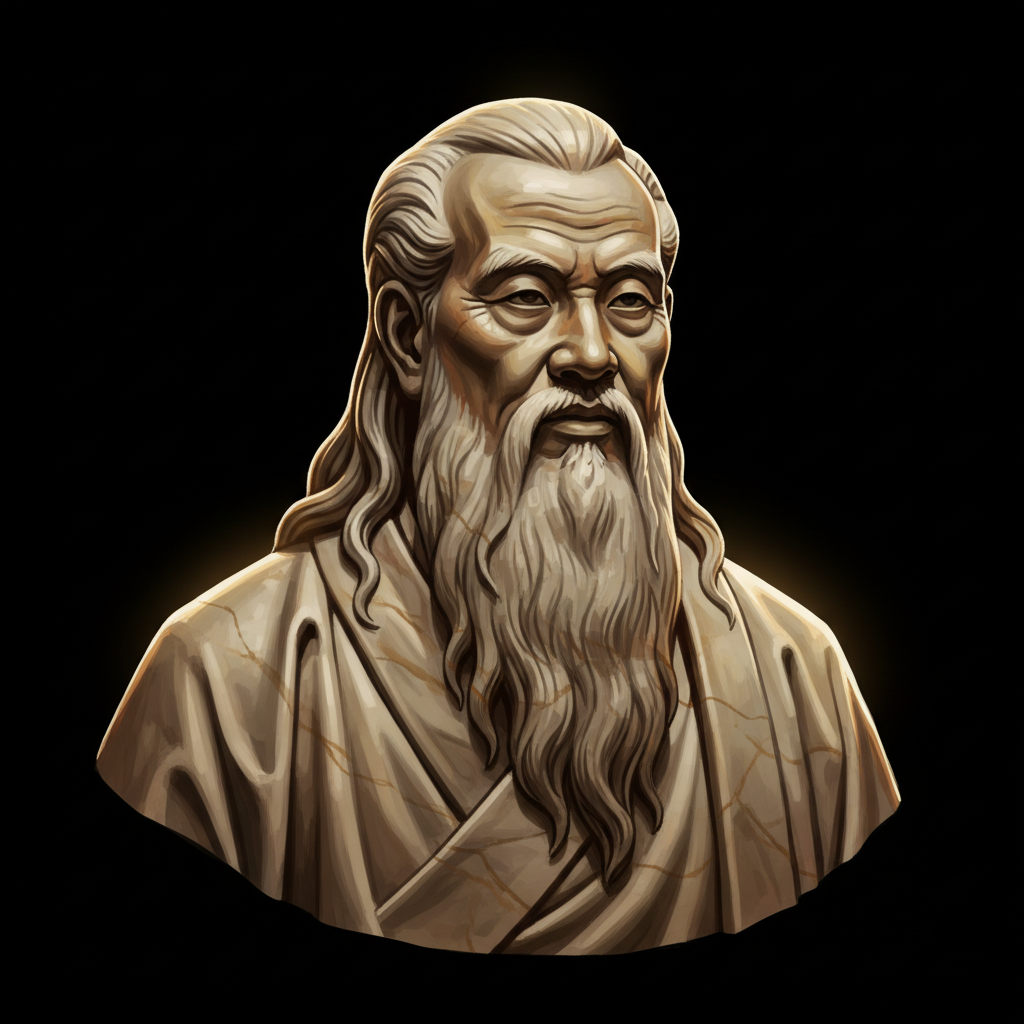
Laozi — "The Sage manages affairs without doing anything, and spreads doctrines without s…"
The Sage manages affairs without doing anything, and spreads doctrines without speaking.
The Sage manages affairs without doing anything, and spreads doctrines without speaking.
Click any product to generate a realistic preview. Up to 3 at a time.
* Initial load can take up to 90 seconds — revising the preview in another color is nearly instant.
"If you realize that all things change, there is nothing you will try to hold on to. If you are not afraid of dying, there is nothing you cannot achieve."
"To yield is to be preserved whole."
"Deal with the small as with the large."
"The heaviest thing in the world is a human heart."
"The sage knows without traveling, perceives without looking, completes without acting."
Reputed founder of Taoism and author of the Tao Te Ching, whose wu wei (effortless action) shaped East Asian philosophy. Closely associated with Zhuangzi (later Taoist who extended Laozi's framework). For an intellectual contrast, see Confucius, near-contemporary Chinese sage of social ritual and duty — Confucius systematized social order through ritual and hierarchy; Laozi argued that all such systems were the disease, not the cure — the two founding poles of Chinese moral philosophy.
Found in 2 providers: gemini,grok
2 sources checked
True leadership works through restraint rather than force. A wise person shapes outcomes by aligning with natural rhythms instead of pushing agendas, and teaches through example rather than lectures. People absorb more from watching quiet competence than from being told what to do. Action without forcing, instruction without preaching—the results arrive on their own when you stop trying to engineer them.
Laozi reportedly served as a keeper of royal archives in the Zhou court, a role of quiet observation rather than command. Disillusioned with political decay, he left civilization and, per legend, wrote the Tao Te Ching at a border guard's request before vanishing west. This saying embodies his core principle of wu wei—effortless action—and his distrust of elaborate governance, rituals, and the Confucian emphasis on verbal moral instruction.
Laozi lived during the late Zhou dynasty, likely the 6th century BCE, as centralized authority crumbled into the warring factions that became the Warring States period. Rulers multiplied laws, armies, and edicts to impose order, while rival philosophical schools competed with increasingly loud prescriptions. Against this backdrop of escalating intervention and verbose moralizing—especially from Confucian bureaucrats—Laozi's counsel of silent, non-coercive governance was a radical rebuke of the era's faith in force and proclamation.
AI-generated insights based on extensive research and information for context. Factual errors? Email [email protected].
Your cart is empty