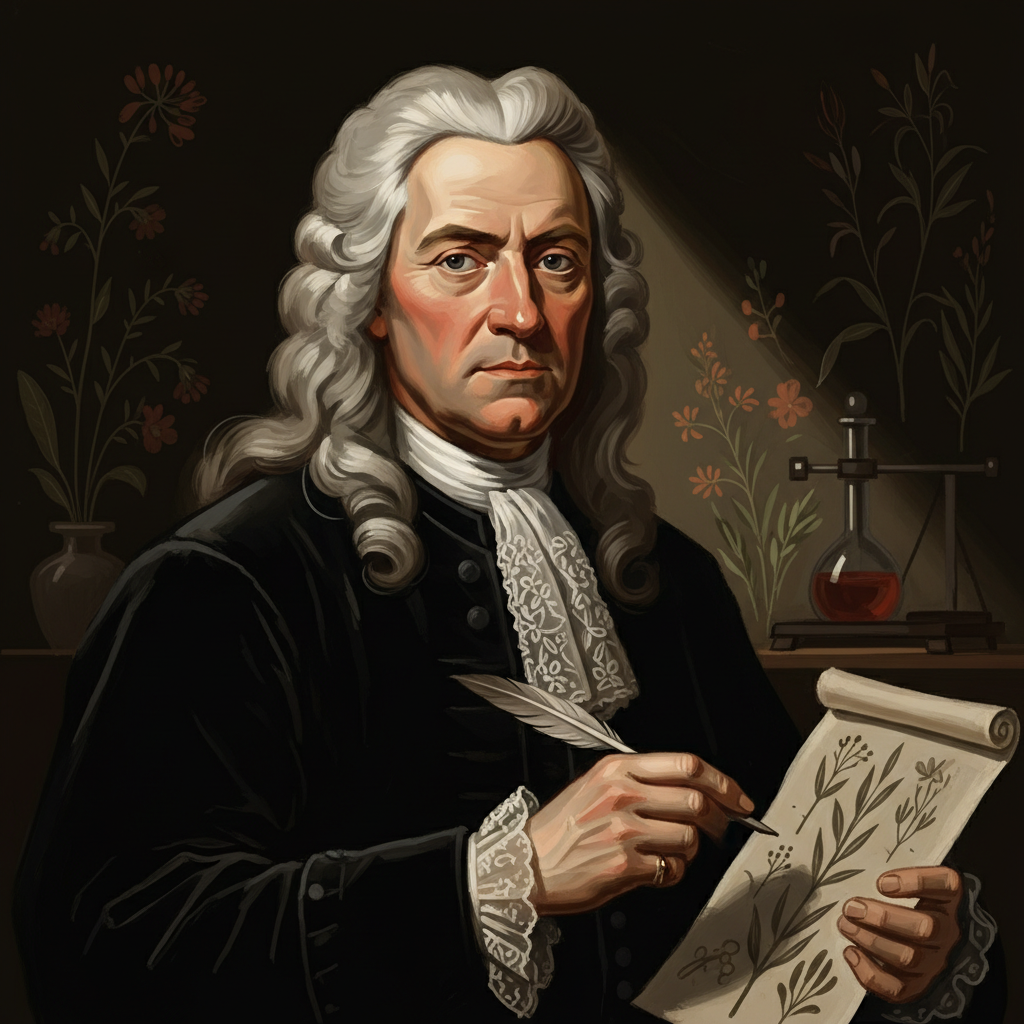
Carl Linnaeus — "The aim of natural history is to know God in His works."
The aim of natural history is to know God in His works.
The aim of natural history is to know God in His works.
Click any product to generate a realistic preview. Up to 3 at a time.
* Initial load can take up to 90 seconds — revising the preview in another color is nearly instant.
"The species are as numerous as the different forms which the Infinite Being produced in the beginning."
"Nature has always been my school, and my teachers have been the trees, the flowers, and the stones."
"The greatest pleasure is to be found in the smallest things."
"The plant kingdom covers the entire earth, offering our senses great pleasure and the delights of summer."
"The whole creation is a song of praise to the Creator."
Swedish botanist and the father of modern taxonomy whose Systema Naturae (1735) introduced binomial nomenclature for naming all species. Closely associated with Joseph Banks (British naturalist who carried Linnaean classification on Cook's voyages). For an intellectual contrast, see Comte de Buffon, French naturalist and Histoire Naturelle author (1749-1788) — Buffon explicitly attacked Linnaean fixed-categories taxonomy as artificial and rejected the binomial system; his gradualist, environment-shaped natural history was the explicit alternative. Anticipates the fixed-species-vs-evolution debate Darwin would later resolve.
Found in 1 providers: gemini
1 source checked
Studying nature — cataloging living things, observing their structures, classifying their relationships — is ultimately a way of understanding God's mind and intentions. The order, diversity, and intricacy found in the natural world serve as direct evidence of divine intelligence and purpose. Rather than separating science from religion, this view treats careful observation of plants, animals, and the earth as a form of worship and theological inquiry.
Linnaeus spent decades building Systema Naturae and developing binomial nomenclature to classify thousands of species — work he explicitly framed as revealing the divine blueprint behind creation. A devout Lutheran, he famously declared 'God creates, Linnaeus arranges.' For him, taxonomy was not merely academic but sacred duty. Each species catalogued was another piece of God's design made legible, and his faith drove his relentless, lifelong precision.
Linnaeus worked during the Enlightenment, when natural theology dominated scientific thought — the conviction that nature's complexity and order proved God's existence and wisdom. This framework, championed by figures like John Ray, reconciled emerging empirical science with Christian faith. As the scientific revolution challenged traditional religious authority, naturalists like Linnaeus found a compelling middle path: rigorous observation was not opposed to faith but actively confirmed it.
AI-generated insights based on extensive research and information for context. Factual errors? Email [email protected].
Your cart is empty