Carl Linnaeus — "The whole creation is a song of praise to the Creator."
The whole creation is a song of praise to the Creator.
The whole creation is a song of praise to the Creator.
Click any product to generate a realistic preview. Up to 3 at a time.
* Initial load can take up to 90 seconds — revising the preview in another color is nearly instant.
"Blessed be the Lord for the beauty of summer and spring, for the air, the water, the verdure, and the song of birds."
"Man is the masterpiece of creation."
"I have explored the whole world of nature."
"The study of nature is the study of God."
"Man is the measure of all things, and the animals exist for his sake."
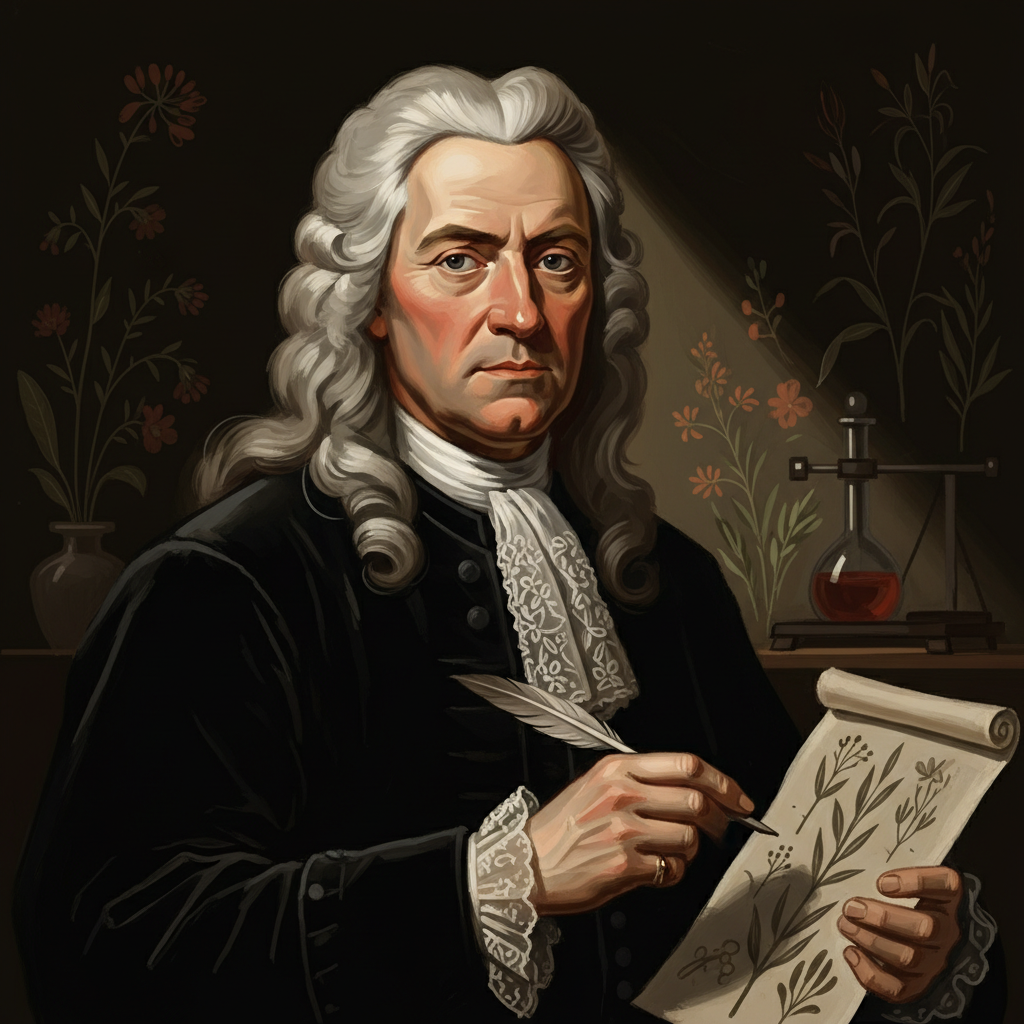
Swedish botanist and the father of modern taxonomy whose Systema Naturae (1735) introduced binomial nomenclature for naming all species. Closely associated with Joseph Banks (British naturalist who carried Linnaean classification on Cook's voyages). For an intellectual contrast, see Comte de Buffon, French naturalist and Histoire Naturelle author (1749-1788) — Buffon explicitly attacked Linnaean fixed-categories taxonomy as artificial and rejected the binomial system; his gradualist, environment-shaped natural history was the explicit alternative. Anticipates the fixed-species-vs-evolution debate Darwin would later resolve.
An expression of his religious awe and perception of natural harmony.
Date: c. 1730s-1770s
Art & CreativityFound in 1 providers: gemini
1 source checked
The natural world, in all its diversity and order, is itself an act of worship toward God. Every organism, every pattern in nature, serves as living testimony to a divine intelligence behind creation. Understanding the natural world isn't separate from spirituality — it is a form of reverence, a recognition that existence itself points toward something greater than any individual creature or observer.
Linnaeus was a devout Lutheran who explicitly saw his taxonomic work as cataloguing God's creation. He wrote 'Deus creavit, Linnaeus disposuit' — God created, Linnaeus organized. His Systema Naturae wasn't merely scientific ambition; he genuinely believed naming and classifying species honored the Creator by revealing the rational order God had embedded in nature. Faith and science were inseparable to him.
The 18th century Enlightenment celebrated reason while most naturalists remained deeply religious. Natural theology — the idea that studying nature reveals God's design — dominated scientific thought. Linnaeus worked before Darwin, when biological complexity was considered proof of divine craftsmanship rather than evolution. Scientists like Linnaeus saw no contradiction between rigorous empirical classification and fervent belief in a purposeful Creator.
AI-generated insights based on extensive research and information for context. Factual errors? Email [email protected].
Your cart is empty