What it means
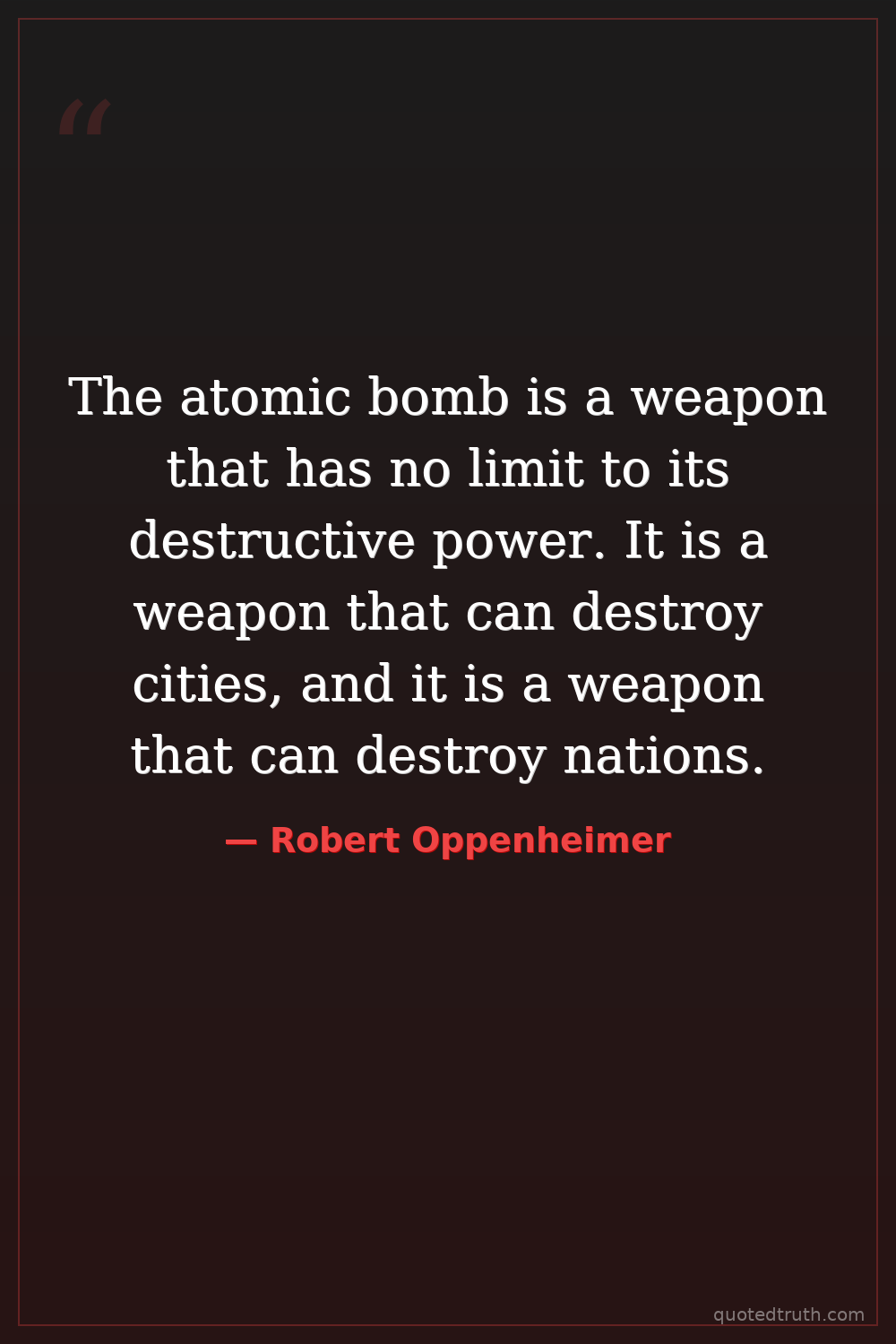
Nuclear weapons represent a fundamentally different order of destruction than anything preceding them. Unlike conventional arms bounded by logistics or cost, atomic bombs can obliterate entire cities in seconds and destabilize or annihilate entire nations. The statement captures that these weapons operate at civilizational scale—beyond military utility into existential threat—making them categorically distinct from every weapon humanity had previously built or conceived of using in warfare.
Relevance to Robert Oppenheimer
Oppenheimer directed Los Alamos Laboratory, building the first atomic bomb detonated at the Trinity test in July 1945. Witnessing that blast, he recalled the Bhagavad Gita: 'Now I am become Death.' After Hiroshima and Nagasaki killed over 150,000 people, he lobbied for international nuclear controls, opposed the hydrogen bomb, and told President Truman scientists had 'blood on their hands.' His security clearance was stripped in 1954 partly for this moral stance.
The era
From 1945 onward the world entered the nuclear age. The US monopoly ended in 1949 when the USSR tested its first bomb, launching a Cold War arms race producing tens of thousands of warheads. Hiroshima and Nagasaki demonstrated cities could be erased in minutes. The Korean War, Berlin crises, and McCarthy-era paranoia made nuclear exchange feel imminent. Oppenheimer's warning arrived as statesmen struggled to grasp a weapon that rendered traditional military doctrine and deterrence theory obsolete.
AI-generated insights based on extensive research and information for context. Factual errors? Email [email protected].