What it means
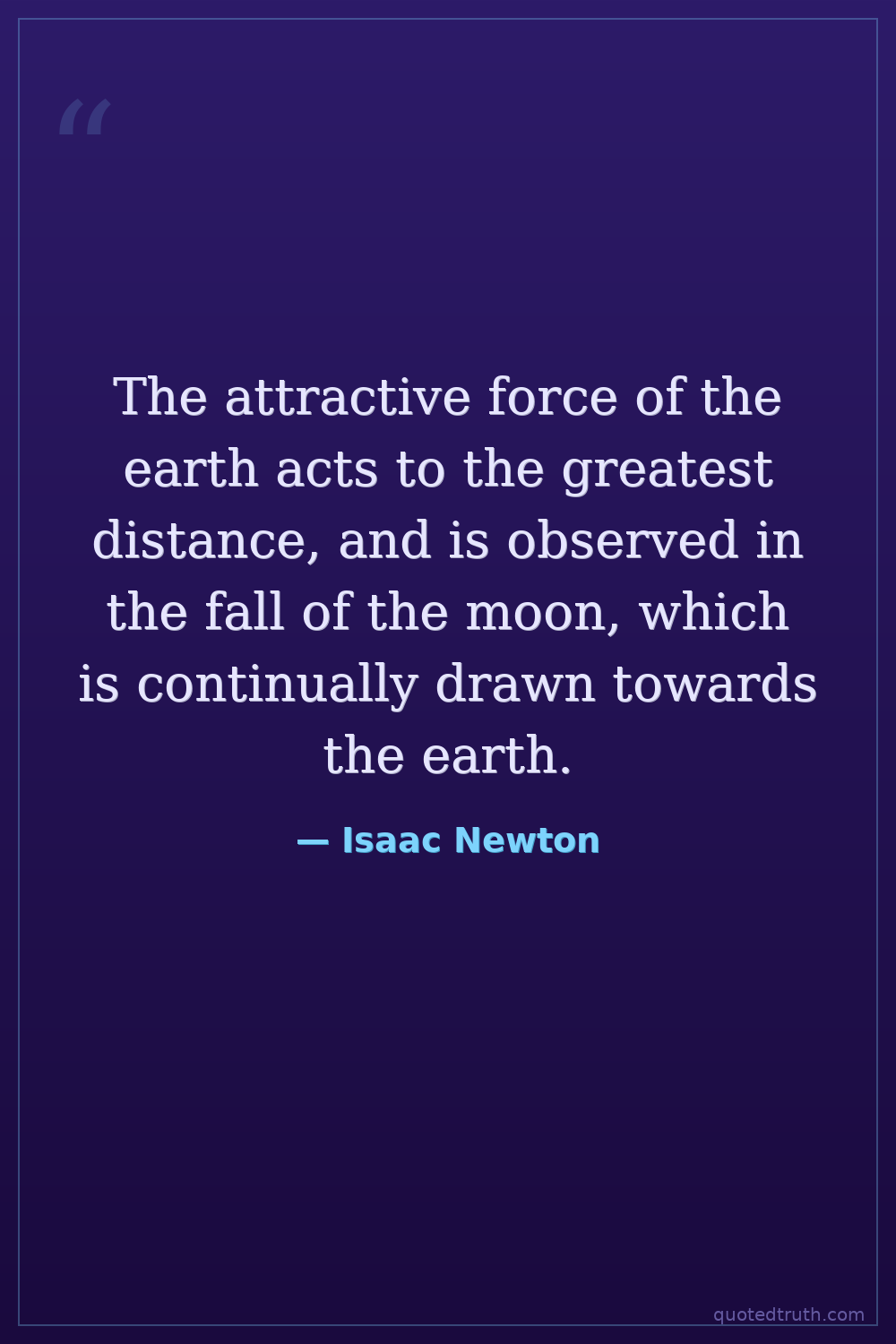
Earth's gravitational pull extends far into space, not just near the surface. The Moon doesn't fly off in a straight line because Earth continuously pulls it inward. This force — the same one that drops an apple — reaches across the vast distance to the Moon, bending its path into an orbit. Gravity is universal, operating across immense distances without physical contact.
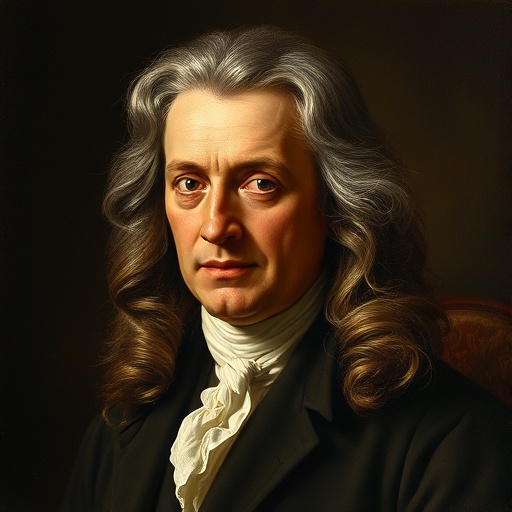
Relevance to Isaac Newton
Newton derived this directly from his law of universal gravitation, his most celebrated achievement. By calculating that the Moon's orbital acceleration matched the inverse-square law applied to Earth's surface gravity, he unified terrestrial and celestial mechanics. This was the empirical proof that his abstract mathematics described real physical reality, cementing his Principia Mathematica as the foundation of classical physics.
The era
In Newton's era, the heavens were still widely considered separate from earthly physics — governed by different divine laws. Aristotelian and Cartesian cosmologies dominated. Newton's demonstration that a single force governed both falling bodies and planetary orbits shattered this division, launching the Scientific Revolution's crowning achievement and enabling precise astronomical prediction for the first time in history.
AI-generated insights based on extensive research and information for context. Factual errors? Email [email protected].