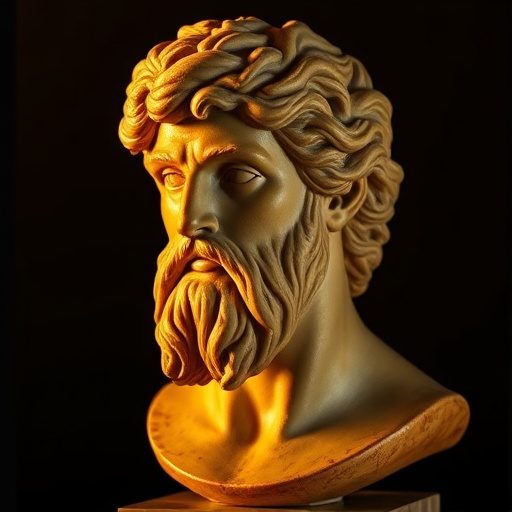
Pythagoras — "The stars in the heavens sing a music if only we had ears to hear."
The stars in the heavens sing a music if only we had ears to hear.
The stars in the heavens sing a music if only we had ears to hear.
Click any product to generate a realistic preview. Up to 3 at a time.
* Initial load can take up to 90 seconds — revising the preview in another color is nearly instant.
"Do not wear a tight shoe."
"Accustom yourself to a way of living that is neat and decent without luxury."
"Reason is immortal, all else mortal."
"The universe is a living creature, endowed with soul and reason."
"There are men and gods, and beings like Pythagoras."
Greek philosopher and mathematician whose school in Croton combined geometry (the Pythagorean theorem), number-mysticism, and a religious-vegetarian way of life. Closely associated with Thales of Miletus (earlier pre-Socratic and the first philosopher). For an intellectual contrast, see Heraclitus, pre-Socratic Greek philosopher of flux — Heraclitus called Pythagoras 'the chief of swindlers' — among the founding insults of the philosophical-rivalry tradition. Their 'all is flux' vs 'all is number' poles still organize the philosophy of mathematics today (Platonist vs anti-realist).
Found in 1 providers: deepseek
1 source checked
The universe operates according to deep harmonic patterns most humans cannot perceive. Reality has an underlying order—mathematical, musical, cosmic—that exists independent of human awareness. The limitation lies in our perception, not in nature itself. If we could transcend ordinary sensory experience and develop deeper attunement, we would recognize that existence is inherently structured like music: ordered, proportional, and beautiful beyond what the senses reveal.
Pythagoras developed the concept of musica universalis—the music of the spheres—believing celestial bodies produce harmonics as they move through the cosmos. He discovered that musical intervals correspond to precise numerical ratios, with the octave being 2:1. His entire philosophical school held that numbers are the fundamental reality underlying all things. This quote is the core of his worldview: mathematics, music, and the cosmos form one unified system, accessible only through disciplined intellectual and spiritual understanding.
In 6th-century BCE Greece, astronomy, music, and mathematics were unified disciplines—all considered branches of number theory. Pre-Socratic philosophers were replacing mythological explanations of the cosmos with rational ones. Pythagoras established his community in Croton, southern Italy, where followers pursued mathematical and spiritual knowledge together. The notion that celestial motion produced sound was philosophically serious then—it implied the heavens operated by the same harmonic laws governing musical instruments, unifying terrestrial and cosmic realms under one mathematical principle.
AI-generated insights based on extensive research and information for context. Factual errors? Email [email protected].
Your cart is empty