Wright Brothers (Orville & Wilbur) — "The best thing about being a man of science is that you never have to be bored."
The best thing about being a man of science is that you never have to be bored.
The best thing about being a man of science is that you never have to be bored.
Click any product to generate a realistic preview. Up to 3 at a time.
* Initial load can take up to 90 seconds — revising the preview in another color is nearly instant.
"The greatest value of our experiments has been their negative results."
"We have been making flights at an altitude of about 50 feet."
"The machine is a triumph of human ingenuity."
"It is not necessary to be a genius to be an inventor."
"No airship will ever fly from New York to Paris. That seems to me to be impossible. What limits the flight is the motor. No known motor can run at the requisite speed for four days without stopping, a…"
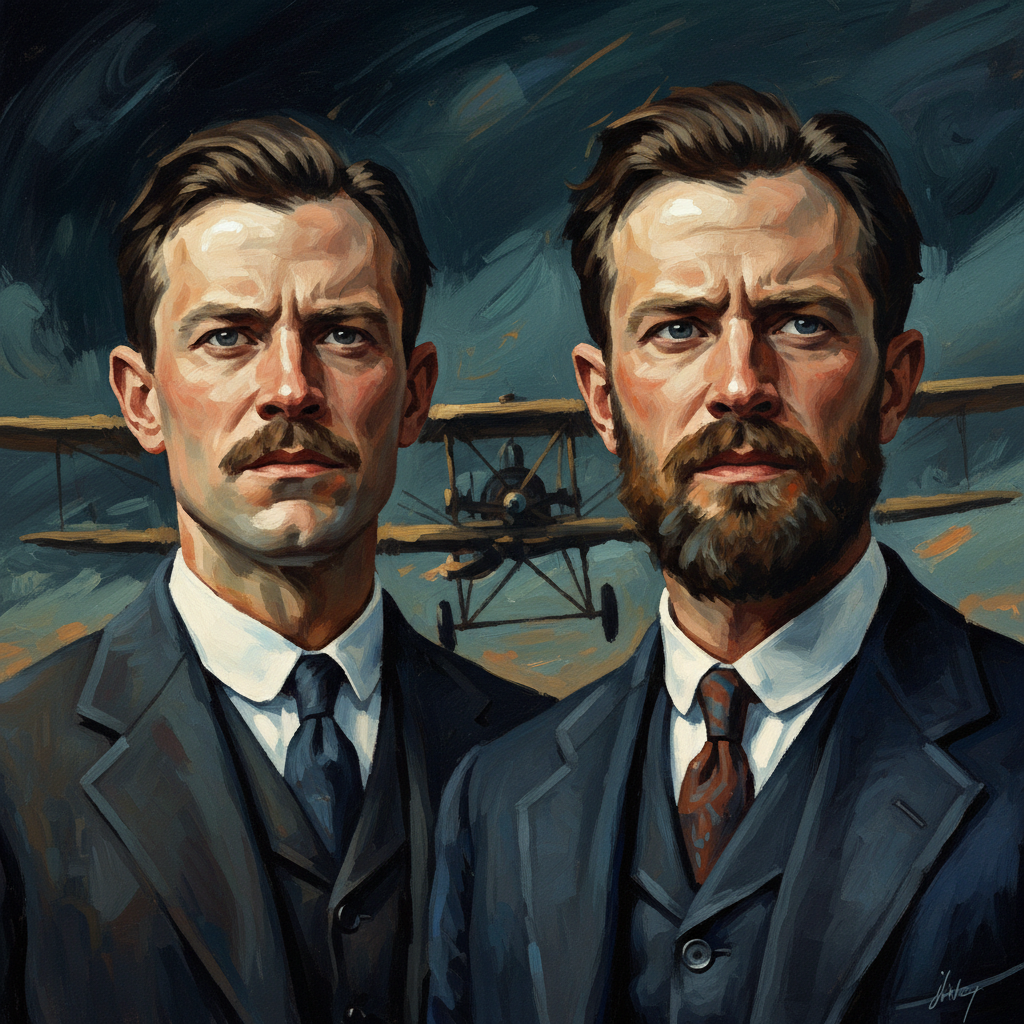
American aviation pioneers who achieved the first sustained powered controlled airplane flight at Kitty Hawk, NC, on December 17, 1903. Closely associated with Octave Chanute (their gliding mentor and aeronautical correspondent). For an intellectual contrast, see Samuel Pierpont Langley, Smithsonian Institution Secretary and government-funded aviation researcher — Langley's Aerodrome crashed twice into the Potomac in October-December 1903 with $50,000 of War Department funding; the Wright Brothers' bicycle-shop empiricism beat Langley's institutional Big Science by 9 days. The most-cited example in engineering history of empirical-tinkerer beating institution-funded credentialism.
Attributed, but hard to pinpoint exact source or verify exact wording.
Date: Disputed
GeneralFound in 1 providers: grok
1 source checked
Curiosity-driven work never gets old — there is always another question to investigate, another mechanism to understand, another experiment to run. A scientist lives in permanent intellectual engagement because the natural world never stops presenting puzzles. Every answer creates new questions, ensuring the curious mind is never idle. This quote celebrates science as a way of life that keeps a person perpetually absorbed and motivated.
Orville and Wilbur Wright were self-taught bicycle mechanics who became aviation pioneers through relentless curiosity. They built their own wind tunnel, tested over 200 wing shapes, and solved aerodynamic problems that had stumped credentialed engineers. Achieving powered flight at Kitty Hawk in 1903 came after years of systematic experimentation. Science was never their formal credential — it was their identity, sustaining them through every setback and failure.
The early 1900s was a moment when independent inventors could still change the world without institutional backing. Edison had lit cities, Tesla was transforming power systems, and the Wrights were conquering the air. Science felt boundless — fundamental questions about flight, electricity, and communication remained unsolved and accessible to amateurs. The era rewarded obsessive curiosity over academic credentials, making the Wright Brothers' self-directed approach both practical and emblematic of their time.
AI-generated insights based on extensive research and information for context. Factual errors? Email [email protected].
Your cart is empty