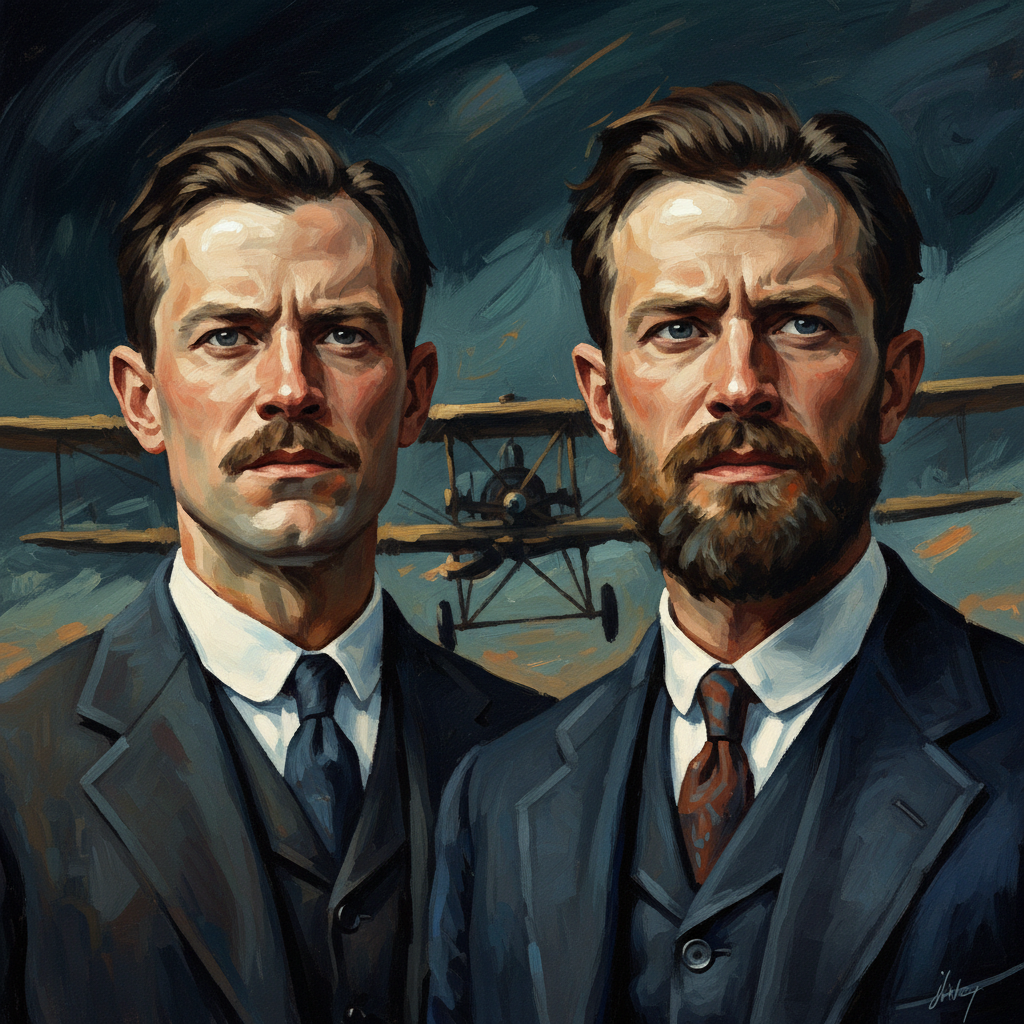
Wright Brothers (Orville & Wilbur) — "We have been making flights at an altitude of about 50 feet."
We have been making flights at an altitude of about 50 feet.
We have been making flights at an altitude of about 50 feet.
Click any product to generate a realistic preview. Up to 3 at a time.
* Initial load can take up to 90 seconds — revising the preview in another color is nearly instant.
"The machine has been working very nicely and we have been making several flights each day."
"It is our view that morally the world owes its almost universal use of our system of lateral control entirely to us. It is also our opinion that legally it owes it to us."
"We have been trying to solve the problem of aerial navigation, and we believe we have succeeded."
"I never had any particular love for the airplane. What I love is to fly."
"We have been trying to make a machine that will fly, and we have succeeded."
American aviation pioneers who achieved the first sustained powered controlled airplane flight at Kitty Hawk, NC, on December 17, 1903. Closely associated with Octave Chanute (their gliding mentor and aeronautical correspondent). For an intellectual contrast, see Samuel Pierpont Langley, Smithsonian Institution Secretary and government-funded aviation researcher — Langley's Aerodrome crashed twice into the Potomac in October-December 1903 with $50,000 of War Department funding; the Wright Brothers' bicycle-shop empiricism beat Langley's institutional Big Science by 9 days. The most-cited example in engineering history of empirical-tinkerer beating institution-funded credentialism.
Found in 1 providers: grok
1 source checked
The speaker matter-of-factly reports flying at roughly 50 feet — a height that sounds modest but represents controlled, repeated powered flight. No dramatic flourish, just a technical data point. The statement implies aviation is no longer a one-off miracle but a measurable, reproducible activity. It captures the mindset of someone who has moved past amazement into engineering refinement, treating the extraordinary as simply the next step in a methodical process.
Orville and Wilbur Wright were meticulous engineers who kept detailed logs of every test flight at Kitty Hawk. Former bicycle mechanics from Dayton, Ohio, they applied systematic experimentation rather than inspiration or intuition. This quote reflects their character: no self-aggrandizement, just recorded data. They communicated achievements in letters and diaries with flat precision, famously keeping their 1903 success quiet for years while rivals raced to claim the glory.
In the early 1900s, heavier-than-air powered flight was the defining technological frontier. The Wrights' 1903 Kitty Hawk flights lasted only seconds; by 1904-1905 they were extending range and altitude at Huffman Prairie near Dayton. Public skepticism was intense — newspapers largely ignored their achievements. Samuel Langley's government-funded efforts had just failed spectacularly. Achieving consistent altitude-controlled flight at 50 feet represented mastery no one else had reached, in an era that doubted it was possible at all.
AI-generated insights based on extensive research and information for context. Factual errors? Email [email protected].
Your cart is empty