What it means
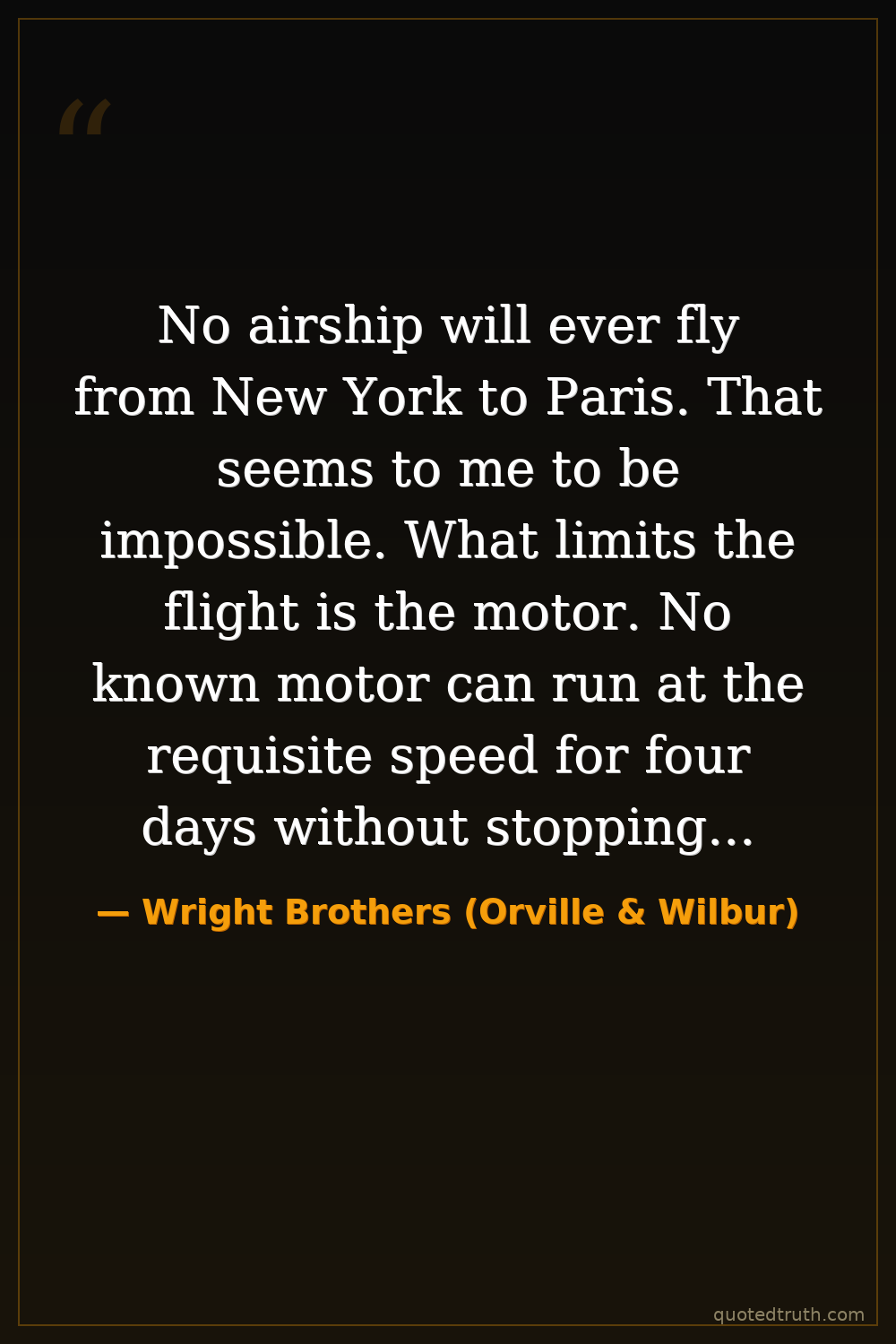
Long-distance transatlantic flight is impossible because engines cannot sustain the high speeds required for four continuous days without breaking down or running out of fuel, and wind conditions cannot be reliably predicted or relied upon to glide that far. The fundamental bottleneck is the motor's endurance, not the aircraft design itself. Crossing an ocean by air is simply beyond what current propulsion technology can achieve.
Relevance to Wright Brothers (Orville & Wilbur)
Wilbur Wright said this in 1908, just five years after he and Orville achieved the first powered flight at Kitty Hawk in 1903. As working engineers who hand-built their own engines, they understood intimately the weight, fuel, and reliability limits of early motors. Ironically, Lindbergh crossed New York to Paris solo in 1927, within their lifetime, proving the pioneer wrong about the very frontier he opened.
The era
In the early 1900s, aviation was brand new and fragile, with flights measured in minutes, not hours. Engines were heavy, underpowered, and prone to failure. Transatlantic travel meant steamships taking a week. The idea of crossing oceans by air seemed fantastical, and even the inventors of flight could not imagine the rapid engine advances World War I would accelerate, leading to reliable long-range aircraft within two decades.
AI-generated insights based on extensive research and information for context. Factual errors? Email [email protected].