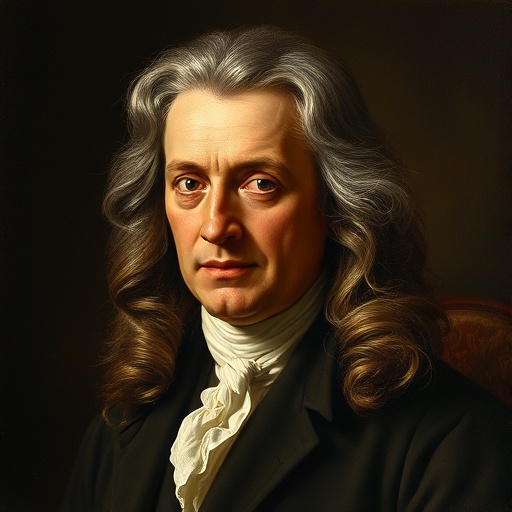
Isaac Newton — "The best way to understand is by examples."
The best way to understand is by examples.
The best way to understand is by examples.
Click any product to generate a realistic preview. Up to 3 at a time.
* Initial load can take up to 90 seconds — revising the preview in another color is nearly instant.
"The causes of gravity are not yet discovered. It is by experiments and observations that we are to know them."
"The description of right lines and circles, upon which geometry is founded, belongs to mechanics. Geometry does not teach us to draw these lines, but requires them to be drawn."
"A man may imagine things that are false, but he can only understand things that are true, for if the things be false, the apprehension of them is not understanding."
"If I have seen further than others, it is by standing upon the shoulders of giants."
"The great ocean of truth lay all undiscovered before me."
Found in 1 providers: deepseek
1 source checked
Abstract ideas become truly comprehensible only when grounded in concrete cases. Definitions and theories alone leave gaps that examples close — they let the mind recognize patterns rather than merely memorize rules. Understanding is active: seeing a principle applied transforms it from an abstract statement into something a person can reason with, recall, and extend to new situations. Examples are not illustrations of understanding; they are the mechanism that produces it.
Newton's greatest work, the Principia Mathematica, demonstrated universal laws through geometric propositions paired with specific worked cases — orbits, pendulums, tides. His optical experiments used prisms and measured angles rather than pure theory. Shaped by Baconian inductive method, Newton trusted observation over authority. He derived gravity's inverse-square law from Kepler's planetary data, always anchoring abstract mathematics in physical, demonstrable examples — mirroring exactly what this quote prescribes as the path to genuine understanding.
Newton worked during the Scientific Revolution, when European thinkers were rejecting Aristotelian scholasticism — which prized logical argument and textual authority — in favor of empirical demonstration. The Royal Society, founded in 1660, adopted the motto Nullius in verba, demanding experimental proof over inherited doctrine. In this climate, examples weren't merely pedagogical aids; they were the epistemological gold standard by which natural philosophers established credibility and separated genuine knowledge from speculation.
AI-generated insights based on extensive research and information for context. Factual errors? Email [email protected].
Your cart is empty