What it means
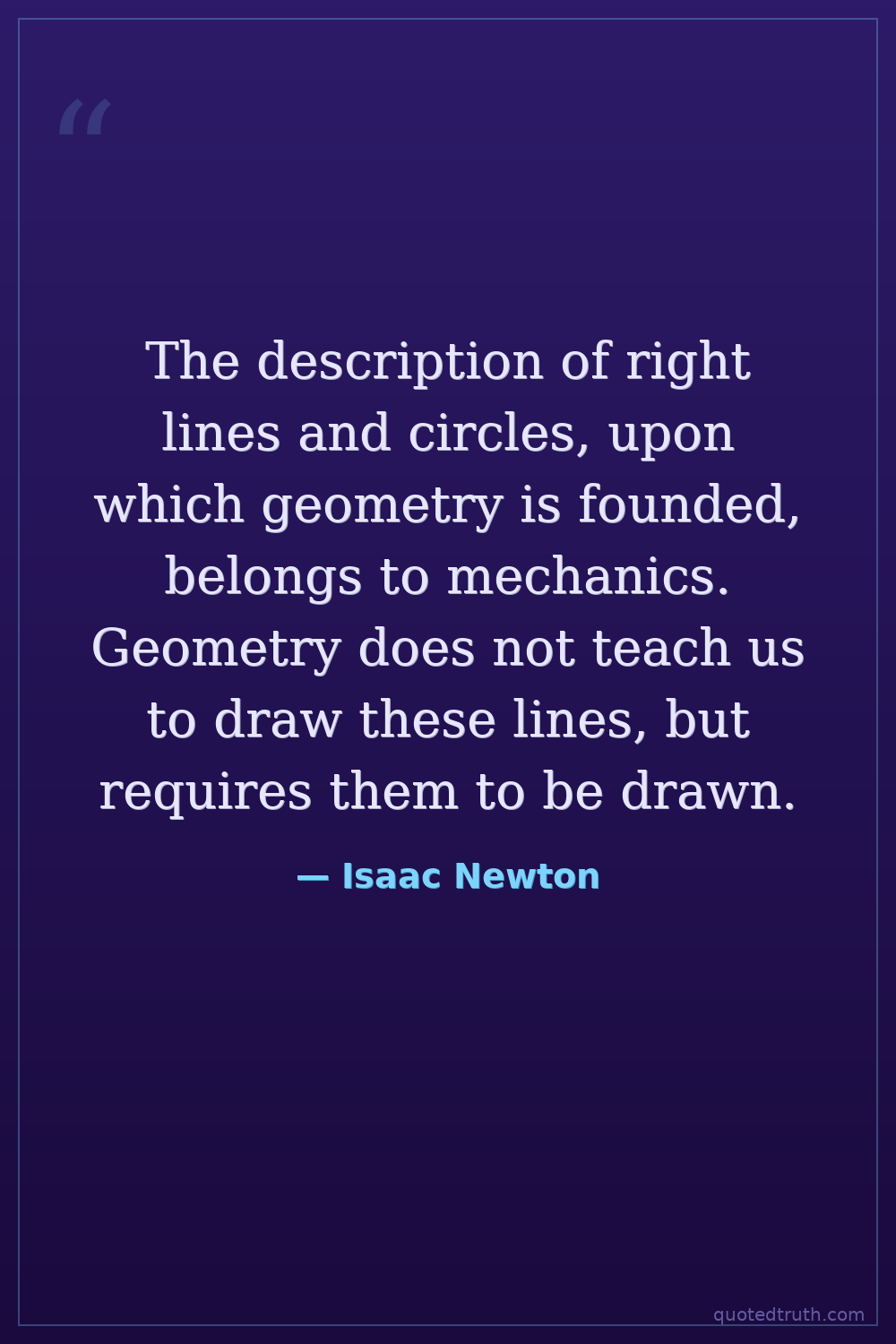
Newton draws a sharp line between the physical act of constructing geometric figures — which belongs to mechanics, the craft of making — and geometry itself, which simply assumes those forms exist. Geometry doesn't teach you how to draw a perfect straight line or circle in the real world; it takes them as given. Hands-on construction is a mechanical skill; geometry reasons abstractly from what mechanics provides.
Relevance to Isaac Newton
Newton straddled mathematics and physical science his entire career — inventing calculus, deriving laws of planetary motion, and writing the Principia as a mathematical account of nature. This quote opens the Principia's Preface, establishing his foundational premise: mechanical reality and geometric reasoning are distinct yet inseparable. Newton saw mechanics as the empirical bedrock on which abstract mathematics rests, a conviction that made his physics revolutionary — rigorously mathematical while never abandoning the physical world.
The era
Newton wrote this in 1687 during the Scientific Revolution, when Europe was debating how mathematics relates to physical reality. Descartes had unified algebra and geometry; Galileo had applied mathematics to motion. Yet the boundary between pure geometric reasoning and physical construction remained unsettled. Newton's distinction helped legitimize natural philosophy as rigorously mathematical without collapsing into pure abstraction — a critical move that defined the framework underpinning modern physics.
AI-generated insights based on extensive research and information for context. Factual errors? Email [email protected].