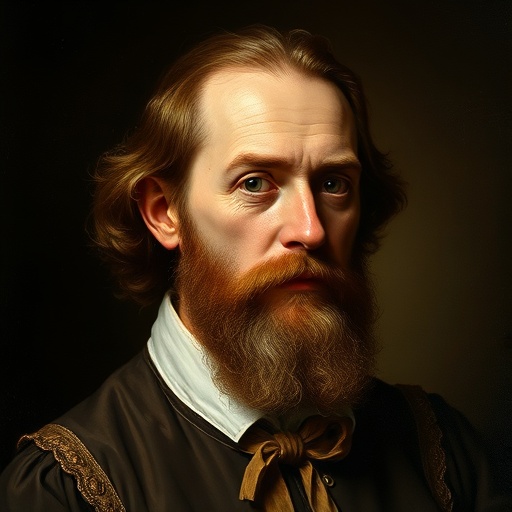
William Harvey — "The book of nature is the only book that offers a wealth of content on every one…"
The book of nature is the only book that offers a wealth of content on every one of its pages.
The book of nature is the only book that offers a wealth of content on every one of its pages.
Click any product to generate a realistic preview. Up to 3 at a time.
* Initial load can take up to 90 seconds — revising the preview in another color is nearly instant.
"The wise man will not be content with the knowledge of things as they are, but will seek to know how they came to be so."
"The blood in the animal body is impelled in a circle, and is in a state of ceaseless motion."
"I appeal to the evidence of my senses, and to the testimony of dissections."
"The blood flows from the right ventricle through the lungs to the left auricle."
"The blood, therefore, moves in a circuit, and is impelled by the heart."
English physician whose On the Motion of the Heart and Blood in Animals (1628) demonstrated blood circulation, overturning 1,400 years of Galenic medicine. Closely associated with Francis Bacon (his contemporary in the new English empiricism). For an intellectual contrast, see Galenic medicine, the 2nd-century Greek medical tradition (humors, blood-as-consumed-fuel) — Harvey calculated that the heart pumps more blood per hour than the body could possibly produce as fuel — a single quantitative observation that demolished the entire Galenic-Aristotelian medical worldview. The cleanest example in medical history of arithmetic disproving 14 centuries of authority.
A metaphorical statement emphasizing the richness of natural observation, similar to Linnaeus.
Date: Uncertain (attributed)
EducationalFound in 1 providers: gemini
1 source checked
This quote asserts that nature itself is the richest, most inexhaustible source of knowledge available. Every natural phenomenon, organism, and process reveals something true and meaningful upon careful observation. Unlike human-written books, which may contain errors, gaps, or speculation, the natural world offers endless, layered content to the attentive observer. It champions direct empirical inquiry over reliance on inherited authoritative texts as the foundation of genuine understanding.
Harvey overturned 1,400 years of Galenic medical doctrine not by reading more books but by dissecting animals and measuring blood flow directly. His 1628 work 'De Motu Cordis' demonstrated cardiac circulation through hands-on experiment alone. He trusted his eyes over Galen's centuries-old texts. This quote perfectly encapsulates his empiricist philosophy: nature is the ultimate authority, and careful observation is the only reliable path to medical truth.
Harvey worked during the Scientific Revolution of the early 1600s, when European thinkers were dismantling ancient Greek and Roman authorities that had dominated medicine for over a millennium. Vesalius had exposed Galen's anatomical errors, and Francis Bacon was formalizing empiricism. Asserting that nature surpasses any written book was a bold, even radical declaration — positioning direct observation above church-sanctioned classical scholarship at a moment when that tension defined intellectual life.
AI-generated insights based on extensive research and information for context. Factual errors? Email [email protected].
Your cart is empty