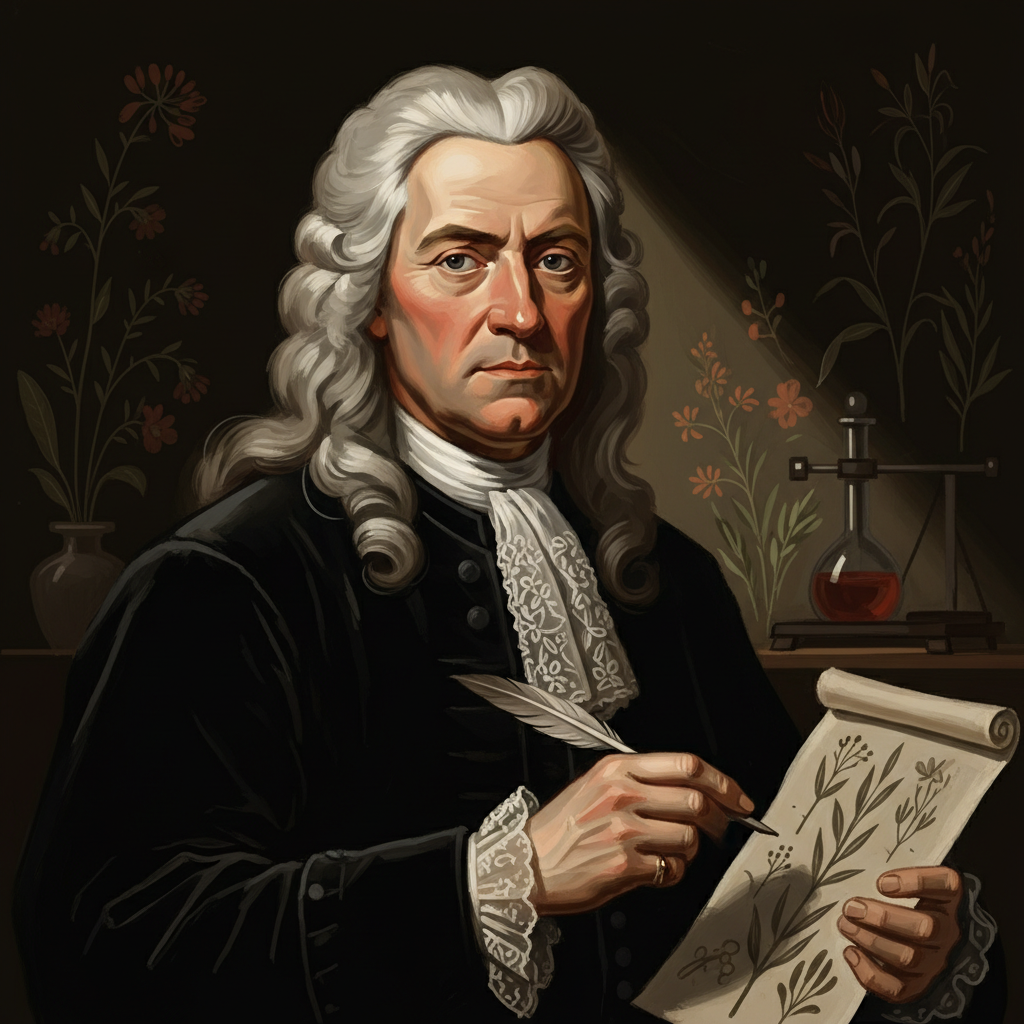
Carl Linnaeus — "The book of nature is the only book that offers a wealth of content on every one…"
The book of nature is the only book that offers a wealth of content on every one of its pages.
The book of nature is the only book that offers a wealth of content on every one of its pages.
Click any product to generate a realistic preview. Up to 3 at a time.
* Initial load can take up to 90 seconds — revising the preview in another color is nearly instant.
"Yet man does recognise himself [as an animal]. But I ask you and the whole world for a generic differentia between man and ape which conforms to the principles of natural history, I certainly know of …"
"The whole creation is a song of praise to the Creator."
"The true botanist is not one who knows many plants, but one who knows how to find them."
"The most beautiful thing in the world is a flower, but it is not so beautiful as a woman."
"The system of nature is a mirror of God's wisdom."
Swedish botanist and the father of modern taxonomy whose Systema Naturae (1735) introduced binomial nomenclature for naming all species. Closely associated with Joseph Banks (British naturalist who carried Linnaean classification on Cook's voyages). For an intellectual contrast, see Comte de Buffon, French naturalist and Histoire Naturelle author (1749-1788) — Buffon explicitly attacked Linnaean fixed-categories taxonomy as artificial and rejected the binomial system; his gradualist, environment-shaped natural history was the explicit alternative. Anticipates the fixed-species-vs-evolution debate Darwin would later resolve.
A metaphorical statement emphasizing the richness of natural observation.
Date: Uncertain (attributed)
EducationalFound in 1 providers: gemini
1 source checked
Nature itself is the ultimate text — infinitely rich and never repetitive. Unlike human-authored books with sparse or tedious passages, every element of the living world — a leaf, a beetle, a constellation — holds layers of meaning waiting to be read. It champions direct observation over inherited scholarship, arguing that studying the natural world yields more genuine insight than any library humanity has ever produced.
Linnaeus spent his career cataloguing thousands of plant and animal species, creating binomial nomenclature to give every organism a precise two-part name. He treated observation as sacred duty, believing God's creation revealed divine order through biodiversity. His Systema Naturae (1735) was his attempt to systematically read that order. This quote mirrors his conviction that specimens and fieldwork mattered more than ancient manuscripts, however revered.
Linnaeus worked during the 18th-century Enlightenment, when European scholars challenged the authority of ancient Greek and Roman texts. Voyages of discovery were returning with thousands of undescribed species, overwhelming old classifications. The printing press had made books a dominant cultural metaphor. Yet Linnaeus and peers like Buffon argued empirical observation outranked classical scholarship — a direct challenge to Renaissance deference toward Aristotle and Pliny the Elder.
AI-generated insights based on extensive research and information for context. Factual errors? Email [email protected].
Your cart is empty