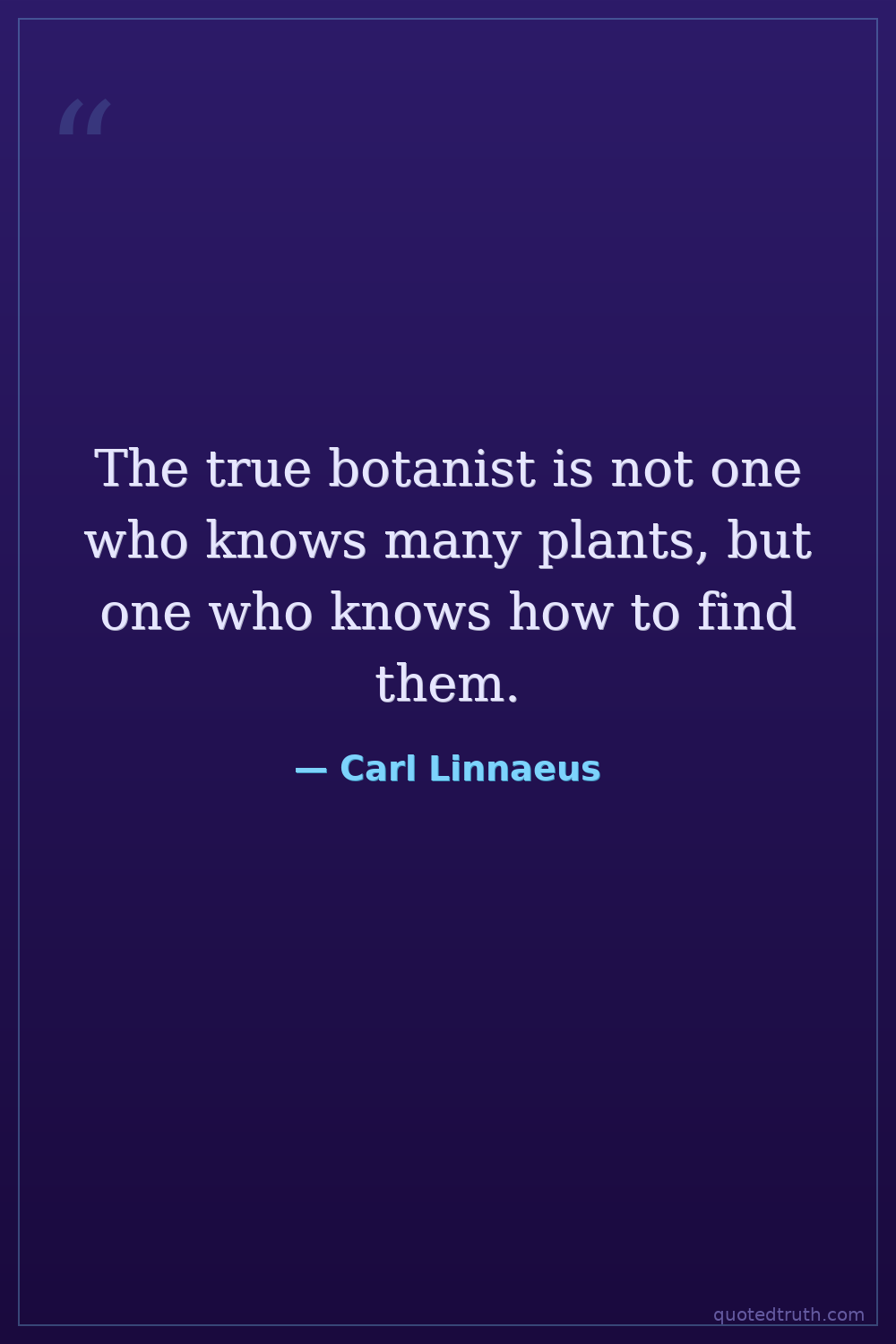
Carl Linnaeus — "The true botanist is not one who knows many plants, but one who knows how to fin…"
The true botanist is not one who knows many plants, but one who knows how to find them.
The true botanist is not one who knows many plants, but one who knows how to find them.
Click any product to generate a realistic preview. Up to 3 at a time.
* Initial load can take up to 90 seconds — revising the preview in another color is nearly instant.
"I have spent my life in the company of plants, and they have taught me more than men."
"All species of the same genus form a natural group, and all genera of the same order form a natural group."
"The whole of natural history depends on the accurate knowledge of species."
"I have established a new era in natural history."
"The Asiatic is haughty, greedy, and governed by opinions."
Swedish botanist and the father of modern taxonomy whose Systema Naturae (1735) introduced binomial nomenclature for naming all species. Closely associated with Joseph Banks (British naturalist who carried Linnaean classification on Cook's voyages). For an intellectual contrast, see Comte de Buffon, French naturalist and Histoire Naturelle author (1749-1788) — Buffon explicitly attacked Linnaean fixed-categories taxonomy as artificial and rejected the binomial system; his gradualist, environment-shaped natural history was the explicit alternative. Anticipates the fixed-species-vs-evolution debate Darwin would later resolve.
A statement emphasizing the skill of observation and discovery over mere memorization.
Date: Uncertain (attributed)
WisdomFound in 1 providers: gemini
1 source checked
Real expertise isn't about memorizing a catalog of known things — it's about possessing the method and perceptual skill to identify and locate specimens in nature. A practitioner who can navigate uncertainty, apply systematic reasoning, and recognize patterns in the field is more valuable than one who merely recalls what others have cataloged. Methodology and the capacity for inquiry outrank static accumulated knowledge.
Linnaeus built his reputation on fieldwork — his 1732 Lapland journey covered thousands of miles. He trained a generation of apostles including Daniel Solander and Carl Peter Thunberg, dispatching them worldwide to discover and classify new species. His binomial nomenclature system was explicitly a tool for systematic identification, not mere naming. He valued botanists who could navigate unknown specimens to a classification over those who simply memorized existing catalogs.
Linnaeus lived during the Age of Exploration, when expeditions to the Americas, Asia, and Pacific were delivering thousands of undescribed species to European naturalists. Before his systematic reforms, botanical nomenclature was a chaotic tangle of inconsistent Latin phrases with no universal standard. The pressing scientific challenge was not accumulating more plant lists but developing reliable methods to classify novel organisms — his quote reflects this era's urgent demand for systematic methodology over encyclopedic collection.
AI-generated insights based on extensive research and information for context. Factual errors? Email [email protected].
Your cart is empty