What it means
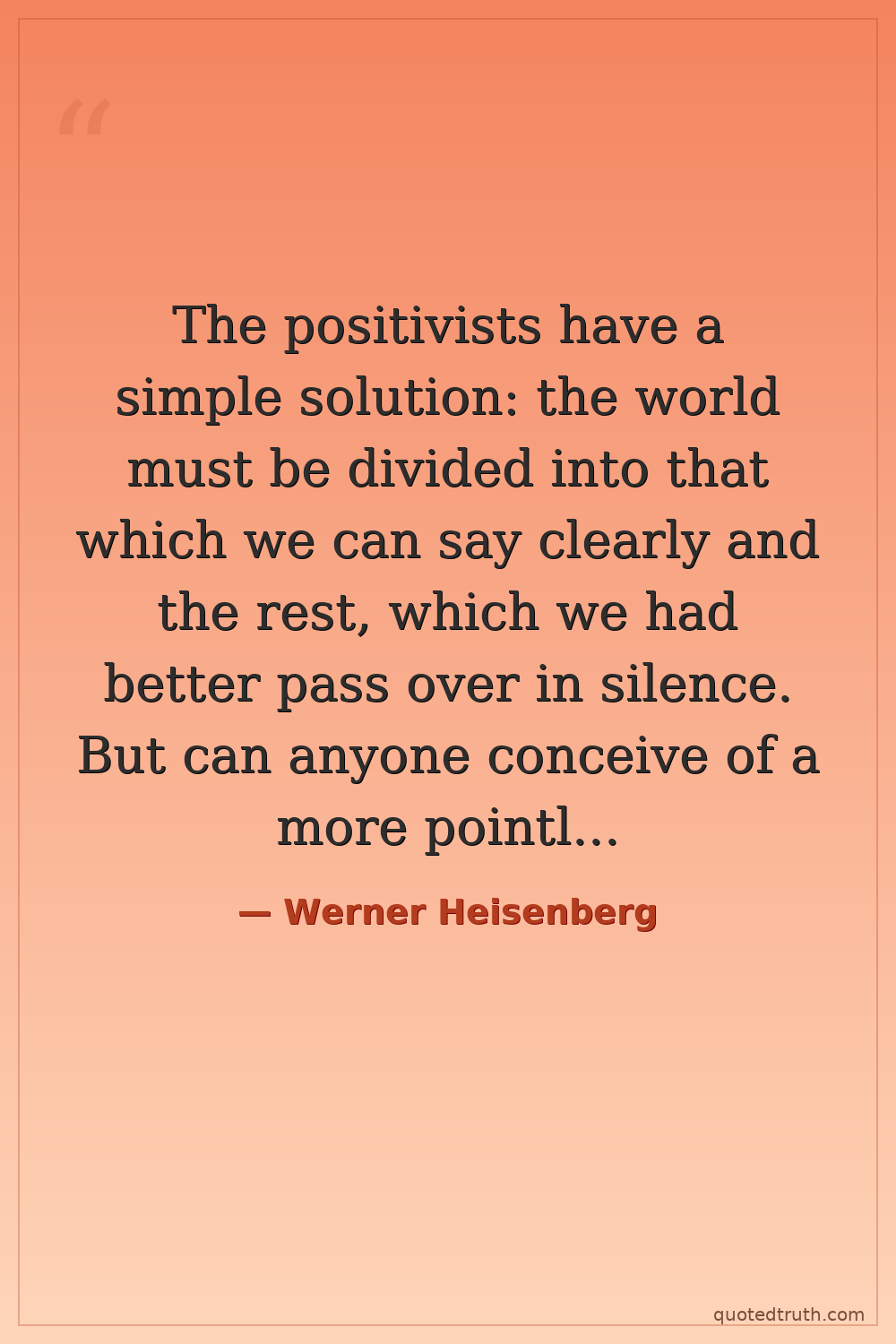
Heisenberg pushes back against the idea that we should only discuss topics we can describe with perfect precision and stay silent about everything else. He argues this approach is useless because the things we can state with total clarity are usually obvious, empty statements. The most meaningful questions about reality, meaning, and existence are inherently fuzzy, and refusing to engage with them leaves us with nothing worth saying.
Relevance to Werner Heisenberg
Heisenberg built his career on embracing uncertainty as fundamental, not as a flaw to eliminate. His uncertainty principle proved that position and momentum cannot both be known precisely, forcing physics to abandon classical clarity. He frequently debated philosophy with Bohr and Einstein, and wrote extensively on the limits of language in describing quantum reality. This quote directly challenges the Vienna Circle positivists who tried to restrict science to verifiable statements.
The era
Heisenberg worked during the rise of logical positivism, when thinkers like Wittgenstein and the Vienna Circle argued philosophy should abandon metaphysics and stick to empirically verifiable claims. Simultaneously, quantum mechanics was shattering classical certainty, revealing that subatomic reality defied clean description. Post-WWII Europe was also grappling with moral and existential questions that pure logic could not answer, making the positivist stance feel increasingly inadequate to lived human experience.
AI-generated insights based on extensive research and information for context. Factual errors? Email [email protected].