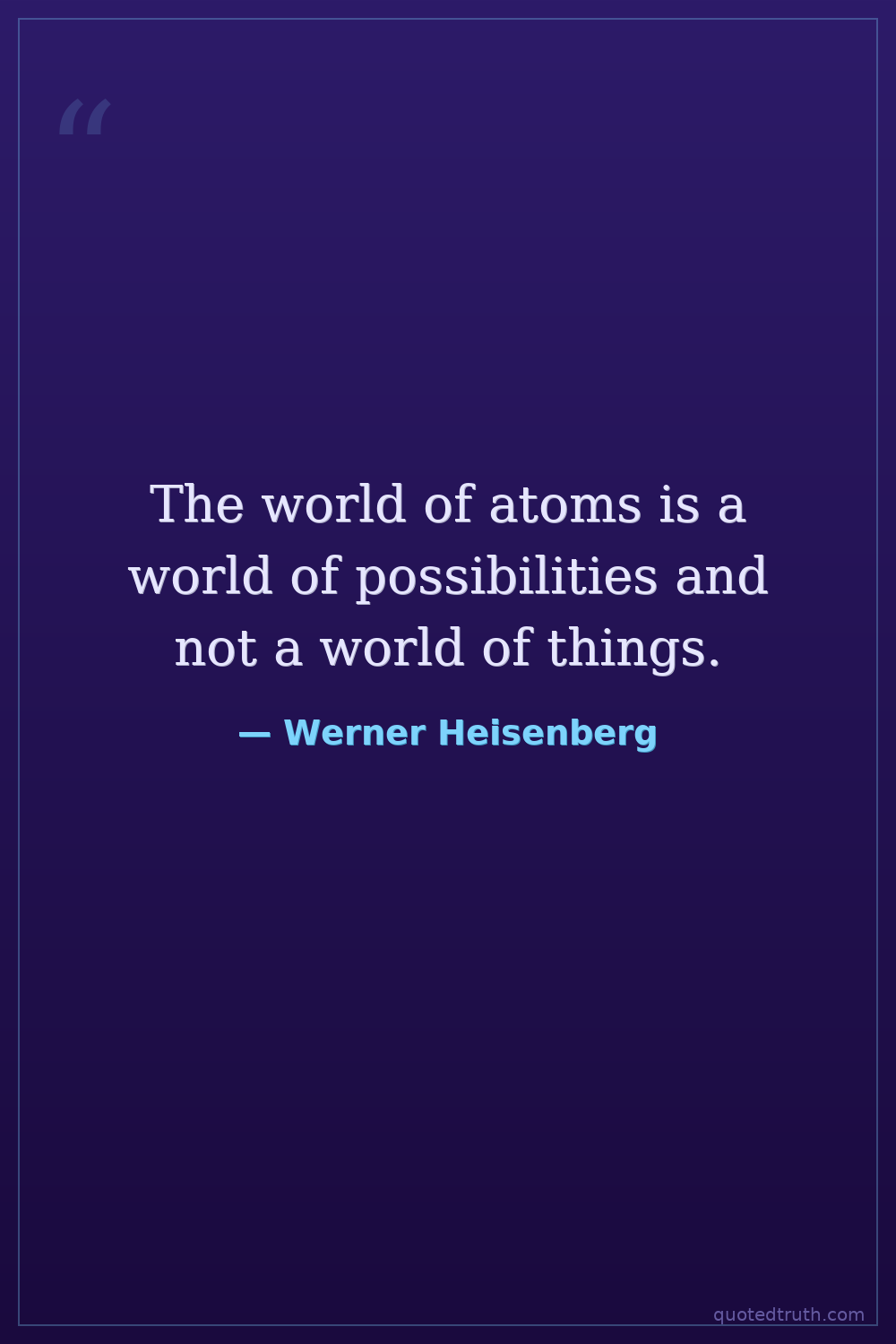
Werner Heisenberg — "The world of atoms is a world of possibilities and not a world of things."
The world of atoms is a world of possibilities and not a world of things.
The world of atoms is a world of possibilities and not a world of things.
Click any product to generate a realistic preview. Up to 3 at a time.
* Initial load can take up to 90 seconds — revising the preview in another color is nearly instant.
"Science is made by men, not by apparatus."
"The more profound the knowledge, the more clear is the awareness of the limits of our knowledge."
"I was forced to find a new way of expressing the fundamental laws of nature, one which would not rely on the outdated concepts of classical physics."
"The atoms or elementary particles themselves are not real; they form a world of potentialities or possibilities rather than one of things or facts."
"The more precise the measurement of position, the more imprecise the measurement of momentum, and vice versa."
Found in 1 providers: grok
1 source checked
Atoms don't behave like tiny solid balls sitting in fixed places. Instead, they exist as a spread of potential outcomes, and only when measured does one specific result emerge. Reality at the smallest scale isn't made of definite objects with exact positions and speeds, but of probabilities describing what could happen. The quote says the subatomic realm is fundamentally about chance and potential, not concrete stuff you can pin down.
Heisenberg formulated the uncertainty principle in 1927, proving you cannot simultaneously know a particle's position and momentum with precision. He co-founded matrix mechanics, rejecting classical visualizations of electron orbits in favor of observable quantities and probability amplitudes. This quote distills his lifelong philosophical stance, shaped by debates with Bohr at Copenhagen, that quantum theory describes tendencies rather than trajectories, earning him the 1932 Nobel Prize in Physics.
The early twentieth century shattered Newtonian certainty. Einstein's relativity bent space and time, while Planck, Bohr, Schrodinger, and Heisenberg built quantum mechanics between 1900 and 1930. Philosophers, artists, and physicists alike grappled with a universe that seemed indeterminate. Heisenberg also worked under Nazi Germany on its wartime nuclear program, and the postwar atomic age made questions about what matter truly is newly urgent for scientists and the public alike.
AI-generated insights based on extensive research and information for context. Factual errors? Email [email protected].
Your cart is empty