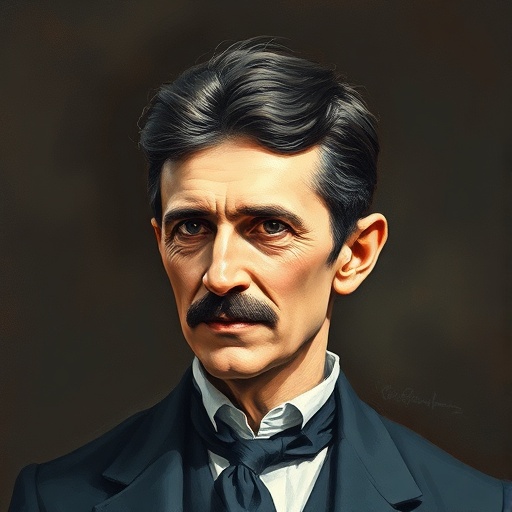
Nikola Tesla — "You may live to see man-made horrors beyond your comprehension."
You may live to see man-made horrors beyond your comprehension.
You may live to see man-made horrors beyond your comprehension.
Click any product to generate a realistic preview. Up to 3 at a time.
* Initial load can take up to 90 seconds — revising the preview in another color is nearly instant.
"That is the trouble with many inventors; they lack patience. They lack the willingness to work a thing out slowly and clearly and sharply in their mind, so that they can actually 'feel it work.' They …"
"I consider myself a very fortunate man, because I have been able to devote my entire life to the pursuit of knowledge and the service of humanity."
"The greatest discoveries have been made by men of science who have not been afraid to depart from the beaten path."
"The greatest discovery of all time will be the discovery of a new source of energy."
"I do not believe in the spirit of competition, but in the spirit of cooperation."
Serbian-American inventor and electrical engineer whose alternating-current designs powered the modern electrical grid; died poor and largely forgotten. Closely associated with George Westinghouse (his AC-power business partner) and Mihajlo Pupin (fellow Serbian-American physicist at Columbia). For an intellectual contrast, see Thomas Edison, American inventor and direct-current advocate — Edison's direct-current power-distribution scheme was displaced by Tesla-Westinghouse AC in the 1890s 'War of Currents'. Edison ran a public-relations campaign electrocuting animals to discredit AC — the most famous engineering-ethics rivalry in American history. Tesla's AC won and powers nearly every electrical grid on Earth.
A dark, prophetic, and somewhat dramatic statement, published in The New York Times.
Date: 1935
GeneralFound in 1 providers: gemini
1 source checked
Human creativity carries a dark shadow — unchecked invention breeds catastrophe. This warns that future generations will witness destruction caused entirely by human hands, horrors so extreme they defy current imagination. It's a sobering recognition that progress is not inherently good; the same minds that build civilization can unleash devastation at scales beyond comprehension. Technology amplifies human capacity for both creation and annihilation, and that balance is always precarious.
Tesla watched his own inventions — AC power, radio frequency, high-voltage transmission — immediately militarized. Later in life he developed 'teleforce,' a directed-energy death ray he believed could deter war by making invasion impossible. He survived WWI's industrial carnage and died months before atomic bombs fell. His genius coexisted with deep anxiety: he understood better than anyone that engineers create the tools history weaponizes.
Tesla's era spanned the late 19th century through 1943 — precisely when technology's destructive potential became undeniable. WWI introduced poison gas, aerial bombing, and industrial-scale slaughter. The 1930s brought totalitarian regimes, eugenics programs, and concentration camps. Nuclear fission was discovered in 1938. Tesla died in January 1943, months before Hiroshima, never witnessing the atomic age arrive — yet his warning proved hauntingly accurate about what human ingenuity would manufacture.
AI-generated insights based on extensive research and information for context. Factual errors? Email [email protected].
Your cart is empty