What it means
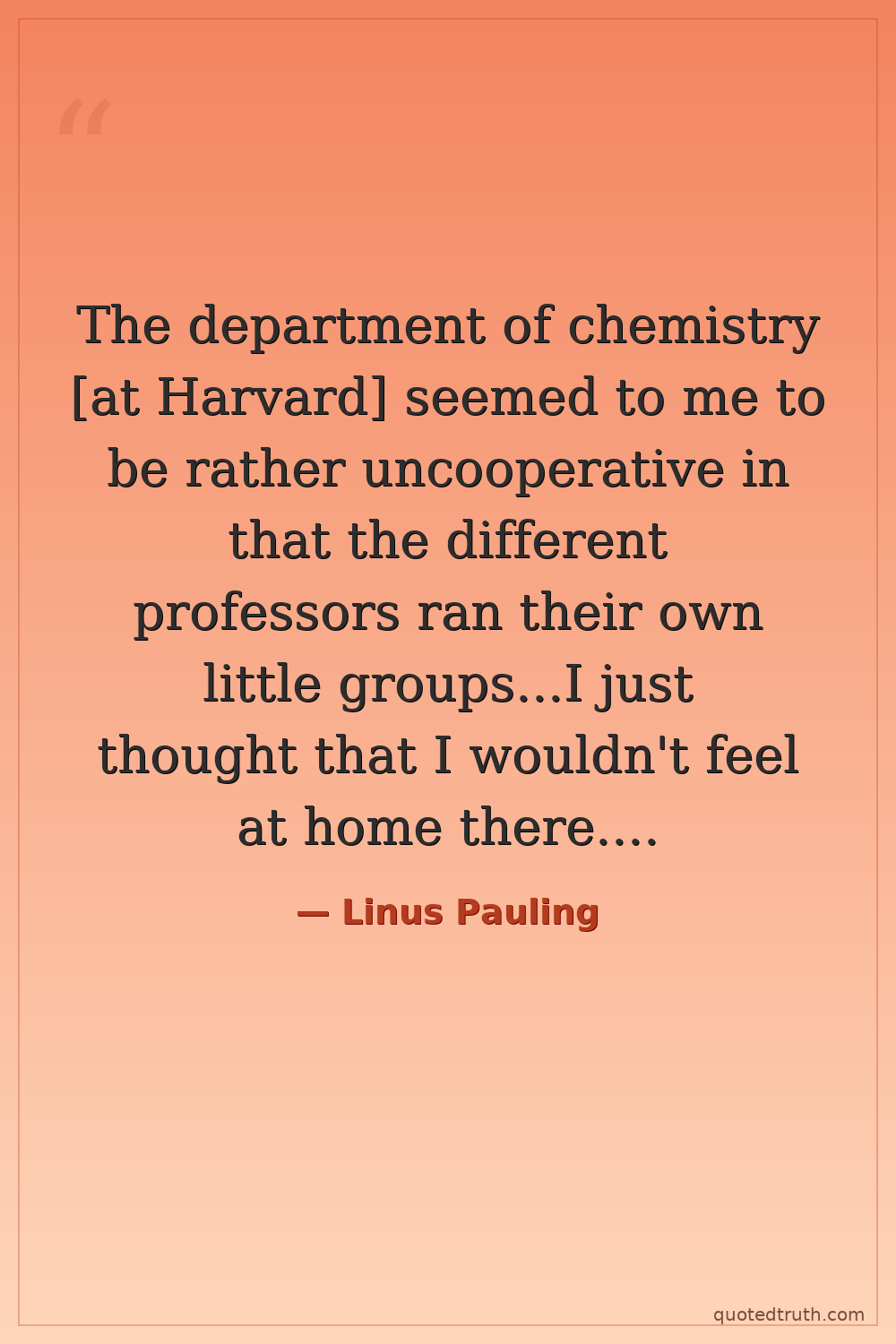
Pauling describes Harvard's chemistry department as fragmented into isolated, self-contained research groups with little cross-pollination between professors. Rather than an integrated intellectual community, he encountered a collection of competing fiefdoms. He recognized a silo culture — where faculty guard their own turf instead of sharing ideas — and concluded it wasn't an environment where he could thrive or feel creatively at home.
Relevance to Linus Pauling
Pauling spent his landmark career at Caltech, where cross-disciplinary collaboration flourished. His greatest breakthroughs — applying quantum mechanics to chemical bonding, decoding protein alpha-helices, pioneering molecular medicine — required bridging physics, chemistry, and biology simultaneously. A department of isolated empires would have constrained him fatally. His discomfort at Harvard reflects not mere preference but a deep professional identity built on synthesis across boundaries that others kept firmly separated.
The era
Mid-20th century American academia ran on a 'great man' model: elite professors commanded insular research empires with little incentive to collaborate. Harvard embodied this entrenched hierarchy. Yet the era was simultaneously witnessing the dawn of interdisciplinary science — quantum physics remaking chemistry, molecular biology emerging, the Manhattan Project proving what cross-disciplinary teams could accomplish. Pauling's unease captured the growing tension between old academic tribalism and the collaborative, boundary-crossing science that would define the century's biggest discoveries.
AI-generated insights based on extensive research and information for context. Factual errors? Email [email protected].