Linus Pauling — "I have come to the conclusion that the proper way to live is to be kind to every…"
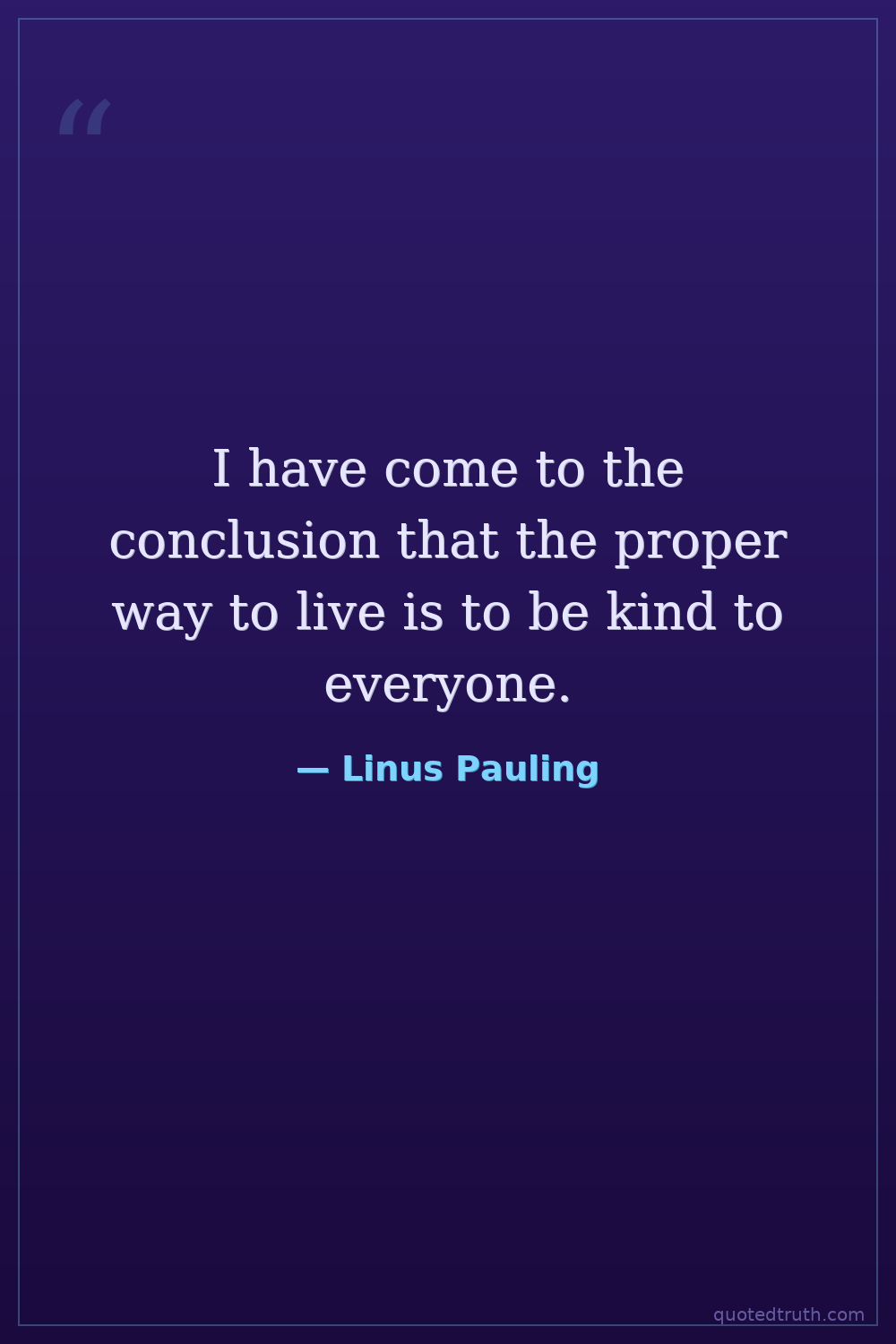
I have come to the conclusion that the proper way to live is to be kind to everyone.
I have come to the conclusion that the proper way to live is to be kind to everyone.
Click any product to generate a realistic preview. Up to 3 at a time.
* Initial load can take up to 90 seconds — revising the preview in another color is nearly instant.
"I might well have become egotistical as a result [of the Langmuir Prize].... But... I think that I just said I shouldn't let this go to my head. I shouldn't think I'm really better than other people e…"
"The most important thing in life is to be happy."
"I think that the human mind is capable of understanding almost anything."
"The world needs more scientists who are willing to speak out on important issues."
"I have always been a non-conformist."
Found in 1 providers: grok
1 source checked
After a lifetime of intellectual achievement, this saying distills life's purpose down to one simple principle: treat everyone with kindness, without exception. The phrase 'come to the conclusion' signals this is not naivety but a deliberate, reasoned judgment forged through long experience. It argues that no amount of status, discovery, or recognition matters more than how we treat other people in daily life.
Pauling earned two Nobel Prizes—Chemistry in 1954 for chemical bonding theory, Peace in 1962 for anti-nuclear activism—making him the only person to win two unshared Nobels. He risked his reputation organizing a 1957 petition signed by over 11,000 scientists opposing nuclear testing, endured McCarthy-era investigations, and sued a newspaper for defamation. His career arc from molecular science to global peace campaigning embodied his belief that intellectual achievement demands moral responsibility toward all people.
Pauling's most prominent activism occurred during the Cold War's peak, when US and Soviet nuclear arsenals capable of ending civilization were expanding rapidly. McCarthyism suppressed American dissent, and scientists faced intense pressure to remain politically silent. Against that backdrop of institutionalized fear, ideological hatred, and nuclear brinkmanship, a Nobel laureate publicly concluding that universal kindness is life's proper foundation was a direct, courageous rebuke to the hostility defining the era.
AI-generated insights based on extensive research and information for context. Factual errors? Email [email protected].
Your cart is empty