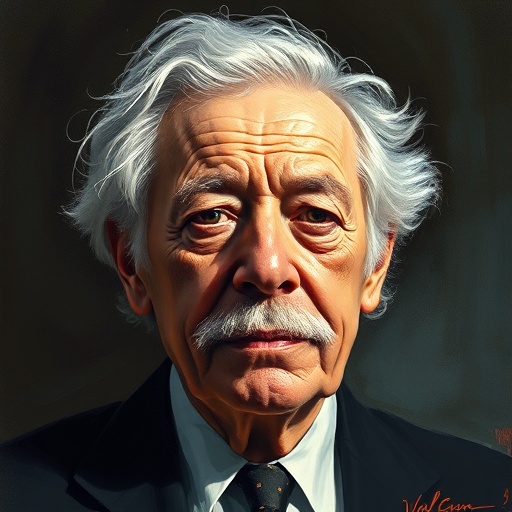
Linus Pauling — "You can't just have a good idea. You have to have a lot of good ideas."
You can't just have a good idea. You have to have a lot of good ideas.
You can't just have a good idea. You have to have a lot of good ideas.
Click any product to generate a realistic preview. Up to 3 at a time.
* Initial load can take up to 90 seconds — revising the preview in another color is nearly instant.
"I am not afraid to be wrong, because I know that I can learn from my mistakes."
"I am convinced that we can abolish war, and that we must do so if we are to survive."
"I think that the formation of [DNA's] structure by Watson and Crick may turn out to be the greatest developments in the field of molecular genetics in recent years."
"Orthomolecular medicine is the preservation of good health and the treatment of disease by varying the concentrations of substances normally present in the body."
"The greatest discoveries are often made by individuals who are not afraid to challenge the existing paradigms."
Found in 1 providers: grok
1 source checked
Innovation isn't a lightning-strike moment — it requires relentless output. Most ideas fail, get superseded, or turn out wrong. The creative process demands volume: generating dozens of possibilities increases the odds that a few genuinely transformative ones emerge. Waiting for a single perfect idea is a recipe for stagnation. Prolific thinking, not selective thinking, is the engine of genuine discovery.
Pauling published over 1,000 scientific papers across chemistry, molecular biology, and medicine — one of the most prolific scientists of the 20th century. He won Nobel Prizes in both Chemistry (1954) and Peace (1962). His breakthroughs — electronegativity scales, the alpha helix, chemical bond hybridization — came from sustained high-volume theorizing. Even his controversial vitamin C megadose advocacy reflected a lifelong willingness to generate and test ideas relentlessly, regardless of consensus.
Mid-20th century science operated at unprecedented scale. Post-WWII funding flooded research universities and national labs, creating intense pressure to publish and innovate constantly. Pauling worked during the race to decode DNA — Watson and Crick beat his proposed triple-helix model in 1953 — and the Cold War arms buildup he publicly opposed. Scientific reputations were increasingly defined by sustained bodies of work, not single breakthroughs, making high idea-volume strategically essential.
AI-generated insights based on extensive research and information for context. Factual errors? Email [email protected].
Your cart is empty