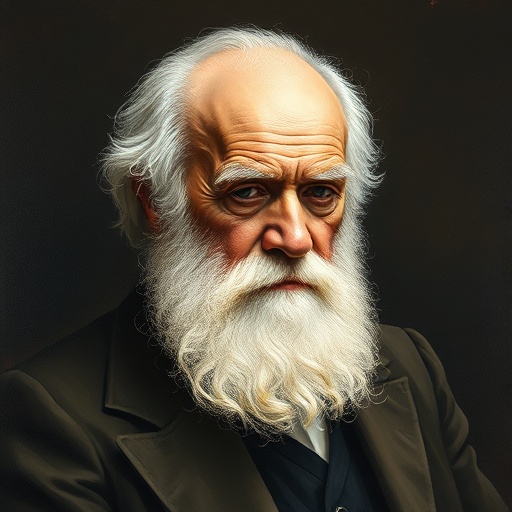
Charles Darwin — "The difference in mind between man and the higher animals, great as it is, certa…"
The difference in mind between man and the higher animals, great as it is, certainly is one of degree and not of kind.
The difference in mind between man and the higher animals, great as it is, certainly is one of degree and not of kind.
Click any product to generate a realistic preview. Up to 3 at a time.
* Initial load can take up to 90 seconds — revising the preview in another color is nearly instant.
"I confess I am not much interested in the future, for I am too much occupied with the present."
"Ultimately, the universe must be the outcome of chance."
"If a man were to read a book on the cultivation of fruit trees, and then attempt to practice it without having seen a single tree, he would not be more unsuccessful than those who attempt to philosoph…"
"I have been much struck by the fact that the more I have read about the subject, the less I have understood it."
"I have no great quickness of apprehension or wit which is so remarkable in some clever men."
British naturalist whose On the Origin of Species (1859) established evolution by natural selection — the unifying theory of modern biology. Closely associated with Thomas Henry Huxley (his 'bulldog' public defender) and Alfred Russel Wallace (independent co-discoverer of natural selection). For an intellectual contrast, see William Paley, Anglican theologian and Natural Theology author (1743-1805) — Origin of Species is structurally a 400-page reply to Paley — Darwin admired Paley's watchmaker-argument as an undergraduate at Cambridge and then spent 20 years building the empirical machinery to displace him. The cleanest 'design argument vs natural selection' founding rebuttal in science.
The standard scholarly entry points to Charles Darwin's work: Janet Browne (Harvard, history of science) — Charles Darwin: Voyaging (1995) and The Power of Place (2002); Adrian Desmond (UCL, biographer) — Darwin: The Life of a Tormented Evolutionist (1991, with James Moore). These are the works graduate seminars cite when teaching Charles Darwin.
Found in 1 providers: grok
1 source checked
Human intelligence and animal cognition aren't fundamentally different categories — they exist on a continuous spectrum. Animals experience emotions, memory, problem-solving, and social bonds much as humans do, only less elaborately. Humans aren't a separate kind of being with a uniquely divine mind; we're simply further along the same continuum. The gap is real but quantitative, not qualitative — a matter of more or less, not an entirely different type of thing.
Darwin spent decades studying animal behavior, culminating in his 1872 book documenting grief in dogs and joy in chimpanzees. Having demolished the biological boundary between humans and animals through natural selection, he logically extended the argument to mental faculties. This quote from 'The Descent of Man' (1871) was his most provocative claim — that human intellect evolved gradually rather than being divinely bestowed, a conclusion his own careful animal observations made unavoidable.
In the 1870s, human reason was considered God-given — the one quality definitively separating humanity from 'brute' animals. Darwin's 1859 'Origin of Species' challenged bodily evolution, but extending natural selection to the human mind was far more explosive. Victorian society built its moral and religious frameworks on human uniqueness. This claim directly threatened church authority, established philosophy, and social hierarchy, sparking fierce public debate among scientists, clergy, and intellectuals across Britain and beyond.
AI-generated insights based on extensive research and information for context. Factual errors? Email [email protected].
Your cart is empty