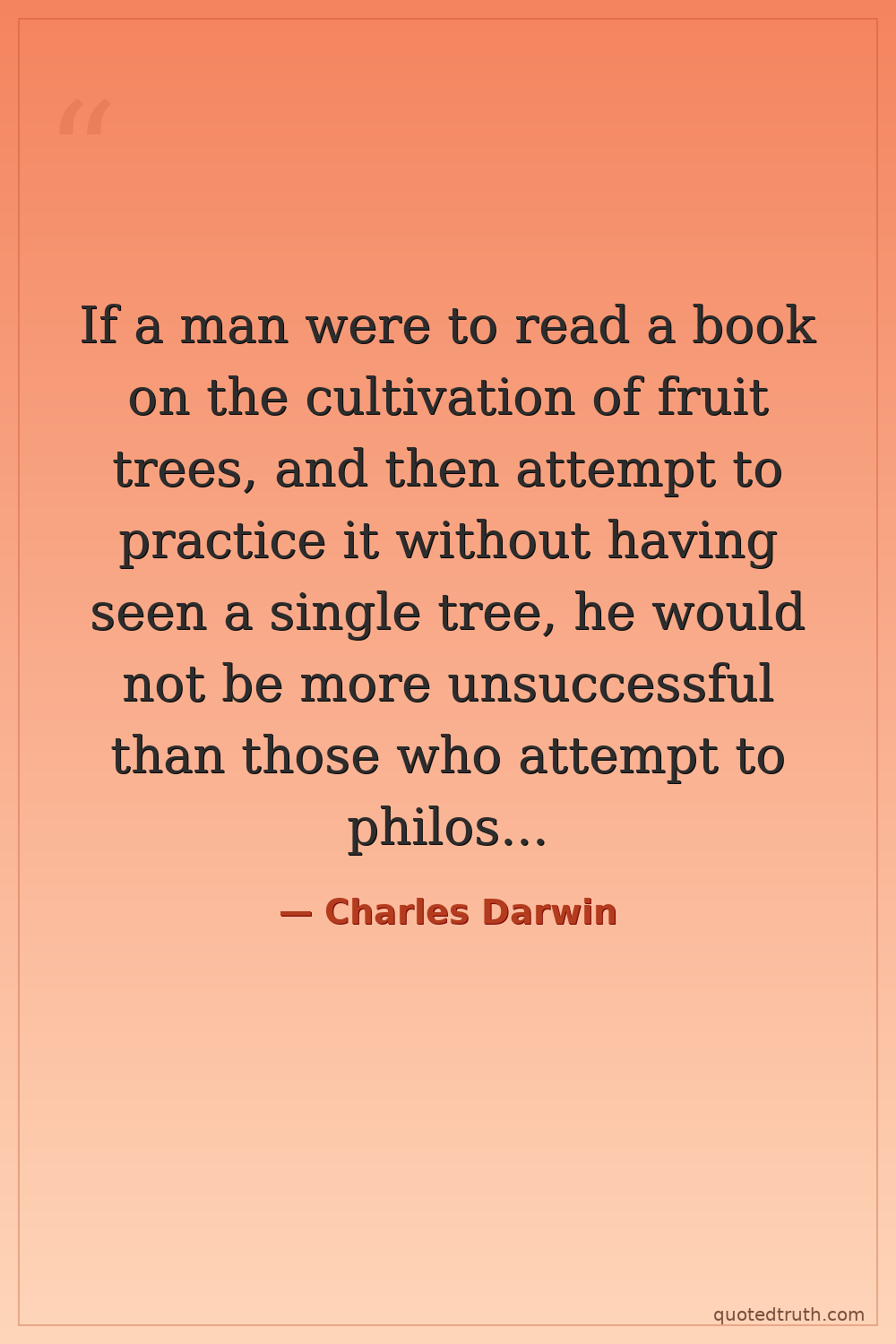
Charles Darwin — "If a man were to read a book on the cultivation of fruit trees, and then attempt…"

If a man were to read a book on the cultivation of fruit trees, and then attempt to practice it without having seen a single tree, he would not be more unsuccessful than those who attempt to philosophise on the causes of things without having made any observations.
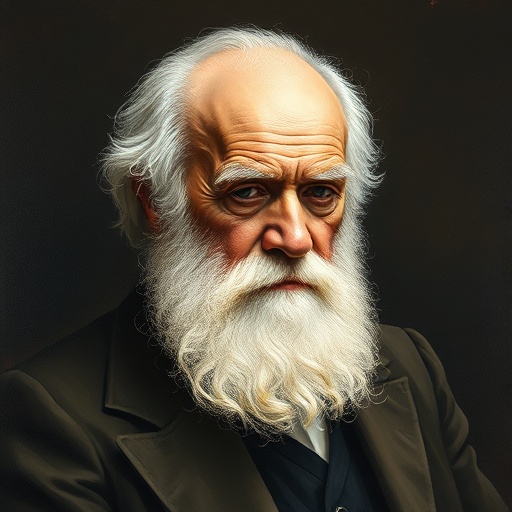
Charles Darwin — Charles Darwin Modern · Theory of evolution

Get This Quote & Author's Image Illustrated On:

Click any product to generate a realistic preview. Up to 3 at a time.
* Initial load can take up to 90 seconds — revising the preview in another color is nearly instant.

Kitchen

Apparel

Other

About Charles Darwin (1809-1882)

British naturalist whose On the Origin of Species (1859) established evolution by natural selection — the unifying theory of modern biology. Closely associated with Thomas Henry Huxley (his 'bulldog' public defender) and Alfred Russel Wallace (independent co-discoverer of natural selection). For an intellectual contrast, see William Paley, Anglican theologian and Natural Theology author (1743-1805) — Origin of Species is structurally a 400-page reply to Paley — Darwin admired Paley's watchmaker-argument as an undergraduate at Cambridge and then spent 20 years building the empirical machinery to displace him. The cleanest 'design argument vs natural selection' founding rebuttal in science.

The standard scholarly entry points to Charles Darwin's work: Janet Browne (Harvard, history of science) — Charles Darwin: Voyaging (1995) and The Power of Place (2002); Adrian Desmond (UCL, biographer) — Darwin: The Life of a Tormented Evolutionist (1991, with James Moore). These are the works graduate seminars cite when teaching Charles Darwin.

Details

Emphasizing the importance of empirical observation.

Date: c. 1830s

General

Verification

Unverifiable

Found in 1 providers: grok

1 source checked

Understanding this quote

What it means

Pure theoretical reasoning without direct observation is as futile as trying to cultivate fruit trees from a manual alone, without ever touching soil or seeing a living tree. Nature does not yield to armchair philosophy. Understanding causes requires encountering actual evidence. Ideas built from logic alone, untethered from observable reality, will fail just as reliably in science as they do in farming.

Relevance to Charles Darwin

Darwin spent five years aboard the HMS Beagle (1831–1836) cataloguing specimens across South America and the Galápagos. He later spent eight years dissecting barnacles and years breeding pigeons to study inheritance. Every element of his evolution theory rested on thousands of direct observations accumulated before he published in 1859. He distrusted grand theories unsupported by physical evidence, repeatedly testing ideas against real specimens before committing them to paper.

The era

In the early-to-mid 19th century, natural philosophy was dominated by gentlemen scholars theorizing from libraries rather than fieldwork. Darwin's generation confronted this tradition as geology and biology professionalized around systematic observation. Natural theology held that God's design could be reasoned without investigation, while empiricists like Lyell used field evidence to overturn received wisdom. The intellectual battle between armchair speculation and rigorous observation defined Darwin's scientific moment.

AI-generated insights based on extensive research and information for context. Factual errors? Email [email protected].
Your Cart

Your cart is empty