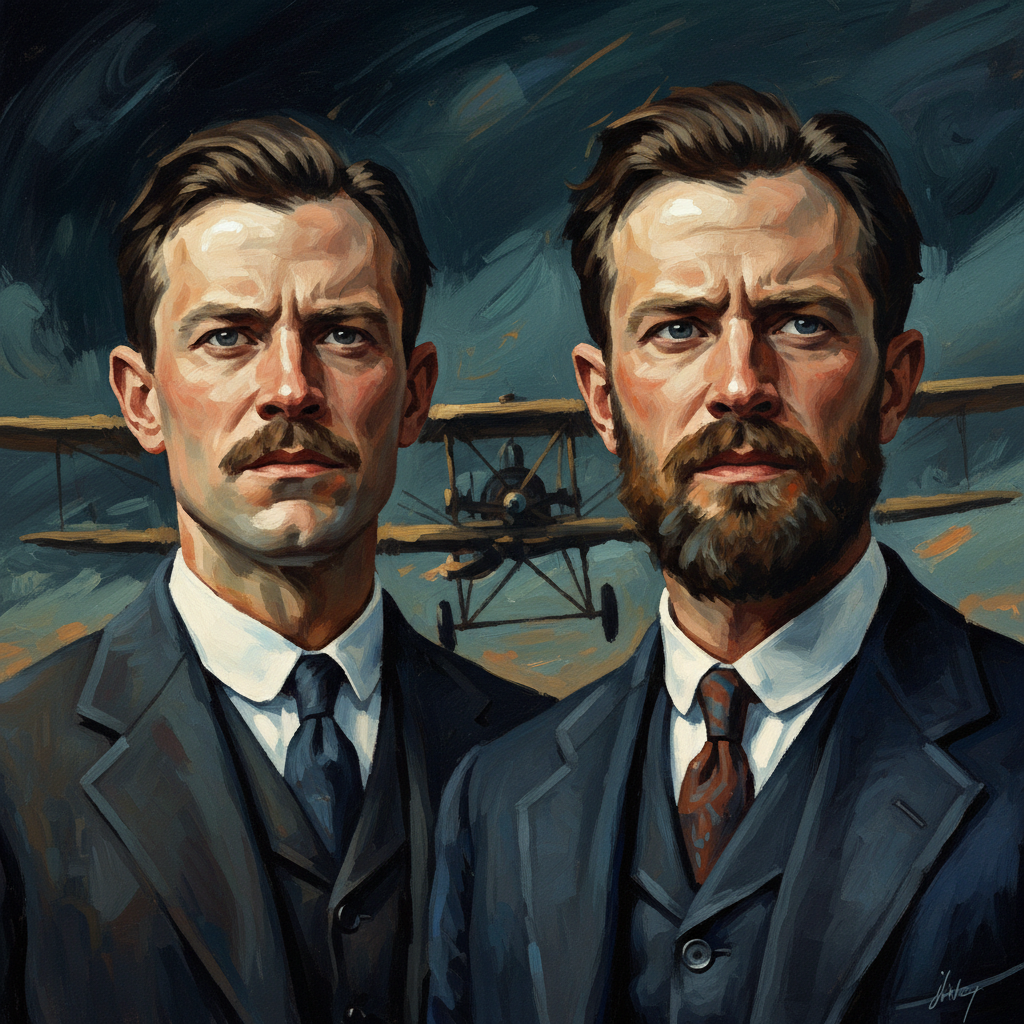
Wright Brothers (Orville & Wilbur) — "The difficulties of the problem are so great that few have dared to attack it."
The difficulties of the problem are so great that few have dared to attack it.
The difficulties of the problem are so great that few have dared to attack it.
Click any product to generate a realistic preview. Up to 3 at a time.
* Initial load can take up to 90 seconds — revising the preview in another color is nearly instant.
"The age of the flying machine is coming; it is not here yet, but it is coming."
"The Wright brothers flew right through the smoke screen of impossibility."
"The aeroplane will be a great factor in bringing together the different nations of the earth."
"We have hopes of making a flight of considerable length before long."
"We have been trying to make a machine that will fly, and we have succeeded."
American aviation pioneers who achieved the first sustained powered controlled airplane flight at Kitty Hawk, NC, on December 17, 1903. Closely associated with Octave Chanute (their gliding mentor and aeronautical correspondent). For an intellectual contrast, see Samuel Pierpont Langley, Smithsonian Institution Secretary and government-funded aviation researcher — Langley's Aerodrome crashed twice into the Potomac in October-December 1903 with $50,000 of War Department funding; the Wright Brothers' bicycle-shop empiricism beat Langley's institutional Big Science by 9 days. The most-cited example in engineering history of empirical-tinkerer beating institution-funded credentialism.
Found in 1 providers: grok
1 source checked
A challenge so formidable that most people refuse to even attempt it. The quote honestly acknowledges overwhelming difficulty while implying the speaker is among the rare few willing to engage regardless. There's no false confidence here—just clear-eyed recognition that hard problems drive most people away, and a quiet acceptance that this very scarcity of competitors makes the problem worth pursuing rather than avoiding.
Orville and Wilbur were self-taught bicycle mechanics who tackled heavier-than-air flight while credentialed engineers like Samuel Langley failed spectacularly. They studied every prior attempt, built their own wind tunnel, and identified the three-axis control problem others had ignored entirely. Without university degrees or government funding, they methodically dismantled an obstacle the scientific establishment had surrendered to, proving at Kitty Hawk in 1903 that courage to confront difficulty outweighs institutional prestige.
In the early 1900s, powered flight was broadly mocked as fantasy. The Smithsonian-backed Langley Aerodrome had publicly crashed twice in 1903, humiliating American science. The War Department dismissed flight proposals as impractical. Inventors who attempted aviation risked ridicule and financial ruin. This climate of expert skepticism and institutional dismissal made the problem doubly daunting—technically and socially—heightening the cultural weight of anyone willing to attack it seriously.
AI-generated insights based on extensive research and information for context. Factual errors? Email [email protected].
Your cart is empty