Wright Brothers (Orville & Wilbur) — "The aeroplane will be a great factor in bringing together the different nations …"
The aeroplane will be a great factor in bringing together the different nations of the earth.
The aeroplane will be a great factor in bringing together the different nations of the earth.
Click any product to generate a realistic preview. Up to 3 at a time.
* Initial load can take up to 90 seconds — revising the preview in another color is nearly instant.
"We were not looking for a fortune, but we were looking for a solution."
"The airplane stays up because it doesn’t have the time to fall."
"Instead of falling to the floor, as we expected, it flew across the room till it struck the ceiling, where it fluttered awhile, and finally sank to the floor."
"We did not find it necessary to use any of the formulas of the scientists, but we worked out our own formulas."
"We have not yet fully solved the problem of balance in high winds."
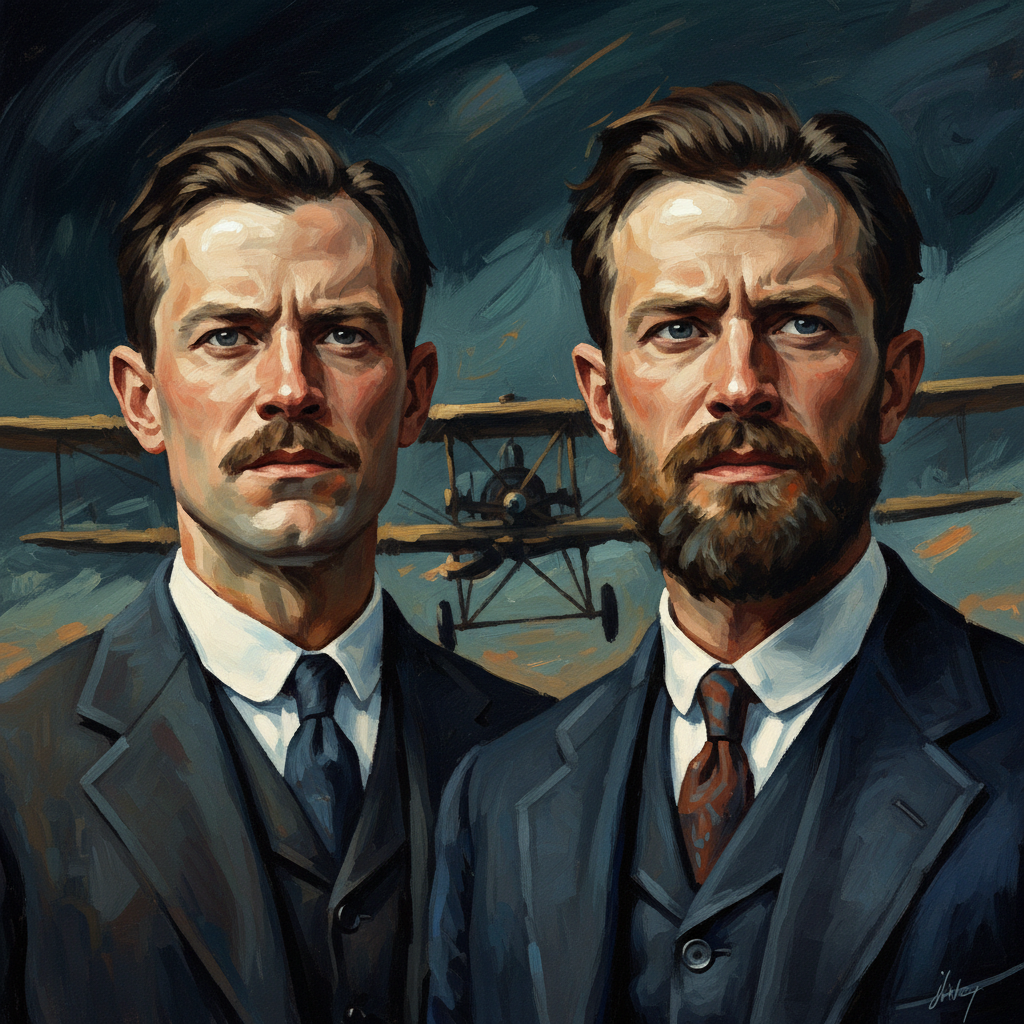
American aviation pioneers who achieved the first sustained powered controlled airplane flight at Kitty Hawk, NC, on December 17, 1903. Closely associated with Octave Chanute (their gliding mentor and aeronautical correspondent). For an intellectual contrast, see Samuel Pierpont Langley, Smithsonian Institution Secretary and government-funded aviation researcher — Langley's Aerodrome crashed twice into the Potomac in October-December 1903 with $50,000 of War Department funding; the Wright Brothers' bicycle-shop empiricism beat Langley's institutional Big Science by 9 days. The most-cited example in engineering history of empirical-tinkerer beating institution-funded credentialism.
Found in 1 providers: grok
1 source checked
Air travel would shrink distances between countries, letting people, goods, and ideas move across borders far faster than ships or trains allowed. By making the world feel smaller and more connected, flight would push nations into closer contact, encourage exchange and understanding, and weaken the isolation that geography once enforced. In short, the airplane is framed as a unifying technology that pulls separate peoples into a single, more interdependent global community.
The Wrights built and flew the first powered aircraft at Kitty Hawk in 1903, then spent years demonstrating it in Europe and signing contracts with the U.S., French, and German governments. Orville and Wilbur saw firsthand how crowds in Le Mans, Berlin, and Rome greeted their machine, convincing them their invention was not just an American novelty but a shared human achievement with diplomatic and commercial reach across continents.
In the early 1900s, travel between continents still meant week-long steamship voyages, and most people never left their home region. Telegraph and radio were young, empires were expanding, and nationalism was rising toward the tensions that produced World War I. Against that backdrop, a machine that could cross borders in hours seemed genuinely revolutionary, promising tourism, trade, and communication on a scale that might soften rivalries and knit distant populations together.
AI-generated insights based on extensive research and information for context. Factual errors? Email [email protected].
Your cart is empty