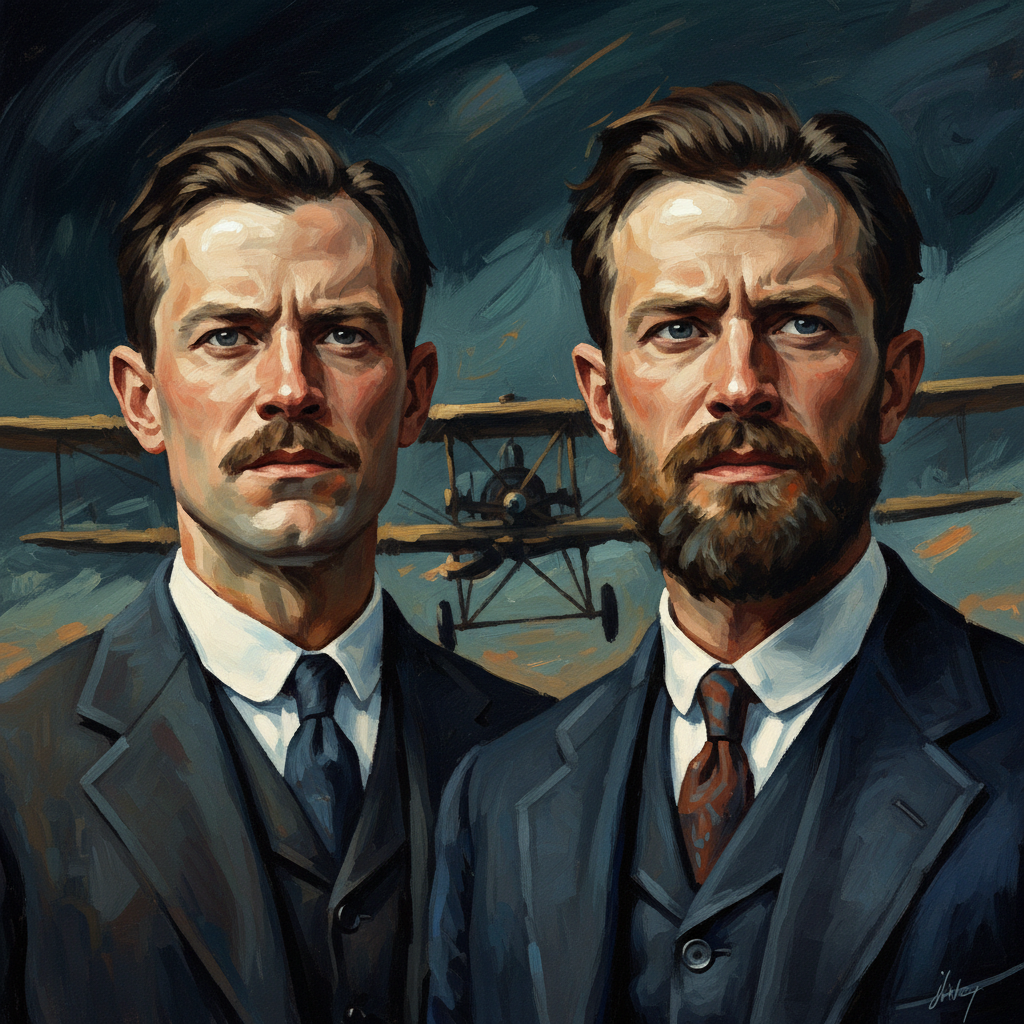
Wright Brothers (Orville & Wilbur) — "We have hopes of making a flight of considerable length before long."
We have hopes of making a flight of considerable length before long.
We have hopes of making a flight of considerable length before long.
Click any product to generate a realistic preview. Up to 3 at a time.
* Initial load can take up to 90 seconds — revising the preview in another color is nearly instant.
"The airplane has forced us into a new relationship with each other."
"The machine was not perfect, but it was a beginning."
"The difficulties of the problem are so great that few have dared to attack it."
"We have not been able to do much with the machine on account of the bad weather."
"I know of only one bird — the parrot — that talks; and it can't fly very high."
American aviation pioneers who achieved the first sustained powered controlled airplane flight at Kitty Hawk, NC, on December 17, 1903. Closely associated with Octave Chanute (their gliding mentor and aeronautical correspondent). For an intellectual contrast, see Samuel Pierpont Langley, Smithsonian Institution Secretary and government-funded aviation researcher — Langley's Aerodrome crashed twice into the Potomac in October-December 1903 with $50,000 of War Department funding; the Wright Brothers' bicycle-shop empiricism beat Langley's institutional Big Science by 9 days. The most-cited example in engineering history of empirical-tinkerer beating institution-funded credentialism.
Found in 1 providers: grok
1 source checked
Expressed with careful confidence rather than bravado, this captures the mindset of someone who knows success is within reach but refuses to overpromise. The speaker believes a significant breakthrough — not just a brief proof of concept but a genuinely extended, meaningful achievement — is imminent. It reflects disciplined optimism: grounded in real, measurable progress and systematic work, not wishful thinking or empty hype.
The Wright Brothers spent years methodically testing gliders before their first powered flight at Kitty Hawk in December 1903 — just 12 seconds, 120 feet. This quote mirrors their character exactly: patient, precise, never claiming more than they could demonstrate. Orville and Wilbur were bicycle mechanics who trusted systematic experimentation over inspiration, advancing step by calculated step toward sustained, controlled flight rather than chasing dramatic announcements.
In 1903, human-powered flight was widely dismissed as fantasy. Samuel Langley's government-funded Aerodrome had just crashed twice into the Potomac River, humiliating the scientific establishment. The press largely ignored Kitty Hawk. Meanwhile, railroads, telegraphs, and automobiles were transforming daily life, intensifying public hunger for the next impossible breakthrough. Against this backdrop of simultaneous skepticism and explosive industrial ambition, the brothers' measured hope for extended flight was quietly revolutionary.
AI-generated insights based on extensive research and information for context. Factual errors? Email [email protected].
Your cart is empty