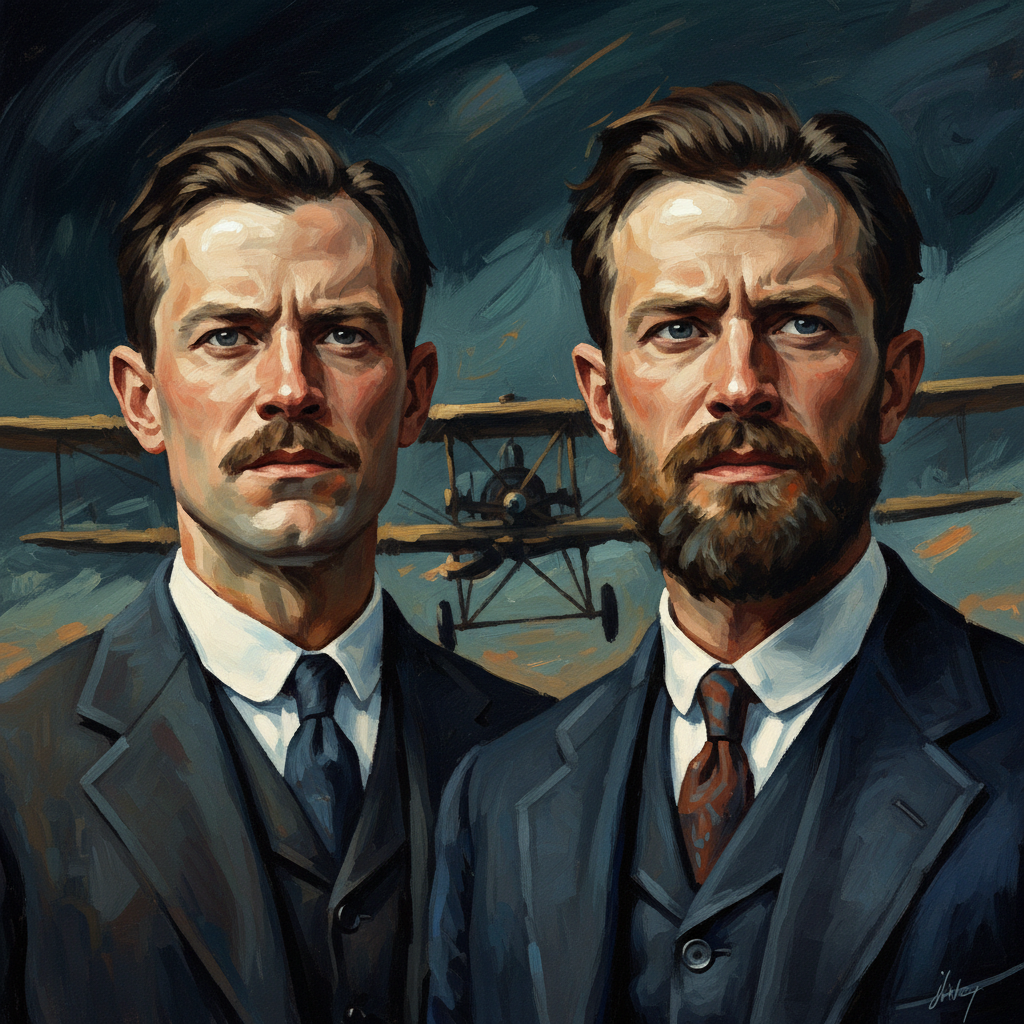
Wright Brothers (Orville & Wilbur) — "The difficulties were great, but our faith was greater."
The difficulties were great, but our faith was greater.
The difficulties were great, but our faith was greater.
Click any product to generate a realistic preview. Up to 3 at a time.
* Initial load can take up to 90 seconds — revising the preview in another color is nearly instant.
"The machine has been working very nicely and we have been making several flights each day."
"The machine is practically ready for its public demonstration."
"If we worked on the assumption that what is currently accepted as true really is true, then there would be little hope for advance."
"The first great principle of success in flying is to learn to soar without power."
"Learning the secret of flight from a bird was a good deal like learning the secret of magic from a magician."
American aviation pioneers who achieved the first sustained powered controlled airplane flight at Kitty Hawk, NC, on December 17, 1903. Closely associated with Octave Chanute (their gliding mentor and aeronautical correspondent). For an intellectual contrast, see Samuel Pierpont Langley, Smithsonian Institution Secretary and government-funded aviation researcher — Langley's Aerodrome crashed twice into the Potomac in October-December 1903 with $50,000 of War Department funding; the Wright Brothers' bicycle-shop empiricism beat Langley's institutional Big Science by 9 days. The most-cited example in engineering history of empirical-tinkerer beating institution-funded credentialism.
Found in 1 providers: grok
1 source checked
This statement acknowledges that pursuing any ambitious goal brings serious obstacles, setbacks, and doubt, but insists that inner conviction can outweigh those barriers. Rather than denying how hard something is, the speaker admits the difficulty openly and then affirms that belief in the mission, in the method, and in eventual success was stronger than every problem encountered. Persistence rooted in confidence, not luck or ease, carried the work through.
The Wrights spent years on bicycle-shop earnings building gliders, wind tunnels, and engines while established scientists insisted heavier-than-air flight was impossible. They endured crashes at Kitty Hawk, skeptical journalists, and Samuel Langley's publicly funded failures. Yet Wilbur and Orville kept refining wing-warping, propellers, and control systems through 1900-1903 until the December 17 flight. Their quiet, methodical Midwestern self-belief, with no university degrees or government grants, is exactly the faith-over-difficulty ethic this line captures.
At the turn of the twentieth century, powered flight was widely ridiculed as a fool's errand after Langley's Potomac crashes and centuries of failed attempts. The scientific establishment, newspapers, and even Scientific American doubted the Wrights for years after Kitty Hawk. This was also the age of the self-taught American inventor: Edison, Ford, and Bell showed that persistent tinkerers without formal credentials could reshape modern life, making such defiant faith culturally resonant and ultimately vindicated.
AI-generated insights based on extensive research and information for context. Factual errors? Email [email protected].
Your cart is empty