Wright Brothers (Orville & Wilbur) — "Learning the secret of flight from a bird was a good deal like learning the secr…"
Learning the secret of flight from a bird was a good deal like learning the secret of magic from a magician.
Learning the secret of flight from a bird was a good deal like learning the secret of magic from a magician.
Click any product to generate a realistic preview. Up to 3 at a time.
* Initial load can take up to 90 seconds — revising the preview in another color is nearly instant.
"We have hopes of making a flight of considerable length before long."
"The air, like the sea, is an untamed element."
"We have been able to keep the machine in the air for longer periods than ever before."
"We had taken up the invention of the flying machine as a sport."
"The Wright brothers flew right through the smoke screen of impossibility."
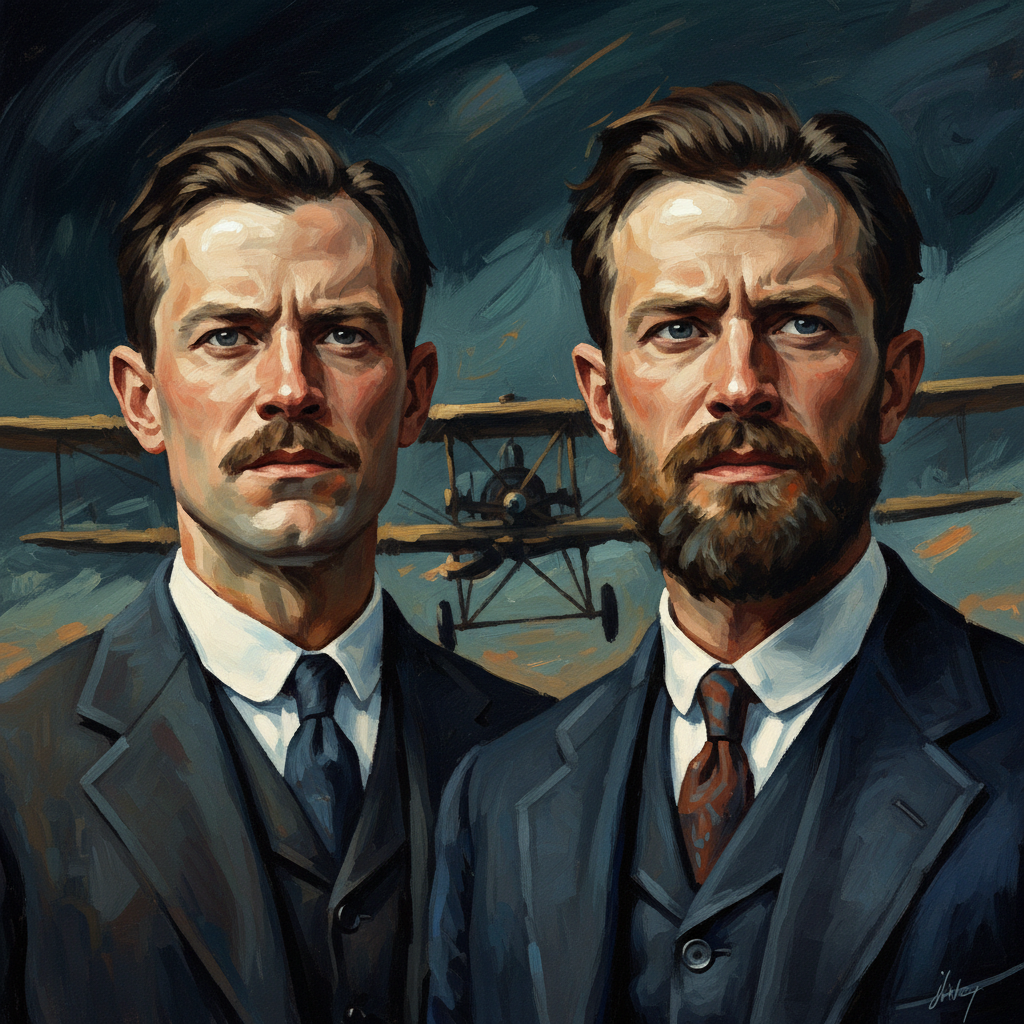
American aviation pioneers who achieved the first sustained powered controlled airplane flight at Kitty Hawk, NC, on December 17, 1903. Closely associated with Octave Chanute (their gliding mentor and aeronautical correspondent). For an intellectual contrast, see Samuel Pierpont Langley, Smithsonian Institution Secretary and government-funded aviation researcher — Langley's Aerodrome crashed twice into the Potomac in October-December 1903 with $50,000 of War Department funding; the Wright Brothers' bicycle-shop empiricism beat Langley's institutional Big Science by 9 days. The most-cited example in engineering history of empirical-tinkerer beating institution-funded credentialism.
Found in 1 providers: grok
1 source checked
Watching something work doesn't tell you how it works. Birds fly effortlessly, but their flight conceals the mechanical principles behind it — just as a magician's performance hides the technique. To truly understand flight, you can't just copy what you see; you have to uncover the invisible rules underneath. Real knowledge is never on the surface — it requires deeper investigation beyond simple observation.
The brothers studied bird flight extensively — Wilbur famously observed how buzzards twisted their wingtips to maintain balance, inspiring their wing-warping control system. But they didn't simply copy birds; they built wind tunnels, tested over 200 wing shapes, and derived their own lift equations. Their breakthrough came from engineering analysis, not mimicry. This quote reflects their core philosophy: systematic experimentation, not surface observation, unlocks nature's secrets.
In the late 1800s and early 1900s, many inventors raced to conquer flight by directly imitating birds — Otto Lilienthal died in an 1896 glider crash pursuing that approach. Samuel Langley's government-funded Aerodrome crashed into the Potomac just nine days before Kitty Hawk. The era assumed nature's secrets were visible. The Wrights' insight that observation alone was insufficient separated them from failed contemporaries and launched the aviation age.
AI-generated insights based on extensive research and information for context. Factual errors? Email [email protected].
Your cart is empty