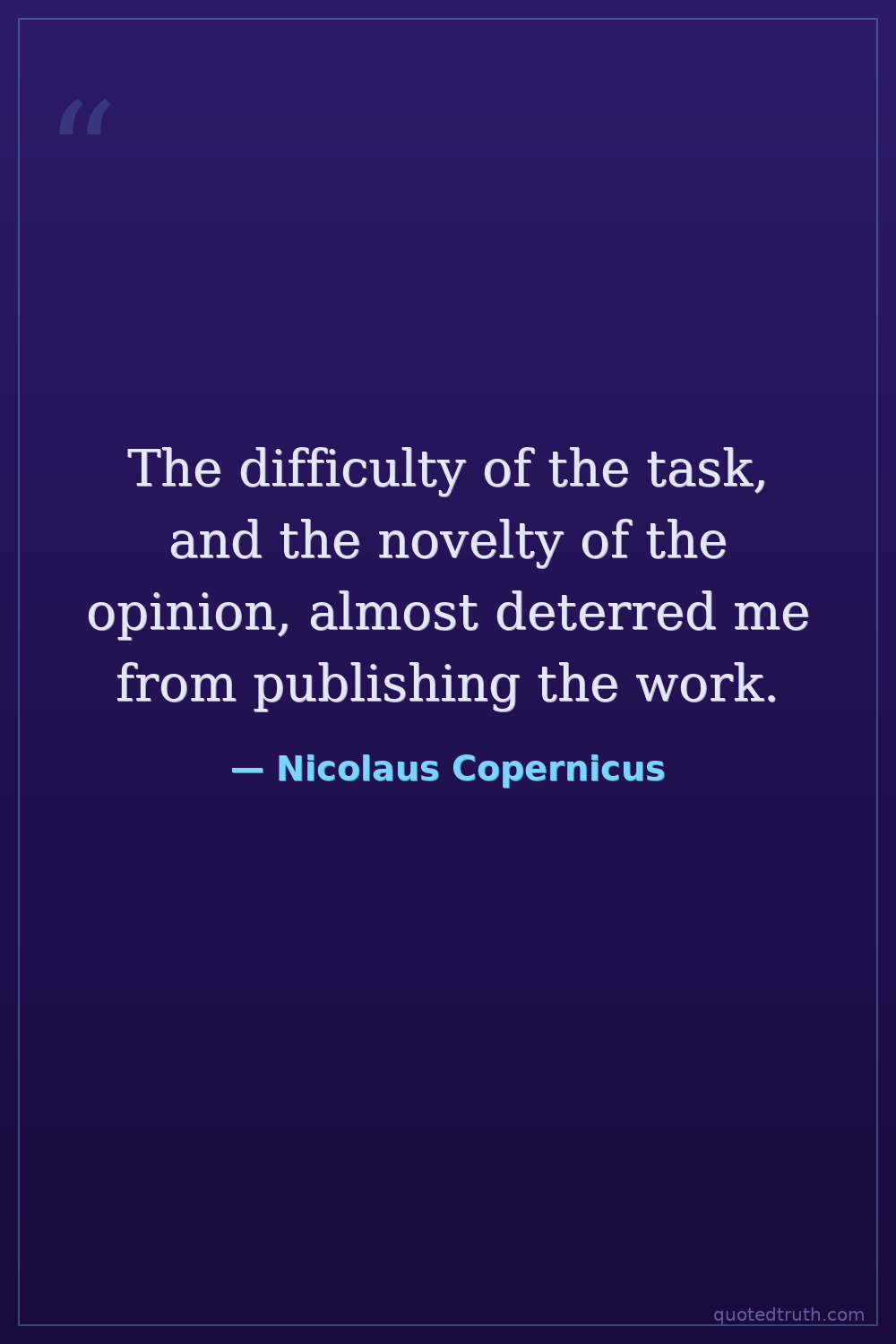
Nicolaus Copernicus — "The difficulty of the task, and the novelty of the opinion, almost deterred me f…"
The difficulty of the task, and the novelty of the opinion, almost deterred me from publishing the work.
The difficulty of the task, and the novelty of the opinion, almost deterred me from publishing the work.
Click any product to generate a realistic preview. Up to 3 at a time.
* Initial load can take up to 90 seconds — revising the preview in another color is nearly instant.
"The world is not a machine, but a living body, with a soul and a mind."
"But if anyone desires to judge these things not ignorantly but with skill and knowledge, he will find that what I have undertaken is in harmony with the best authorities, and that it is in no way oppo…"
"The massive bulk of the Earth does indeed shrink to insignificance in comparison with the size of the heavens."
"Having thus assumed the motions which I ascribe to the earth, I have, after long and careful investigation, finally discovered that, if the motions of the other planets be related to the revolution of…"
"For the world is spherical, and is bounded by a spherical surface."
Preface to De revolutionibus orbium coelestium (paraphrased sentiment)
Date: 1543
Art & CreativityFound in 1 providers: grok
1 source checked
He came close to never sharing his life's work with the world. The sheer complexity of calculating a sun-centered solar system — combined with how radically it departed from everything scholars believed — made him doubt whether to publish at all. He understood that genuinely new ideas invite ridicule and rejection, not just debate. It took decades and persistent encouragement from allies to finally release work he knew would overturn humanity's understanding of its place in the cosmos.
Copernicus spent roughly 30 years developing his heliocentric model before publishing De revolutionibus in 1543, the year he died — legend holds he first held the printed copy on his deathbed. A Catholic canon who risked Church censure, he had circulated a shorter manuscript privately around 1514 to gauge reaction before committing. His profession, faith, and scholarly reputation were all at stake. The quote captures his lifelong tension between intellectual conviction and the very real dangers of challenging orthodoxy.
In early 16th-century Europe, Ptolemy's Earth-centered cosmology had been scientific and theological consensus for over 1,400 years, enshrined in Church doctrine and Aristotelian philosophy taught at every university. The Protestant Reformation was fracturing Christendom, making Catholic authorities hypersensitive to any challenge to established truth. Scholars who contradicted received wisdom risked professional ruin and accusations of heresy. Galileo's later trial under the Inquisition proved Copernicus's caution was entirely rational, not mere timidity.
AI-generated insights based on extensive research and information for context. Factual errors? Email [email protected].
Your cart is empty