Alan Turing — "The digital computers of today are in principle exactly the same as the universa…"
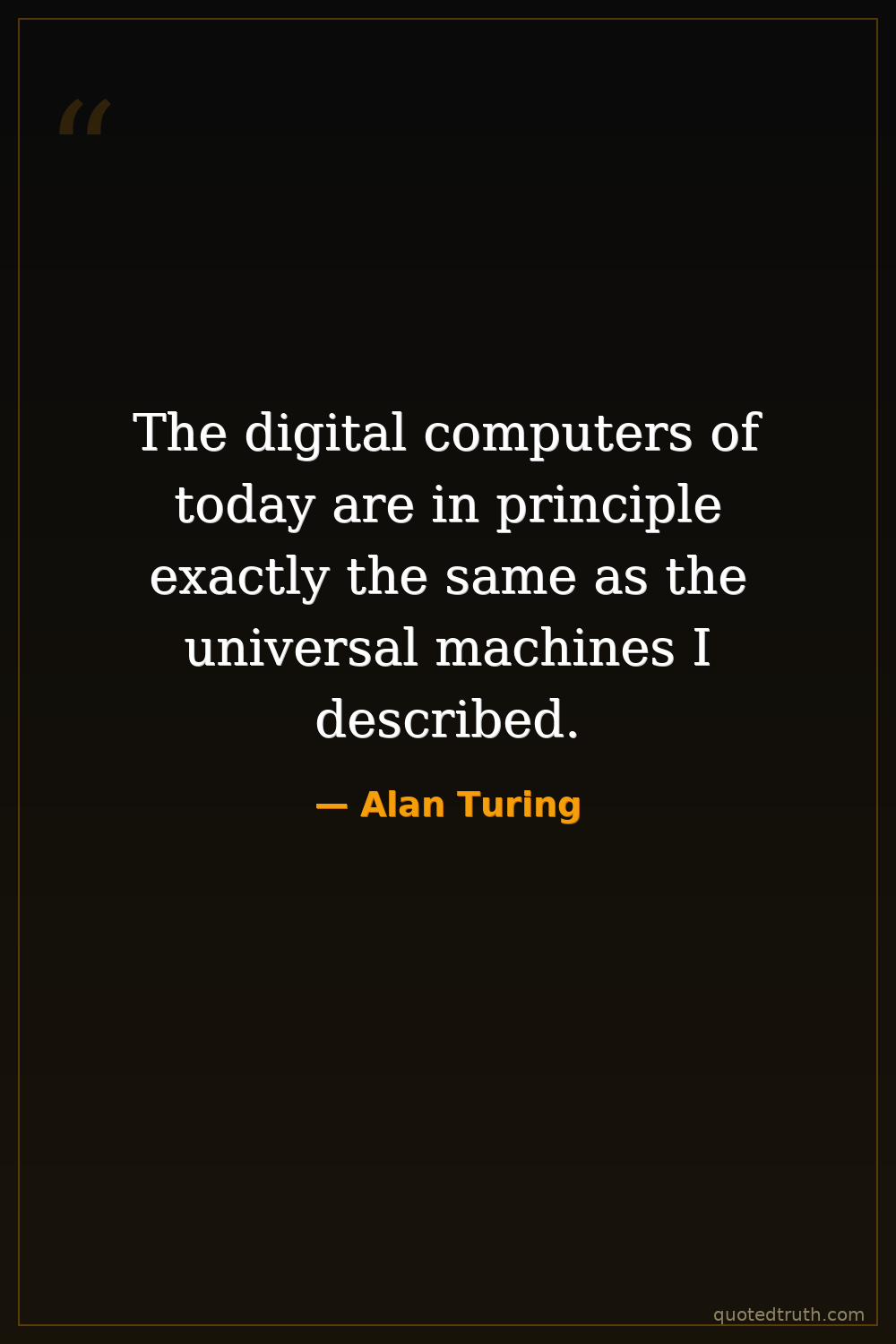
The digital computers of today are in principle exactly the same as the universal machines I described.
The digital computers of today are in principle exactly the same as the universal machines I described.
Click any product to generate a realistic preview. Up to 3 at a time.
* Initial load can take up to 90 seconds — revising the preview in another color is nearly instant.
"We are trying to create a machine that can solve problems."
"The idea of a 'thinking machine' is not so absurd as it seems."
"Arguments against the hope of artificial intelligence included that 'you will never be able to make [a machine] to do' any of these: Be kind, resourceful, beautiful, friendly, have initiative, have a …"
"The idea behind digital computers may be explained by saying that these machines are intended to carry out any operations which could be done by a human computer."
"The machine should be able to learn from experience."
Attributed, general understanding of his work, but precise quote is elusive.
Date: Approx. 1950s
ShockingFound in 1 providers: grok
1 source checked
Modern computers—regardless of their speed or size—operate on the same foundational logic Turing formalized in 1936: reading input, following instructions, writing output, repeating. His theoretical universal machine could simulate any computation given the right program. He's asserting that silicon chips and magnetic drums didn't change the underlying nature of computation—they only made his abstract idea physical, faster, and practical.
In his 1936 paper "On Computable Numbers," Turing invented the Universal Turing Machine—a theoretical device capable of performing any computation given the right instructions. When real computers emerged in the late 1940s, he worked directly on Britain's ACE at the National Physical Laboratory and later the Manchester Mark 1, recognizing them as physical realizations of his 1936 abstraction. His theory preceded the hardware by over a decade.
The late 1940s and early 1950s saw the first operational electronic computers—ENIAC, Manchester Baby, EDSAC—emerge from wartime research. These enormous vacuum-tube machines were reshaping science, cryptography, and military strategy during the early Cold War. Pioneers debated what computers fundamentally were and what limits they faced. Turing's remark grounded these new physical machines in pre-war theory, asserting that the conceptual architecture, not just the engineering, had already been solved in 1936.
AI-generated insights based on extensive research and information for context. Factual errors? Email [email protected].
Your cart is empty