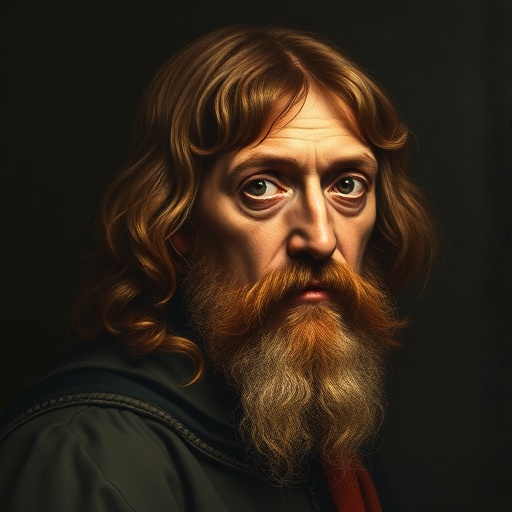
Nicolaus Copernicus — "The Earth also is not without a certain motion."
The Earth also is not without a certain motion.
The Earth also is not without a certain motion.
Click any product to generate a realistic preview. Up to 3 at a time.
* Initial load can take up to 90 seconds — revising the preview in another color is nearly instant.
"It is the duty of a good astronomer to seek for truth in all things, and to follow it wherever it may lead."
"The massive bulk of the Earth does indeed shrink to insignificance in comparison with the size of the heavens."
"For the universe, wrought for us by the best and most orderly Workman of all, is a wonderful work."
"Having thus assumed the motions which I ascribe to the earth, I have, after long and careful investigation, finally discovered that, if the motions of the other planets be related to the revolution of…"
"The world is not a machine, but a living body, with a soul and a mind."
Found in 1 providers: deepseek
1 source checked
Earth moves — it is not the fixed, stationary center of the universe everyone assumed. The phrase "a certain motion" is deliberately understated for what is actually a radical claim: Earth orbits the Sun and rotates on its axis. The careful, hedging language softens an idea that upended over a thousand years of accepted cosmology, quietly insisting that human beings are not standing still at creation's center.
Copernicus spent decades refining his heliocentric model before publishing De Revolutionibus in 1543, the year he died. A Catholic canon with training in medicine and law, he understood the risks of contradicting Church-endorsed Ptolemaic cosmology. He withheld publication for roughly thirty years. That caution echoes in the understatement here — "not without a certain motion" rather than "the Earth moves." He knew the idea was explosive and chose language accordingly.
For fourteen centuries, Ptolemy's geocentric model — Earth fixed and motionless at the universe's center — was accepted as physical and scriptural truth. Aristotelian philosophy reinforced it; the Church relied on it. In early-16th-century Europe, the Renaissance was dismantling ancient authorities in art and anatomy, yet the Reformation simultaneously made religious institutions more defensive. Asserting Earth's motion challenged both science and scripture, which explains why even Copernicus framed the idea with maximum caution.
AI-generated insights based on extensive research and information for context. Factual errors? Email [email protected].
Your cart is empty