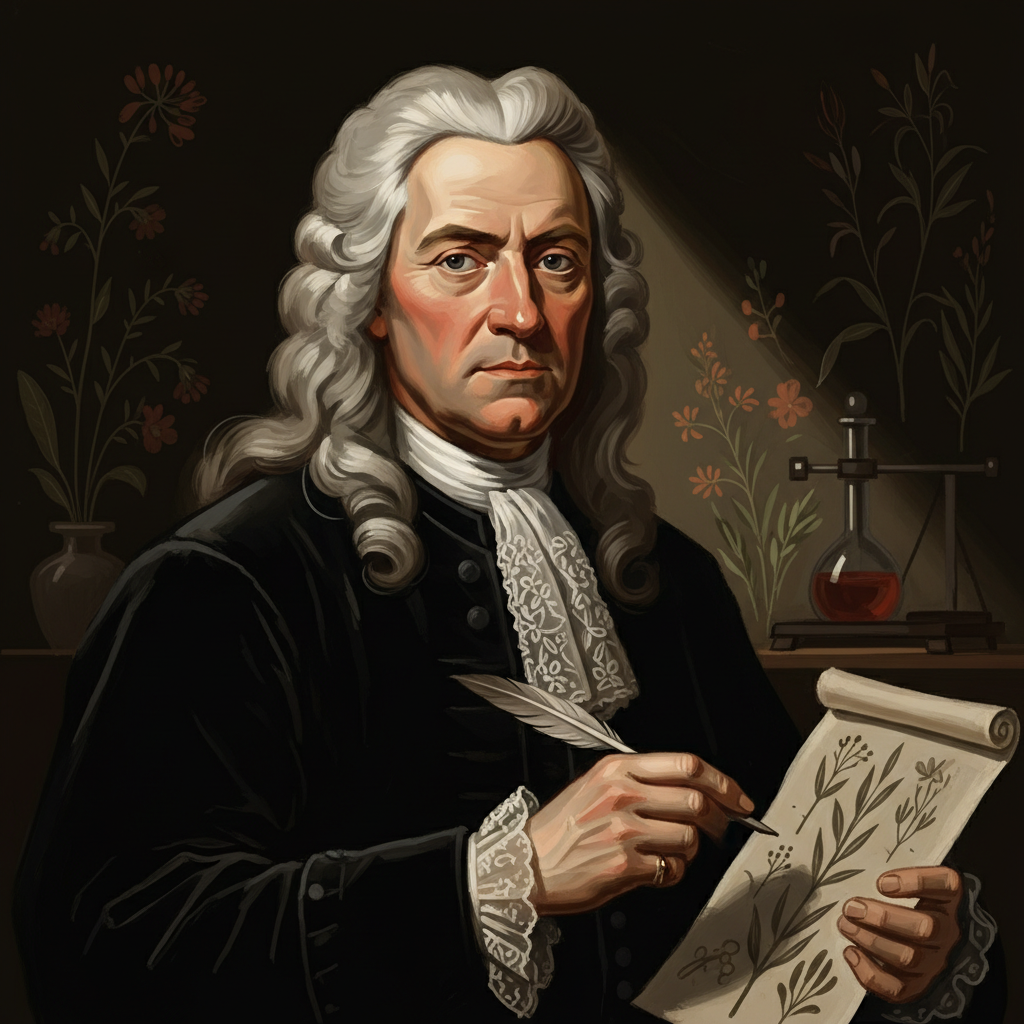
Carl Linnaeus — "The European is inventive, governed by laws, and wears tight clothing."
The European is inventive, governed by laws, and wears tight clothing.
The European is inventive, governed by laws, and wears tight clothing.
Click any product to generate a realistic preview. Up to 3 at a time.
* Initial load can take up to 90 seconds — revising the preview in another color is nearly instant.
"Every genus is natural, created as such in the beginning, hence not to be rashly split up or stuck together by whim or according to anyone's theory."
"The study of nature will reveal the divine order of creation."
"The earth is the theatre of God's glory."
"I was born on a farm, and I have always loved the countryside."
"The system of nature is a great chain of being."
Swedish botanist and the father of modern taxonomy whose Systema Naturae (1735) introduced binomial nomenclature for naming all species. Closely associated with Joseph Banks (British naturalist who carried Linnaean classification on Cook's voyages). For an intellectual contrast, see Comte de Buffon, French naturalist and Histoire Naturelle author (1749-1788) — Buffon explicitly attacked Linnaean fixed-categories taxonomy as artificial and rejected the binomial system; his gradualist, environment-shaped natural history was the explicit alternative. Anticipates the fixed-species-vs-evolution debate Darwin would later resolve.
Found in 1 providers: deepseek
1 source checked
Linnaeus used this line to categorize Europeans as a human variety defined by cultural and behavioral traits—inventiveness, legal governance, and distinctive dress. Reflecting early scientific racism, it assumes that group-level behavioral and cognitive traits are inherent to geographic populations. The mundane detail about tight clothing shows how he blended cultural observation with biological classification, treating European norms as natural attributes rather than contingent historical outcomes.
Linnaeus published this in Systema Naturae (1758), his landmark taxonomic work sorting Homo sapiens into four geographic varieties. His career was built on ordering nature into hierarchical categories—kingdom, class, order, genus, species—and he applied the same impulse to humans, assigning behavioral traits alongside physical ones. As a devout Swedish naturalist who prized order and law, he positioned European civilization at the apex of his human taxonomy, reflecting his belief in divinely structured nature.
The 18th-century Enlightenment prized reason, classification, and systematic knowledge, while European colonial empires were expanding across Africa, the Americas, and Asia. Scholars sought scientific frameworks to explain—and justify—European dominance. Racial categorization was emerging as a respectable academic enterprise. Linnaeus's human taxonomy appeared in an era when civilization was equated with European norms of governance and dress. Such classifications provided intellectual cover for colonial hierarchies that would shape global politics for centuries.
AI-generated insights based on extensive research and information for context. Factual errors? Email [email protected].
Your cart is empty